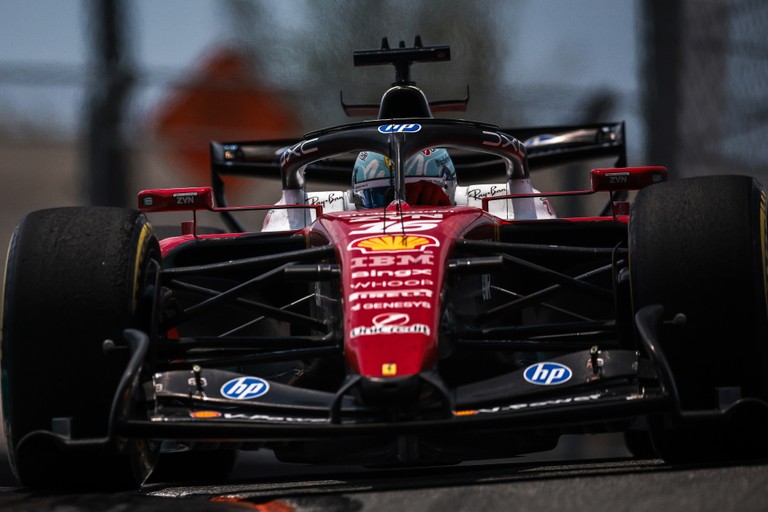
Scuderia Ferrari driver Charles Leclerc has been given a post-race penalty at the 2026 F1 Miami GP following a wild end to his race.
Charles Leclerc has a crazy conclusion to the 2026 F1 Miami GP
On the penultimate lap, he decided to let Oscar Piastri through on the back straight before turn 17, hoping to repass on the final lap and claim P3 back with overtake in his pocket. However, he had a massive spin out of turn 3, hitting the wall. The 28-year-old picked up some damage to his suspension.
As he hobbled around on the final lap, he cut the circuit at turns 5 to 7, as well as the chicane at turns 14 and 15.
Even then, George Russell managed to overtake him at turn 17 as he could not brake especially late, with Max Verstappen getting him on the run to the line in a dramatic ending.
The stewards called the 8-time race winner to their office post-race as they wanted to speak to him about 1) cutting corners 2) driving a car in an unsafe condition.
In the end, he was handed a drive-through penalty for corner cutting, converted into a 20-second time penalty. As Lewis Hamilton had finished 9.5s adrift and Franco Colapinto was also within 20s, he drops from P6 to P8 in the final results.
Stewards verdict
”Car 16 spun on the last lap at turn 3 and hit the wall but continued on track. The driver informed us that the car appeared fine save that the car would not negotiate the right hand corners properly.
“Given this problem, he was forced to cut chicanes on the way to the chequered flag. We determined that the fact that he had to cut the chicanes (i.e. to leave the track) meant that he gained a lasting advantage by leaving the track in that manner. The fact that he had a mechanical issue of some sort did not amount to a justifiable reason.
“We accordingly impose a Drive Through penalty on Car 16, given the number of times the car left the track and gained an advantage.
“We also considered whether there was an additional breach in continuing to drive a car with an obvious and discernible mechanical issue. We determined that there was no evidence of there being an obvious of discernible mechanical issue. We therefore took no further action in relation to that potential infringement.”