McLaren has taken a major step in its return to top-tier endurance racing with the reveal and first on-track test of its forthcoming MCL-HY Hypercar. Set to make its competitive debut in the 2027 FIA World Endurance Championship (WEC), the car represents a bold new chapter for the British marque as it prepares to rejoin elite sportscar competition nearly three decades after its last appearance at this level.
Blending cutting-edge hybrid technology with unmistakable design heritage, the MCL-HY is more than a new race car. It is a statement of intent, linking McLaren’s celebrated past with its future ambitions in endurance racing. McLaren uses its Can-Am-inspired livery and modern hybrid powertrain to honour its legacy while embracing the demands of a new competitive era.
A heritage-inspired design
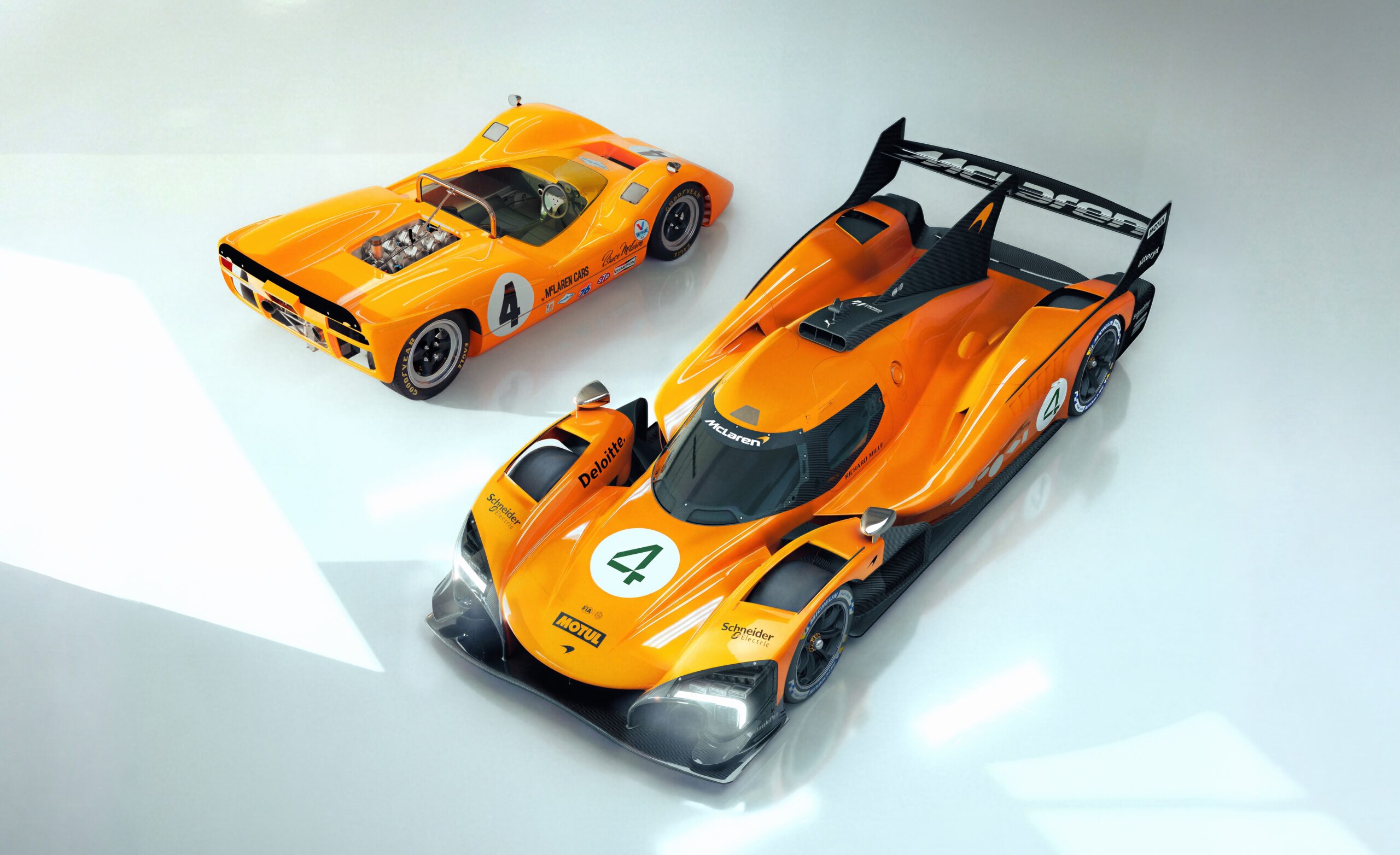
The MCL-HY immediately captures attention with its striking test livery, which draws inspiration from the legendary McLaren M6A. That iconic machine dominated the Can-Am series in 1967 and helped cement Bruce McLaren’s legacy during one of the most formative periods in the company’s racing history.
By reviving the unmistakable Papaya Orange colour scheme associated with the brand, McLaren has created a visual connection between its historic achievements and its future goals. As a result, the MCL-HY becomes both a modern Hypercar and a symbol of continuity, ambition, and racing heritage.
The decision to lean into this design language is not merely nostalgic. It reinforces McLaren’s belief that its future in endurance racing should be built on the same boldness and technical confidence that defined its early motorsport success.
Engineering excellence meets hybrid innovation
At the core of the MCL-HY is a sophisticated blend of engineering expertise and modern hybrid technology. Built to LMDh regulations, the car features a lightweight carbon-fibre monocoque chassis supplied by Dallara. It is powered by an in-house twin-turbocharged V6 engine working in tandem with a hybrid MGU system.
This combination is designed to deliver the balance between outright performance and long-distance efficiency required in endurance racing. The collaboration between McLaren Racing and McLaren Automotive has also enabled a close integration of aerodynamics, powertrain development, and design philosophy.
For McLaren, this project is not simply about building a competitive car for the FIA World Endurance Championship. It is also about demonstrating how race-bred innovation can shape the brand’s wider technical direction. In that sense, the MCL-HY stands as both a competition machine and a showcase of McLaren’s engineering capability.
First laps at varano
Following its reveal, the MCL-HY completed its first on-track test at the Autodromo Riccardo Paletti in Varano de’ Melegari, Italy. The venue, located beside Dallara’s headquarters, was a fitting location for the car’s maiden outing and reflected the close relationship between McLaren and its chassis supplier.
Earlier in the day, the team fired up the car’s twin-turbo V6 engine, developed by ATM-AutoTecnica Motori, in the pitlane. Shortly afterwards, the Hypercar rolled onto the circuit for its first laps, officially beginning the testing and development phase.
Although a shakedown is only the first step in a long technical journey, it is one of the most important moments in any new race car programme. It allows engineers to confirm that the car’s fundamental systems are functioning correctly, while giving the drivers their first opportunity to understand how the machine behaves on track.
Jensen leads initial running
Mikkel Jensen, McLaren’s first confirmed Hypercar driver, took the wheel for the crucial installation laps. As the programme’s lead development driver, he focused on validating the car’s core systems and ensuring the team could begin gathering real-world data.
The day was primarily about systems checks rather than outright performance. For the team, the priority was to make sure that the gearbox, engine, software, and hybrid-related systems were all operating as expected. Jensen’s role was therefore central, as his feedback would form the basis of the next stage of development.
After completing the rollout, Jensen described the significance of the day and offered his first impressions of the car.
“So we just finished our day with the car, the rollout here in Italy,” commented the Dane, the programme’s first official driver, who will share development duties with Gregoire Saucy, Richard Verschoor, and Ben Hanley, while speaking to Motorsport.com.
However, Jensen was also clear that the initial running had a practical purpose, with the team working methodically through a planned programme of checks.
“The McLaren hypercar feels great. We went through all our run plan; mainly system checks, making sure gearbox, engine, all the system, a lot of software on the car, was working well.
With those early checks completed, McLaren can now move from basic validation towards more detailed optimisation. Jensen explained that the focus will increasingly shift towards performance refinement as the programme gathers momentum.
“So now [we are] getting [into] more detail into how we can optimise the car. It’s been a great day. A lot of fun driving the car for the first time, so a lot of work from here to be ready for next season.”
A carefully planned milestone
The shakedown marked the culmination of months of preparation, with McLaren working towards a clearly defined target date. McLaren Endurance Team Principal James Barclay emphasised the importance of the moment for the team and the wider programme.
For Barclay and the wider McLaren Hypercar Team, the rollout represented more than a routine technical exercise. It was the first visible confirmation that the programme had moved from design, assembly, and simulation into live track development.
“It’s day one of the McLaren Hypercar Team testing programme and it’s been our rollout day and our shakedown day. It is the first day the car turns wheels on track for the first time here,” he said to Motorsport.com.
Barclay explained that the team had been working towards this exact moment for more than a year. The fact that the car ran on schedule gave the programme an important early boost and demonstrated the level of preparation behind the scenes.
“The team here have been working absolutely flat out. We wrote this date down over a year ago. We said we wanted to be out on track for the first time at the start of May and, just after 9:00 this morning, we left the pitlane and fired up the IC engine and did our first laps.
“A milestone moment” for the team
While the first laps were a milestone in themselves, Barclay also placed the moment in the wider context of McLaren’s return to top-tier sportscar racing. The 2026 testing year will be crucial, as the team must develop the car, refine its operations, and prepare for the intensity of the FIA World Endurance Championship.
“So a milestone moment for us as a team, a historic moment for us at McLaren returning back to the top tier of sportcar racing. 2026 is the year we test and develop the car, we get our team ready to go and face world class competition in the World Endurance Championship and, of course, the oldest motor race in history, the Le Mans 24 Hours. We can’t wait.
Despite the optimism surrounding the rollout, Barclay acknowledged that the challenge ahead should not be underestimated. Competing at the front of the WEC requires more than a fast car; it demands reliability, operational excellence, strategic sharpness, and consistency across long-distance races.
“A big year ahead but we are just getting started. We don’t underestimate how difficult it’s going to be, but we have a fantastic starting point, the team are hugely motivated and we have a car which we hope will help us realise our dream of getting ourselves back in the top tier of sportscar racing and back onto that podium.”
The reveal sets the tone
Before the car completed its first laps in Italy, McLaren had already framed the MCL-HY as a pivotal project in the company’s motorsport future. The reveal introduced not only the car’s technical direction, but also the philosophy behind its design and development.
Barclay described the unveiling as the beginning of McLaren’s next chapter in elite sportscar racing, linking the team’s future ambitions to its deep-rooted motorsport identity.
“The reveal of the MCL-HY sets the scene for the next chapter of McLaren’s return to the top level of sportscar racing,” remarked Barclay to FIA WEC.
That next chapter is built around a car that deliberately combines old and new. On one hand, the livery pays tribute to McLaren’s Can-Am roots; on the other, the hybrid-powered Hypercar is being engineered for one of the most technically competitive periods in endurance racing history.
“From the test livery that reflects and respects our 1960s Can-Am roots, to our new hybrid-powered Hypercar that has been designed and is being developed by our world-class team to take on this exciting and highly competitive era of sportscar racing, it represents the start of our journey ahead.”
His remarks highlight McLaren’s dual focus: respecting its heritage while preparing for the demands of a fiercely competitive modern endurance racing era. The MCL-HY is therefore not being presented as a symbolic return alone, but as a serious contender-in-development for the challenges that await.
From track to exclusive road experience
Beyond its racing ambitions, the MCL-HY will also influence an exclusive track-focused variant, the MCL-HY GTR. Through McLaren’s Project: Endurance initiative, select VIP clients will be offered access to the machine.
This move extends the Hypercar’s significance beyond the WEC programme, strengthening McLaren’s relationship with its most dedicated enthusiasts while showcasing the technological capability of its racing division. It also reflects a broader strategy in which motorsport innovation and customer experience are closely connected.
By creating a track-only derivative linked directly to its endurance racing programme, McLaren can offer clients a closer connection to the technology, design, and emotion of its top-level sportscar return.
Driver line-up and development programme
McLaren’s testing programme will be led by works driver Mikkel Jensen, with support from McLaren Driver Development Programme talents Grégoire Saucy and Richard Verschoor. Experienced driver Ben Hanley will also contribute through team partner United Autosports.
This blend of experience and emerging talent gives McLaren a broad range of feedback during development. Jensen provides continuity as the programme’s first confirmed Hypercar driver, while Saucy and Verschoor bring the perspective of rising talents within the McLaren system. Hanley’s experience adds another valuable layer as the car moves deeper into testing.
United Autosports is set to run the programme from 2027, while McLaren will use the coming months for intensive testing, data collection, and optimisation. The development phase will be crucial as the team prepares the MCL-HY for world-class competition in the FIA World Endurance Championship and the 24 Hours of Le Mans.
Pursuit of the Triple Crown
McLaren’s return to endurance racing also strengthens its pursuit of motorsport’s coveted Triple Crown: victories at the 24 Hours of Le Mans, Monaco Grand Prix, and Indianapolis 500. Few manufacturers have the history and competitive reach to target such an achievement, but McLaren now has machinery aligned with all three arenas.
For McLaren Racing Chief Executive Officer Zak Brown, the MCL-HY forms part of a much larger motorsport picture. Its arrival means McLaren now has cars positioned across the biggest stages in global racing, reinforcing the company’s status as one of the sport’s most ambitious and wide-ranging competitors.
“Years in the making and here we are,” commented McLaren Racing Chief Executive Officer, Zak Brown to FIA WEC. “McLaren Racing now has race cars ready to contest the three biggest motorsport series in the world – a unique story that sets us apart.”
With the MCL-HY, McLaren is not merely re-entering endurance racing. It is reinforcing its ambition to compete, and ultimately win, across the most prestigious stages in global motorsport.