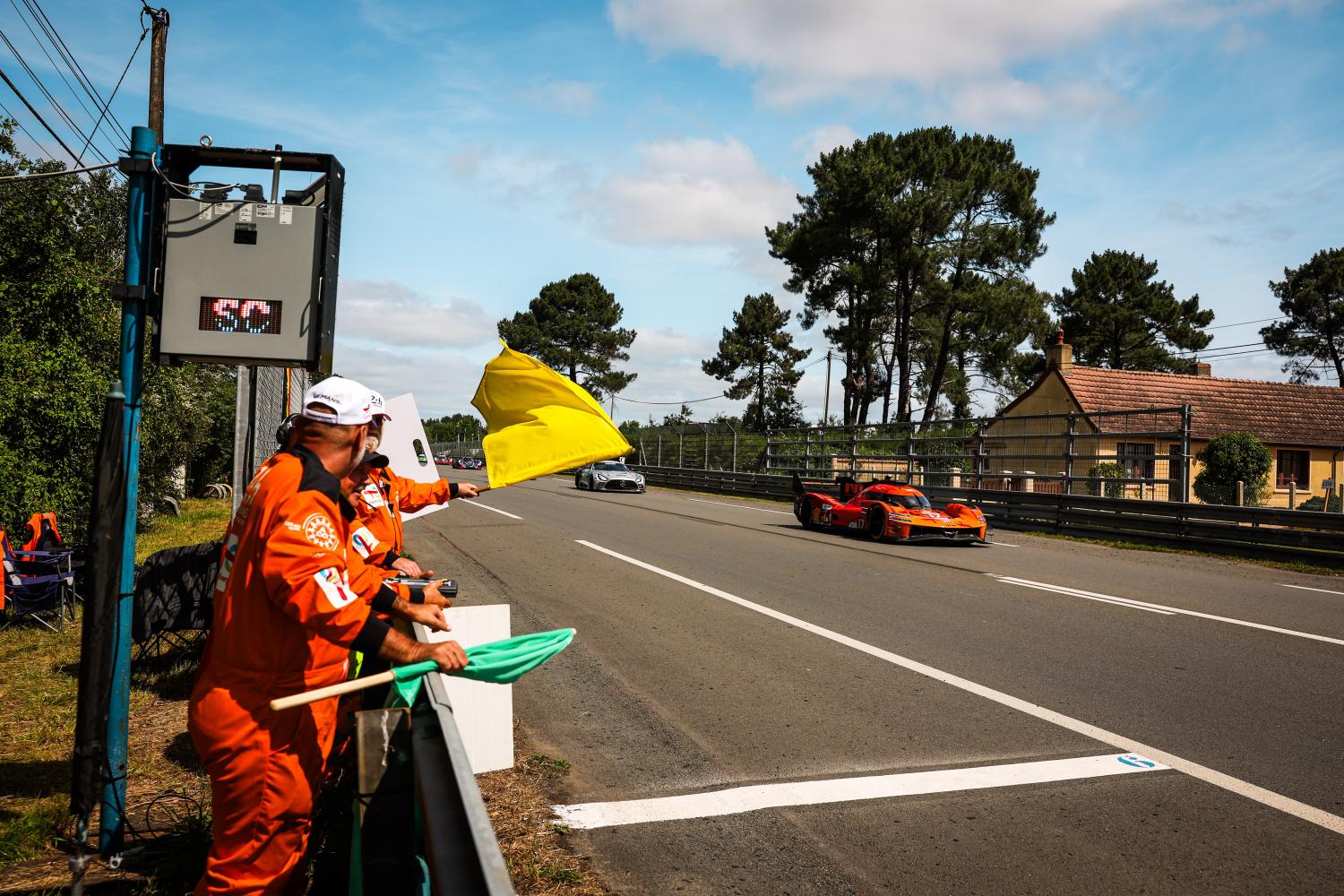
The 24 Hours of Le Mans has built its legend through more than a century of speed, endurance, heartbreak and historic records. Since the first race in 1923, the event has produced records that show how much the race has changed, while also highlighting the names that continue to define it.
Some records reflect domination across decades. Others capture one perfect lap, one extraordinary stint or one narrow finish. Together, they explain why Le Mans remains one of motorsport’s most prestigious events.
The record list remains accurate up to and including the 2025 24 Hours of Le Mans, meaning Ferrari’s modern Hypercar success now sits alongside the achievements of Porsche, Audi, Toyota, Bentley, Jaguar and Ford.
Porsche remains the benchmark among constructors
No manufacturer has shaped the Le Mans record book more than Porsche. The German marque leads the all-time constructor standings with 19 overall victories, placing it ahead of Audi on 13 and Ferrari on 12.
Porsche’s dominance stretches across multiple eras. It won with prototypes, customer-linked efforts and hybrid machinery, showing an ability to adapt across regulation changes. Audi, meanwhile, built its reputation through a hugely successful modern era, while Ferrari’s recent run from 2023 to 2025 has revived its position near the top of the all-time list.
Toyota’s five consecutive victories from 2018 to 2022 also stand out as one of the strongest recent streaks, particularly after years of near-misses before its first overall win.
Relevant records:
- Most overall wins by a constructor: Porsche — 19 wins
- Second-most overall wins by a constructor: Audi — 13 wins
- Third-most overall wins by a constructor: Ferrari — 12 wins
- Most consecutive constructor wins: Porsche — seven wins from 1981 to 1987
- Most wins by a constructor nation: Germany — 34 wins
- Most class wins by a constructor: Porsche — 108 class wins
- Most podiums by a constructor: Porsche — 55 podiums
- Most participations by a single constructor: Porsche — 73 participations between 1951 and 2023
Iconic cars have created dynasties of their own
Le Mans does not only remember brands. It also remembers cars. The Audi R8 remains the most successful individual car model in the race’s history, with five overall victories between 2000 and 2005.
Several other cars sit close behind with four wins, including the Alfa Romeo 8C 2300, Ford GT40, Porsche 956 and Audi R18. Each represents a different Le Mans era: pre-war elegance, 1960s power, Group C efficiency and modern diesel-hybrid endurance engineering.
The Ferrari 499P has also entered the record book quickly. Its three consecutive wins from 2023 to 2025 place it alongside celebrated machinery such as the Jaguar D-Type, Matra-Simca MS670, Porsche 936, Audi R10 TDI, Porsche 919 Hybrid and Toyota TS050 Hybrid.
Relevant records:
- Most wins by a car model: Audi R8 — five wins
- Four-time winners: Alfa Romeo 8C 2300, Ford GT40, Porsche 956, Audi R18
- Three-time winners: Jaguar D-Type, Ferrari 250 TR, Matra-Simca MS670, Porsche 936, Audi R10 TDI, Porsche 919 Hybrid, Toyota TS050 Hybrid, Ferrari 499P
- Most consecutive wins by the same specific chassis: two wins, achieved by cars including Bentley Speed Six #LB2332, Ford GT40 #P-1075, Porsche 956 #117 and TWR Porsche WSC-95 #691
Tom Kristensen stands alone among Le Mans drivers
Tom Kristensen remains the most successful driver in Le Mans history. The Dane won the race nine times, earning victories in 1997, six consecutive wins from 2000 to 2005, and further triumphs in 2008 and 2013.
His record places him three wins clear of Jacky Ickx, who held legendary status long before Kristensen moved the benchmark further away. Derek Bell, Frank Biela and Emanuele Pirro follow with five wins each.
Kristensen also holds the record for the most consecutive driver wins, with six straight victories from 2000 to 2005. That run underlines his consistency across different line-ups, teams and pressure-filled editions of the race.
Relevant records:
- Most overall wins by a driver: Tom Kristensen — nine wins
- Second-most overall wins by a driver: Jacky Ickx — six wins
- Five-time winners: Derek Bell, Frank Biela and Emanuele Pirro
- Most consecutive driver wins: Tom Kristensen — six wins from 2000 to 2005
- Most podiums by a driver: Tom Kristensen — 14 podiums
- Most consecutive podium finishes: Emanuele Pirro — nine podiums from 1999 to 2007
Longevity matters as much as victory at Le Mans
Winning Le Mans creates history, but simply returning year after year also builds a legacy. Henri Pescarolo holds the record for most starts, with 33 appearances. He also holds the record for most consecutive starts, having contested 30 straight editions from 1970 to 1999.
Bob Wollek sits second on the all-time starts list with 30, while Yojiro Terada follows with 29. These records show another side of Le Mans greatness: resilience, adaptability and long-term commitment.
Derek Bell, a five-time winner, also leads the record for most finishes with 19. Meanwhile, Johnny O’Connell holds the record for most consecutive finishes, having reached the chequered flag 11 times in a row from 1999 to 2009.
Relevant records:
- Most starts by a driver: Henri Pescarolo — 33 starts
- Most consecutive starts: Henri Pescarolo — 30 from 1970 to 1999
- Second-most starts: Bob Wollek — 30 starts
- Third-most starts: Yojiro Terada — 29 starts
- Most finishes: Derek Bell — 19 finishes
- Most consecutive finishes: Johnny O’Connell — 11 from 1999 to 2009
- Most starts without an overall win: Bob Wollek — 30 starts
Le Mans has rewarded both youth and experience
The race’s age-related records highlight how wide the Le Mans challenge can be. Alexander Wurz became the youngest overall winner at 22 years and 91 days in 1996, while Luigi Chinetti became the oldest overall winner at 47 years and 343 days in 1949.
Josh Pierson became the youngest driver to start the race in 2022 at 16 years and 119 days. He also became the youngest driver to finish the race one day later. At the other end of the scale, Dominique Bastien became the oldest driver to start and finish the race in 2021, at 75 years old.
These records reflect the unusual nature of endurance racing. Le Mans can reward young speed, but it also places huge value on judgement, patience and experience.
Relevant records:
- Youngest overall winner: Alexander Wurz — 22 years, 91 days in 1996
- Youngest class winner: Julien Andlauer — 18 years, 352 days in 2018
- Oldest overall winner: Luigi Chinetti — 47 years, 343 days in 1949
- Youngest driver to start: Josh Pierson — 16 years, 119 days in 2022
- Youngest driver to finish: Josh Pierson — 16 years, 120 days in 2022
- Oldest driver to start: Dominique Bastien — 75 years, 269 days in 2021
- Oldest driver to finish: Dominique Bastien — 75 years, 270 days in 2021
Speed records show how extreme Le Mans became
Le Mans has always pushed the limits of speed. The fastest race lap in the modern chicane era belongs to Mike Conway, who set a 3:17.297 in the Toyota TS050 Hybrid in 2019. Kamui Kobayashi holds the fastest pole lap since the Mulsanne chicanes were added, thanks to his 3:14.791 in 2017.
Before the chicanes, Pedro Rodríguez recorded a 3:13.90 pole lap in a Porsche 917 in 1971. Meanwhile, Roger Dorchy reached the highest top speed in Le Mans history, hitting 407kph in the WM P88-Peugeot in 1988.
The distance record also belongs to Audi. In 2010, the Audi R15+ TDI covered 5,410.713km and completed 397 laps, setting a benchmark that still defines modern Le Mans efficiency.
Relevant records:
- Longest distance covered: 5,410.713km — Audi R15+ TDI in 2010
- Most laps completed: 397 laps — achieved in 1971 and 2010
- Fastest race lap: 3:17.297 — Mike Conway, Toyota TS050 Hybrid, 2019
- Fastest pole lap since 1990: 3:14.791 — Kamui Kobayashi, Toyota TS050 Hybrid, 2017
- Fastest pole lap before 1990: 3:13.90 — Pedro Rodríguez, Porsche 917, 1971
- Highest top speed: 407kph — Roger Dorchy, WM P88-Peugeot, 1988
- Highest average race speed by a winner: 225.228kph — Audi R15+ TDI, 2010
The closest and biggest finishes show Le Mans’ extremes
Le Mans can produce both crushing dominance and almost impossible closeness. The smallest winning margin remains the famous 1966 Ford finish, recorded at just 20 metres between two GT40s.
At the opposite end, the largest winning margin came in 1927, when Bentley beat a Salmson by 349.808km. That record belongs to a very different era, but it still captures how punishing the race could be when reliability varied dramatically across the field.
Modern Le Mans often produces tighter racing, especially with Balance of Performance in the Hypercar era. Yet the race still creates huge swings through strategy, safety cars, weather, reliability and traffic.
Relevant records:
- Smallest winning margin: 20 metres — 1966, between two Ford GT40s
- Largest winning margin: 349.808km — 1927, Bentley over Salmson
- Most cars on the lead lap: nine — 2024
- Most safety cars in a race: 12 — 2013
- Most time behind the safety car: 6 hours, 54 minutes, 27 seconds — 2024
Pole position helps, but it does not guarantee victory
Le Mans rewards qualifying speed, but the record book shows that pole position only forms part of the story. The first qualifying session took place in 1963, and since then Porsche has taken the most poles by a constructor, with 19.
However, the most successful starting position remains first place, with 13 wins from pole. Second place has produced 12 wins, while fourth has produced 10. The lowest recorded starting position for an overall winner is 19th, achieved by the Mazda crew of Bertrand Gachot, Johnny Herbert and Volker Weidler in 1991.
This explains why Le Mans teams care deeply about qualifying, but never treat it as decisive. Over 24 hours, race pace, traffic, pit work and reliability usually matter more than grid position alone.
Relevant records:
- Most pole positions by a constructor: Porsche — 19
- Second-most pole positions by a constructor: Audi and Toyota — eight each
- Most wins from a starting position: pole position — 13 wins
- Second-most wins from a starting position: second — 12 wins
- Third-most wins from a starting position: fourth — 10 wins
- Lowest starting position before an overall win: 19th — Mazda in 1991
- Most total pole positions by a driver: Jacky Ickx — five
- Most consecutive pole positions by a driver: Jacky Ickx, Stéphane Sarrazin and Kamui Kobayashi — three each
Tyres and fuel also tell Le Mans’ technical story
The Le Mans record book also tracks the technologies that carried winners to the chequered flag. Dunlop and Michelin share the top of the tyre supplier table with 34 wins each, ahead of Goodyear on 14.
Fuel records show how the race evolved from petrol dominance into diesel and hybrid eras. Petrol remains far ahead with 73 wins, but diesel changed the race in the 2000s before hybrid systems became central to the top class.
Those figures show how Le Mans has always acted as a technical proving ground. Manufacturers have used the race to test endurance, efficiency and innovation under extreme pressure.
Relevant records:
- Most wins by tyre supplier: Dunlop and Michelin — 34 each
- Third-most tyre supplier wins: Goodyear — 14
- Most wins by fuel type: Petrol — 73
- Second-most wins by fuel type: Petrol-electric hybrid — 10
- Diesel wins: Six
- Diesel-electric hybrid wins: Three
Why the Le Mans record book still matters
Le Mans records do more than list numbers. They show how the race has evolved from early road-racing endurance into a modern, high-technology contest between global manufacturers.
Porsche’s win total, Kristensen’s nine victories, Audi’s distance record, Kobayashi’s pole lap and Ford’s 1966 margin all tell different parts of the same story. Le Mans rewards speed, but it only immortalises those who combine speed with reliability, execution and endurance.
Relevant records:
- Most successful constructor: Porsche — 19 wins
- Most successful driver: Tom Kristensen — nine wins
- Longest distance: Audi R15+ TDI — 5,410.713km in 2010
- Fastest modern pole lap: Kamui Kobayashi — 3:14.791 in 2017
- Closest finish: 20 metres — Ford GT40 one-two in 1966
See the full schedule for the 2026 edition of the 24 Hours of Le Mans, and you can get live updates on race day from our blog.