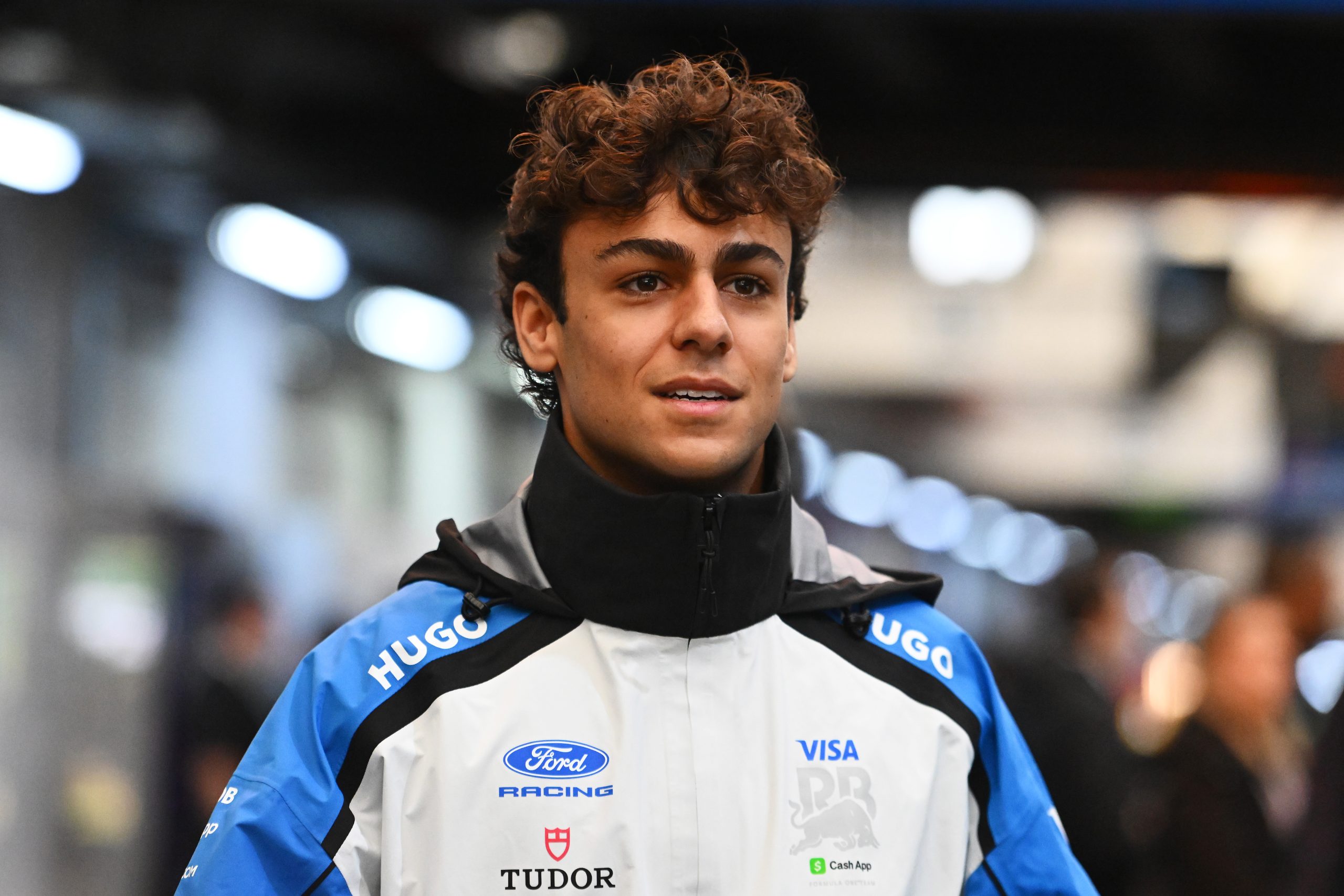
Arvid Lindblad has reflected on his development throughout the 2026 Formula 1 (F1) season, highlighting the experience he has gained alongside teammate Liam Lawson. Speaking ahead of the Las Vegas GP, the young driver discussed his confidence in retaining his seat, the lessons he has learnt from Lawson and why Lindblad does not consider championship points an accurate reflection of his performances during the 2026 F1 season.
Lindblad also explained how his rapid progression through the junior categories has shaped his approach to F1. Despite facing setbacks throughout the season, he remains focused on improving his abilities rather than measuring his success against his teammate’s results.
Lindblad confident in his future with Red Bull
Lindblad expressed confidence in his position within the Red Bull family, pointing to the support he has received throughout his junior career and his performances during his first F1 season. Having progressed from karting to F1 in just a few years, Lindblad believes his qualifying performances have demonstrated his potential. He also dismissed suggestions that Lawson’s results had caused him to worry about his future.
“It’s like I said before, I’ve been part of the Red Bull family for many years. They pushed me very hard to come through the ranks. I’ve done a good enough year. I don’t think they were gonna, you know, I’ve been in Q3, what, 13 out of 20 times. Someone who, four years ago, I was in karting. Yeah, it didn’t worry me.”
Learning from Lawson’s experience
Lindblad acknowledged the importance of having an experienced teammate, particularly when it comes to understanding tyre management and approaching race situations. While he has used Lawson’s experience to develop his racecraft, Lindblad believes he has already demonstrated strong qualifying pace independently of his teammate during the 2026 F1 season.
“Yeah, I think just, obviously, he’s done it. He’s got the experience. He knows how to work with the tyres, how to approach it. And I think just being able to see that has helped me to learn more. I think in qualifying, honestly, I’ve done my own thing. Obviously, whenever I’ve been behind, I’ve looked to him. But I wouldn’t say in quali I’m massively looking. I’ve had very good pace. I don’t know what the head-to-head is, but I’ve been fast. It’s gone back and forth.”
Lindblad also pointed to the difficulties he has encountered during qualifying sessions, maintaining that his outright speed has remained competitive.
However, he recognised that race conditions demand a different set of skills, where experience becomes particularly valuable.
“I think I’ve had, being honest, a few more problems than him in quali. But I’ve always been fast in the short run, so it’s not… That’s raw pace, you know? And that’s the more natural thing, you know? And it’s the race, which is where there’s more elements. There’s more thinking, more tyres, more things to manage. And that’s where the experience plays more of a factor.”
Understanding tyre management in race conditions
One of Lindblad’s most significant discoveries during the season has involved understanding how aggressively he can push the tyres through slower corners during races. He explained that F1 tyres operate under different demands compared to those used in junior categories.
As a result, he has had to adjust his approach to certain corners and better understand how the tyres respond to different levels of energy.
“And for sure, on that side, he’s helped. I think, for me, one thing, going a bit more into the details, what I found very interesting this year is how much you can push in the lower-speed corners in the race. And that I didn’t quite appreciate. And I think it’s because the tyres are designed to go much faster than other categories.”
Lindblad used the differences between F3 and F1 to illustrate how the relative demands placed on the tyres change between categories. Although higher-speed corners generate significantly greater loads in F1, slower corners allow drivers to push harder than Lindblad initially expected.
“So the difference…If you imagine an F3, you do 250 in corners, and here you do 300 in corners. The low-speed corner speed is almost the same. The relative energy you put through the tyre is much lower. So just how flat-out we can be in the low-speed corners in the race, for me, took a little bit to appreciate. And I wouldn’t have learnt that if he wasn’t here.”
Development takes priority over championship points
Looking ahead to the following season, Lindblad rejected the suggestion that matching Lawson’s points tally should serve as a benchmark for his progress. He argued that the championship standings do not fully reflect the challenges he has faced, particularly during the final stages of the season. The Brit trails 38-75 in points in their 17 races together, with Lawson scoring a further 14 during his cameo at Red Bull Racing.
Grid penalties, technical issues and other setbacks have influenced his results, making a direct comparison with Lawson less meaningful in his view. He took grid drops in Malaysia, Austin and Brazil because of unreliability.
“I think, if I’m honest, the points don’t tell the whole story. You know, in the last six races, there’s a lot that’s not gone my way. I’ve taken three grid penalties. I’ve had issues. I mean, I’ve had some problems, which is normal with the new regulation. I don’t look at the points and say, I’ve had a bad year because he’s scored more points than me and I think that’s a very superficial way of looking at things.”
Rather than setting a specific points target, Lindblad intends to continue prioritising his development as a driver. His accelerated progression through motorsport has made learning an important part of his approach, and he believes consistent improvement will ultimately translate into stronger results.
“So no, I’m not going to look at it and say, next year I have to be on par with him because this year I was behind. What I focus on is my learning, my development. That’s always what I focus on. I’ve come through the ranks very quickly. It’s a journey to being the best that I can, and all I’m focused on is making a step towards the best driver I can be every year. And that’s what I’m focused on. And I believe that if I do that, I’ll do well.”