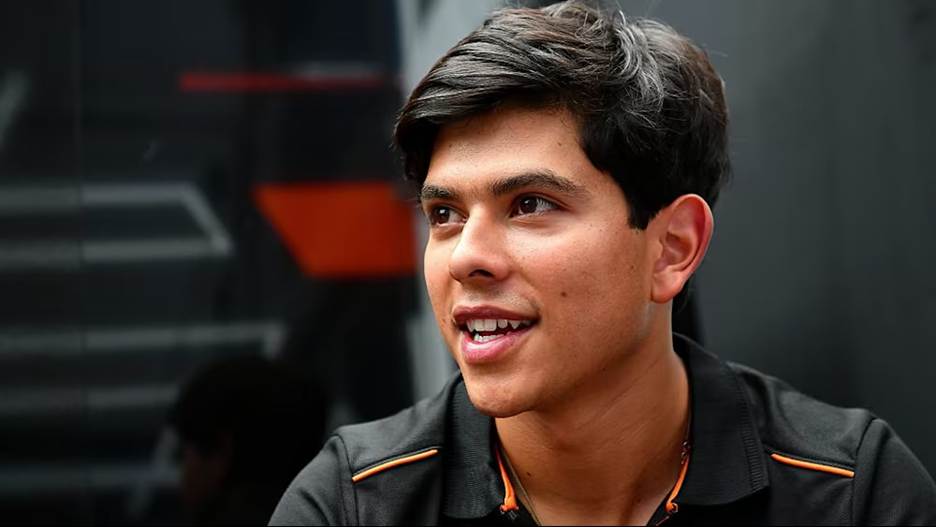
Rafael Villagómez, one of Mexico’s rising stars in single-seater racing, continues to develop his craft in the ultra-competitive environment of F2 with Van Amersfoort Racing (VAR). Known for its structured approach and focus on driver growth, the Dutch outfit has provided a strong foundation for Villagómez to refine both his technical understanding and his racecraft.
As motorsport technology evolves, drivers now rely as much on simulation and data as on instinct and physical feel. Villagómez, part of a new generation raised with these tools, views them not as replacements for driving intuition but as essential components of preparation. In an exclusive interview with Pit Debrief, he explained how simulation, feedback, and communication combine to shape his approach — and how his ambitions remain firmly set on the sport’s top tiers.
How the simulator prepares drivers for modern racing
In F2, the margin between confidence and confusion can be measured in fractions of a second. With limited track time and an unforgiving calendar, preparation has become as much about simulation as it is about seat time. Villagómez, who has seen his skills sharpen under the guidance of Van Amersfoort Racing, knows that preparation begins long before the first green flag.
“As you know, from F3 to F2, everything is very limited and Free Practice as well is just, if you’re lucky, you get seven laps or so, no more than that, because purely the tyres go pretty quickly.”
The restricted running places a premium on preparation. Drivers use the simulator to rehearse braking points, test car balance, and become familiar with circuit characteristics before driving in real conditions. According to Villagómez, this approach forms a significant part of his race-weekend readiness.
“So, we use the simulator to basically prepare different scenarios, make sure you’re familiar with the track as much as possible. But then it’s a very good tool that you can get up to, I’ll say, 80 percent of the prep done.”
Balancing simulation and reality
The simulator provides repetition — the chance to make mistakes and correct them before the real weekend even begins. However, as Villagómez pointed out, the virtual world can only take you so far.
“But just like in anything, there’s still many, many things that can change, many variables, like the weather. What ran before [on] the weekend could be like GTs and then they use a different tyre. Obviously, things like traffic and all of those things you cannot predict. So I would say it gets you up to 80 percent prepared.”
His comments highlight how teams must balance simulation data with adaptability. Despite extensive virtual preparation, on-track running continues to reveal new parameters that require adjustment. Villagómez explained that his team follows a consistent procedure to ensure he arrives at each event well-prepared.
“We normally do two days per track before the event. And we go through different things, race runs, pre-practise, qualifying, all of those stuff.”
Through this structured preparation, Villagómez aims to establish a solid baseline before the first practice session. For drivers in F2, this process is crucial in maximising performance within the tight time limits that define the championship.
Adapting to the limitations of simulations
Yet for all the simulator’s benefits, it remains a world without motion — an absence that matters more than most fans might realise. Villagómez explained that while technology allows incredible precision, the physical element of driving — the visceral communication between car and body — cannot be recreated fully. That difference demands adaptation, and adaptability is something he has learned to treat as a skill in itself.
“Yeah, obviously, the simulator doesn’t move, so everything you feel is through your hands, kind of. So obviously, there’s many tricks, but I also like that it’s also a bit of a challenge, you know, to get as quick as possible in the simulator because you need to adapt and use different tools.”
This contrast between physical and digital experience captures the evolution of modern racing: technology has made preparation more complete, yet it has also forced drivers to think differently, to feel differently, and to trust instincts born not just from sensation, but from understanding.
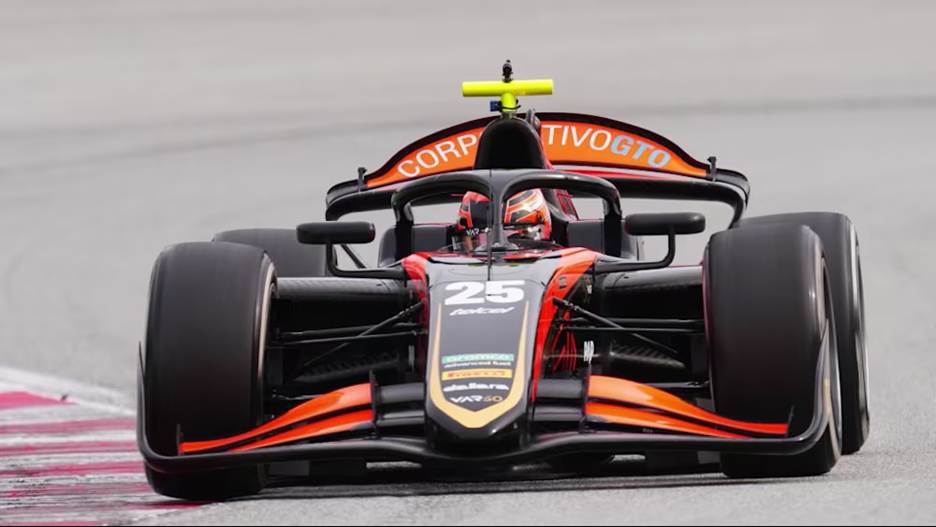
Communicating performance: The role of feedback
If the simulator is the classroom, then the race weekend is the exam. Here, communication becomes everything. Between driver and engineer, clarity is the currency of progress. Villagómez, thoughtful and deliberate in his phrasing, described this process not as a simple conversation, but as a delicate translation — turning sensations into actionable data.
“Regarding how the feedback works in the team, in a car it’s obviously a lot easier because you feel through your whole body. So you know exactly what’s going on with the car and you got to report it. As clear as possible, but also not too much detail with the team, because it’s really easy to get confused and start going left or right, and then you can end up actually making the wrong decisions and making a team a little bit more confusing.”
The delicate balance of precision and simplicity
Villagómez emphasised the importance of balancing precision and simplicity. Providing too much information can overwhelm engineers, while insufficient feedback may leave critical insights unaddressed. He has developed a structured approach to ensure communication is both concise and effective.
“So the feedback is extremely important. And how I like to do it is I just focus on the main points where I feel like there needs to be an improvement. And then from there, just give maybe two or three other things. But yeah, I just like to do one thing. And then after that, after that is fixed, then ‘Okay, we can move into the next thing.’ But I know some people go like corner by corner, which we do. But at the end of the day, if you say that, then it’s like, ‘OK, we might as well build a new car.’”
He noted that isolating the most critical issue first also supports team motivation and ensures that engineers can respond efficiently.
“So in a way of motivating the team and helping them pinpoint what exactly it is, I think it’s always easier to focus on one thing.”
Adaptation, awareness, and the human factor
Building on the limits of simulation and the precision of team communication, Villagómez demonstrates a key truth in modern motorsport: preparation is not just technical; it is also human. Simulators provide repeatable scenarios, and structured feedback ensures clarity, but neither can replicate the constantly changing variables of a live race. Tyre degradation, track evolution, temperature, and confidence all demand real-time interpretation and response.
For Villagómez, the unpredictable 20 percent of racing — the elements that defy rehearsal — is not a source of frustration but a core attraction. It is in these moments that instinct, composure, and analytical skill combine, transforming the sport into both science and art.
Van Amersfoort Racing’s supportive environment fosters this development. Known for its family-like atmosphere and focus on driver growth, the team balances preparation with freedom to experiment. This allows Villagómez to refine technical acumen alongside adaptability, becoming a driver who maximises controllable details while remaining flexible when conditions change.
The result is a balanced competitor: analytical without rigidity, competitive without impatience, and fully aware that success in F2 relies as much on mental agility as on raw speed.
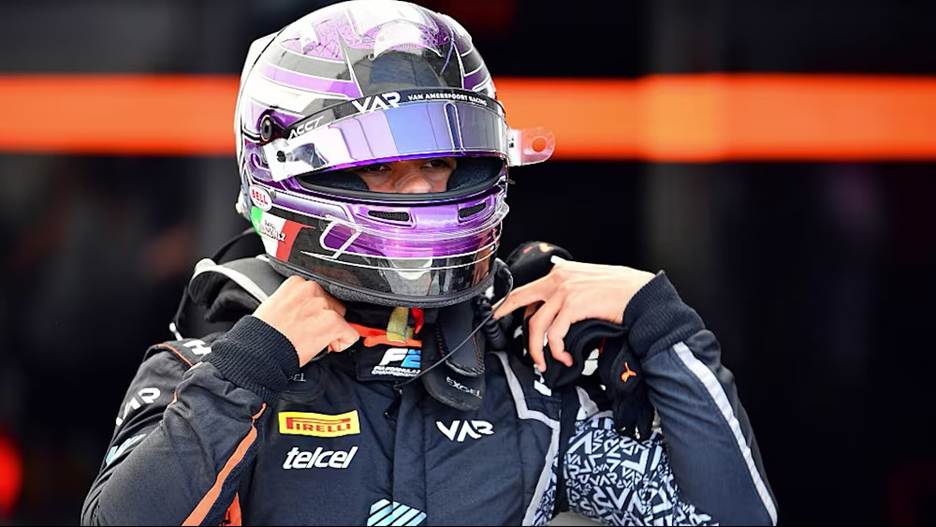
Eyes on the horizon: The future and the dream
Inevitably, the conversation turned to the future — the question every driver must confront. For Rafael Villagómez, as for nearly every racer in the F2 paddock, the dream is clear.
“I think everyone has a dream, you know. Probably if you ask that question to the whole paddock, they’ll give you the same answer. It’s just Formula One. Because we’re there with them and we see them and we hear everything about it. So that’s the dream, I think, for everyone. And you don’t need to take off your mind out of it. But I’m aware of there’s plenty of other options.”
Formula One is, and always will be, the summit. Yet Villagómez speaks with perspective, mindful of the wider world of motorsport and aware that the path forward is uncertain and fiercely competitive. For him, racing is not a single destination but a journey of opportunities — whether in Formula E, IndyCar, or endurance racing, every challenge that keeps him behind the wheel is valuable.
“And basically, after F2, whatever the opportunities are, I’ll just take it, you know. A car is a car, I love driving, so I wouldn’t complain about any other option.”
Villagómez embodies the evolution of the modern racing driver — equally skilled at analysing telemetry as he is at feeling the car through the wheel. His philosophy is consistent: preparation, precision, and patience. The value for simulator work, his method of tackling one improvement at a time, and his awareness of team dynamics all reflect a disciplined, methodical approach.
Yet beneath that discipline lies genuine passion. This combination of intellect and intuition is arguably his greatest advantage: while simulators, data, and analysis can take a driver far, it is ultimately the human touch — the ability to feel, adapt, and embrace the craft — that makes racing extraordinary.