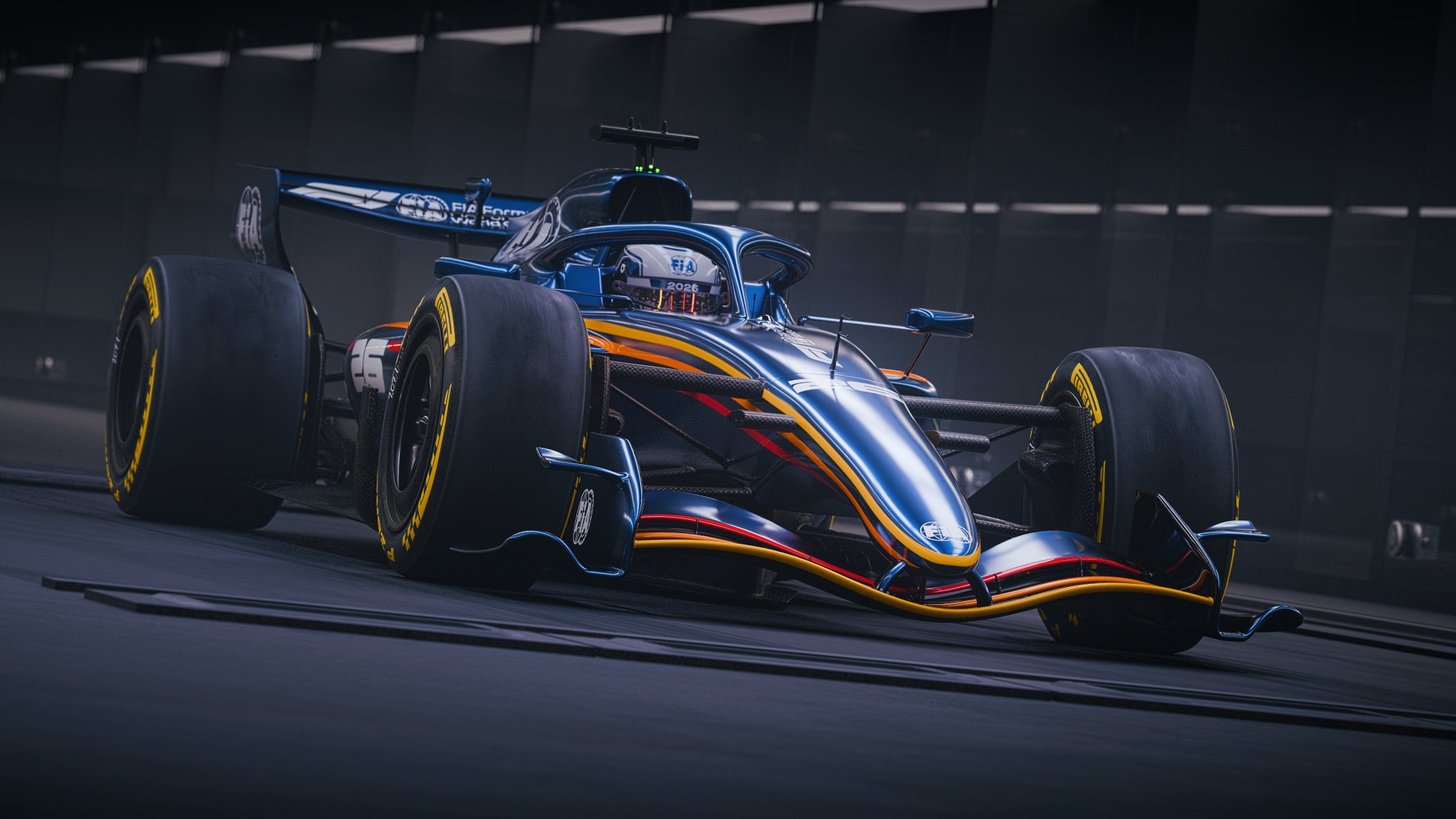
The 2026 F1 season will usher in a wave of change, from new regulations to an expanded 22-car grid featuring 11 teams. Following a thrilling and tightly fought 2025 season, attention turns to 2026 as the countdown to the season-opener in Melbourne begins. Ahead of this new era, here’s everything you need to know about the regulations coming into force next year.
Lighter and smaller cars at the core of the new regulations
For the FIA, the “Nimble Car Concept” lies at the core of the 2026 regulations. Next year, fans, teams and drivers step into a new era of “smaller, lighter and more agile” cars. To do that, cars will be 30kg lighter with reduced dimensions to the wheelbase and width overall.
Across the car, aerodynamics have been simplified with narrower, active front and rear wings, the removal of the beam wing and cleaner rear wing endplates. For the first time in the sport’s history, the cars will feature aerodynamically adjustable front and rear wings that adapt accordingly to where they are on-track. The FIA has designed changes to the wheel bodywork and wake control to improve racing by allowing cars to follow more closely.
The overall downforce of the cars will drop by 30% and drag by around 55%. While this will initially slow cornering speeds, improved acceleration and continued development of these cars are expected to recover lost lap time.
The FIA expects a significant improvement in racing action
Difficulty in following has always been a long recurring challenge in F1. While the 2022 ground-effect regulations initially improved wake performance, teams found ways to exploit the rules as those gains started to gradually then fade away. However, in this new era, the FIA expects a significant step forward.
FIA Single-Seater Director Nikola Tombazis said: “The 2022 cars started off with a significant improvement in their wake characteristics, I don’t remember the exact numbers, but downforce at approximately 20 metres behind went from about 50% on the previous generation of cars to about 80 or 85% to start with on the 2022 cars.
“And then that gradually decayed during the regulation cycle to what it is now, where we are probably talking about 70%. We believe that the start of the new cycle will be more like 90%, better than it’s ever been.
“The front wing end plates morphed into shapes that permitted quite a lot of outwash, while the inside of the front brake drums also worsened the characteristics, as did the side of the floor,” he says. “We learned a lot from that and in developing the regulations for 2026 we hope we will maintain the good characteristics for a longer period or hopefully not have this decay again.”
DRS replaced with two active aero modes: Straight and Corner Mode
The biggest challenge is the introduction of active aero, as the Drag Reduction System (DRS) will be replaced by two crucial systems: Straight and Corner Mode. Cars will now feature a moveable front and rear wing.
In Straight Mode, both wing flaps open to reduce drag. Unlike DRS, drivers will be able to activate this mode at predetermined straights on a circuit, regardless of their position relative to other cars. In Corner Mode, both the front and rear wings will remain in the high-downforce position for optimal cornering speeds and performance.
The new system conserves energy and helps drivers manage the 2026 hybrid power-units better. While DRS is gone, the regulations provide other ways to support overtaking.
Overtake mode
Instead of DRS, overtaking will be aided by a new “Overtake Mode”. When deployed, this gives drivers an extra 0.5MJ of electrical energy when within a second of the car ahead at designated activation points. As a result, the leading car’s power drops after 290km/h, while the chasing car can use the full 350kW boost up to 337km/h that gives them a speed advantage to help with overtaking.
To Mercedes’ Deputy Technical Director Simone Resta, he said: “It’s going to be quite different, especially in racing rather than in quali, we are all used to a certain format with the DRS that helps with overtaking and is used in defined areas and with certain gaps.
“But next year, every driver will be running moveable front and rear wings together, at many points in the lap, and they will be using the energy to help overtaking. It’s going to be different and potentially quite more unpredictable in the way that the drivers will use the energy to overtake.”
Aston Martin’s Sporting Director Andy Stevenson added: “A lot of work has been done so that we can create these cars that will give us much closer racing. And that’s what we’re all aiming for. Yes, we have close grids but I think we can improve the racing and make it better. And when you see what technologies that we’re bringing to Formula 1 for next year, I’m really excited.”
Redesigned hybrid power-units
For 2026, the cars will also feature new redesigned hybrid power-units. Still based on the 1.6-litre hybrid engine, the new unit delivers a 300% increase in battery power and a balanced split between internal combustion and electrical energy. With the removal of the MGU-H and drop in power in the ICE from 550-560kW to 400kW, each car’s battery increases from 120kW to 350kW.
New manufacturers and teams join the grid
Cost reduction, simplification and financial stability lied in the heart of the 2026 power-unit regulations, in hopes of attracting new manufacturers to the sport. As a result, the championship will soon feature five power-unit suppliers: Ferrari, Mercedes, Audi, Honda and Ford.
Additionally, the new rules have also paved the way for a new constructor: Cadillac. The American outfit will make its debut at the season-opener in Melbourne with Valtteri Bottas and Sergio Perez behind the wheel of their cars. The team will use Ferrari power-units for its initial season but switch to GM Performance Power Units — a partnership formed between TWG Motorsports and General Motors specifically to develop engines for the team — approved to supply power-units starting in 2029.
Since Haas’ entry into the championship in 2016, Cadillac becomes F1’s first entirely new team to join the grid.
Cars to use advanced sustainable fuels
The increase use of electrical energy is just one step towards the FIA’s push for a more sustainable sport. From 2026, all cars will use advanced sustainable fuels made from Advanced Sustainable Components (ASCs) that meet strict greenhouse gas emission standards.
To ensure, the FIA has partnered with Zemo Partnership to create a Sustainable Racing Fuel Assurance Scheme (SRFAS). This independent verification process will track all aspects of the supply chain to ensure that all F1 fuels meet the FIA’s sustainability targets.
Safety continues to improve and progress
Not only do the 2026 regulations improve on-track performance, but also driver safety. Updated front impact structures and enhanced side intrusion protection will better safeguard drivers in a crash. Roll hoop strengths have increased from 16G to 20G, with test loads also rising from 141kN to 167kN. And lastly, the FIA will standardise rear wing endplate lights and introduce new lateral safety lights to indicate Energy Recovery Status (ERS) status.