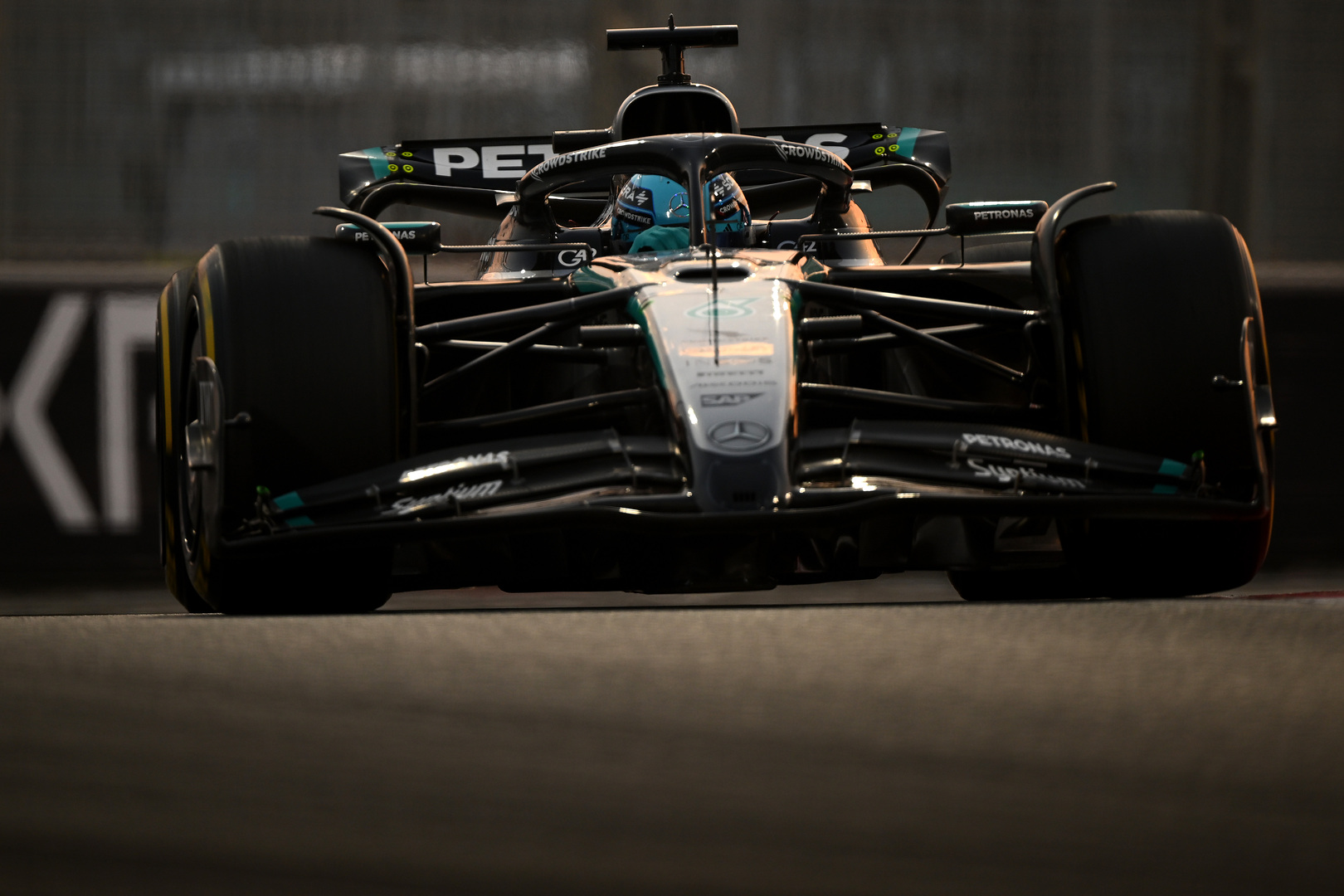
‘What wins you a championship: a dominant car or a skilled driver?’ is an age-old question in the realm of Formula 1. The apex league of motorsport once again faces the same question as we await the advent of a new set of regulations. The 2026 F1 season will mark the start of these regulations that can potentially reset the pecking order, and Mercedes’ Hywel Thomas tells how it may pan out.
Mercedes engineer predicts heavier reliance on drivers under 2026 regulations
The outgoing regulations famously earned the name ‘the ground effect era’. This was because of the biggest change in design philosophy, which pertained to the underside of the car generating downforce. That happened in tandem with the traditional aids like the front wing, the floor, the rear wing, etc.
The 2026 regulations, on the other hand, aim to bring back the Power Unit (PU) element to the forefront. Among the biggest changes is the shift in the power distribution proportions. As opposed to the 80% Internal Combustion Engine (ICE) and 20% electric component (MGU-H and MGU-K) factor, the upcoming season will run cars with a 50-50 power distribution between the ICE and the MGU-H. The MGU-K component will be done away with.
The absence of DRS and the introduction of active aero mark another big change. Despite this massive change in hardware, Mercedes HPP boss Thomas opines that the drivers will be the bigger differentiators in this new era.
Comparing the 2026 regulations with his experience from 2014 on the F1 Beyond The Grid Podcast, he said these ones are not as extreme.
“I think in the hardware, probably not as huge as that change. When I remember back to when we were first talking about those regulations with 2012, 2013 time, you looked at it and you thought, “oh my God, there’s stuff in here that we’re genuinely inventing.’ It’s that electric turbo, running an electric motor at over 100,000 RPM and these things just didn’t exist. And we were having to invent that stuff. That was a real, what a push and what an incredible project that was. Plenty of dips in the road, but that was incredibly difficult from a hardware point of view.
“I think from this 2026 regulation set, you could take any element within it. You can take a battery, we can take the electric motor, 350 kilowatts, they exist. Okay, they don’t exist in an F1 framework. They don’t exist in the right size, the right shape, but they do exist. So in that way, this regulation set doesn’t feel as big. But what is going to definitely change with this regulation set is the interaction with the driver because of the electrical aspects of it.
“We are generally going to be slightly energy limited. So it’s going to be working with the driver to make sure they’ve got the right energy at the right time to defend, to attack, to go as quickly as they can. And it’s definitely going to need some real thought from the driver and from the engineers around them to understand how to go racing and how to do this the right way. And I think that is a bigger challenge than the one we faced in the similar area in ’13-’14.”
Mercedes doing ‘a good job’ so far in build up to 2026 F1 regulations: Thomas
Thomas’ driver-dominance analysis prompted host Tom Clarkson to further probe him on the drivers’ relationship with their race engineers. Clarkson asked if the interaction between the drivers and race engineers would increase during runs. Thomas feels it potentially could during races and believes it definitely will prior to one.
Giving a behind-the-scenes update about Mercedes drivers, Thomas revealed they are already up to the task.
“[Driver-race engineer communication will increase] potentially during the races, but definitely beforehand, far more than we have now. And we already think, crikey, we’re doing a good job. Crikey, we’ve got these guys coming in regularly and really talking to us. This is great. But I think for next year, it’s going to be even more and more. The link between the power unit, the energy, the car, I mean, the whole thing’s so new. The way that that’s all put together is there’s going to be tens of laps time in that,” he concluded.