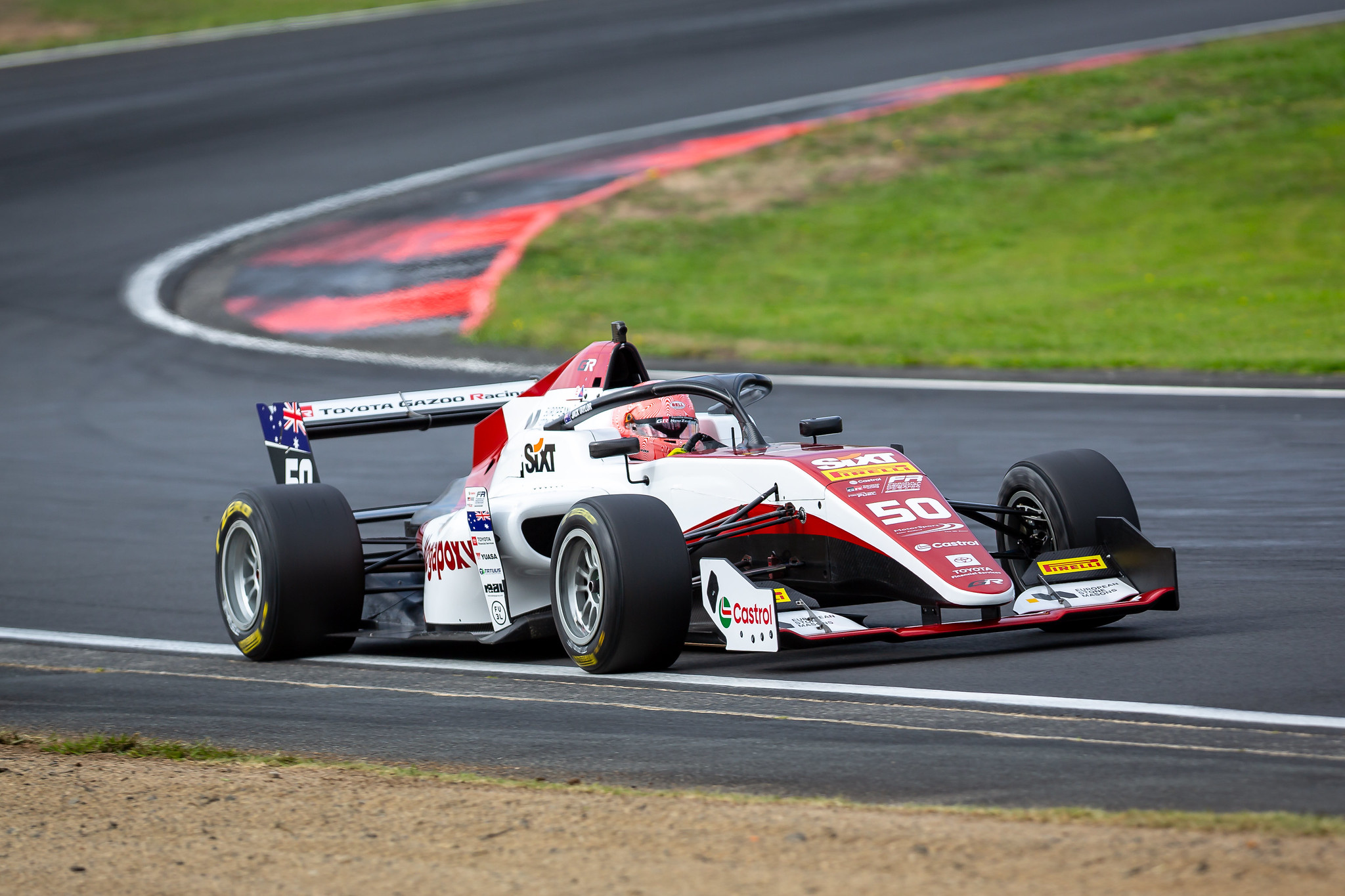
Jack Taylor delivered one of the most eye-catching drives of the opening weekend of the 2026 Castrol Toyota Formula Regional Oceania Trophy (CTFROT) at Hampton Downs, fighting from 15th to eighth in Race 2 after a challenging start to his New Zealand campaign. The Australian driver’s recovery stood out amid a weekend defined by contrasting race formats, intense midfield battles and high-profile names on the grid.
A difficult start turns into a determined fightback
Taylor entered Race 2 on the back foot after losing positions earlier in the meeting, yet he refused to let the setback define his afternoon. Speaking after the race, he detailed the obstacles he faced and the decisions that shaped his recovery drive.
“So, yes, the start was not very good. I obviously started quite far back because I lost a few positions in race one. But, yes, I was just trying to fight my way through. Yes, it’s quite tough to overtake around here. So, yes, using the push to pass is important, but, yes, I kind of mucked up my push to pass a little bit. I used them all too soon, so I had to pass the normal way. But, yes, it’s tricky to overtake. You’ve got to do a lot of setting up to try and get past. But, yes, I think it was a good race, quite intense.”
Taylor carved his way forward in a race shaped by a reverse-grid start, an early Safety Car and sustained pressure throughout the pack. While Zack Scoular converted pole into a commanding victory and Jin Nakamura and Freddie Slater completed the podium, Taylor focused on clean passes and race craft rather than short-term gambles.
From GB4 to CTFROT: A physical step up
The Hampton Downs weekend also marked another stage in Taylor’s transition from a strong GB4 season to the demanding Formula Regional Oceania environment. He highlighted the physical and tactical differences that defined racing in New Zealand.
“They’re a lot longer here, obviously. It’s a lot hotter. The track’s a lot more physical. The car’s a lot more physical. Yes, I’d say that’s the main thing, just the length of the races. Obviously, the field here is quite good as well. So, even though I was up the back, the racing is still quite clean and quite good.”
Those demands became clear across both races. Race 1 saw Louis Sharp convert a lightning start into a controlled lights-to-flag victory despite relentless pressure from polesitter Ugo Ugochukwu, while the midfield produced constant position changes driven by Push-to-Pass strategy and defensive precision. Race 2 amplified that intensity, forcing drivers like Taylor to balance aggression with tyre and energy management over a longer, more physical contest.
Racing a Rally World Champion: A measure of the field
One of the weekend’s talking points centred on the presence of two-time World Rally Champion Kalle Rovanperä, who started alongside Taylor in the deeper part of the grid. Taylor welcomed the challenge and assessed the Finn’s adaptation to circuit racing.
“Yes, his race craft was quite good, which, obviously, I wasn’t sure what to expect. But, yes, his race car was quite good, so it was pretty hard to pass him. I think he’s got a lot of potential and he was quite good.”
Rovanperä’s steady progress and Taylor’s eventual climb into the top ten underlined the depth of competition across the field, where experience from multiple disciplines met emerging single-seater talent.
Momentum building after Round 1
With Scoular and Sharp splitting victories across the opening two races and the championship already showing its competitive edge, Taylor’s recovery drive offered a clear statement of intent. His move from 15th to eighth demonstrated resilience, adaptability and race intelligence—qualities that will prove vital as the 2026 CTFROT unfolds.
As the paddock looks ahead to the next CTFROT round of 2026, Taylor leaves Hampton Downs having turned a difficult starting position into a performance that matched the intensity and quality of one of the strongest junior single-seater fields in the world.