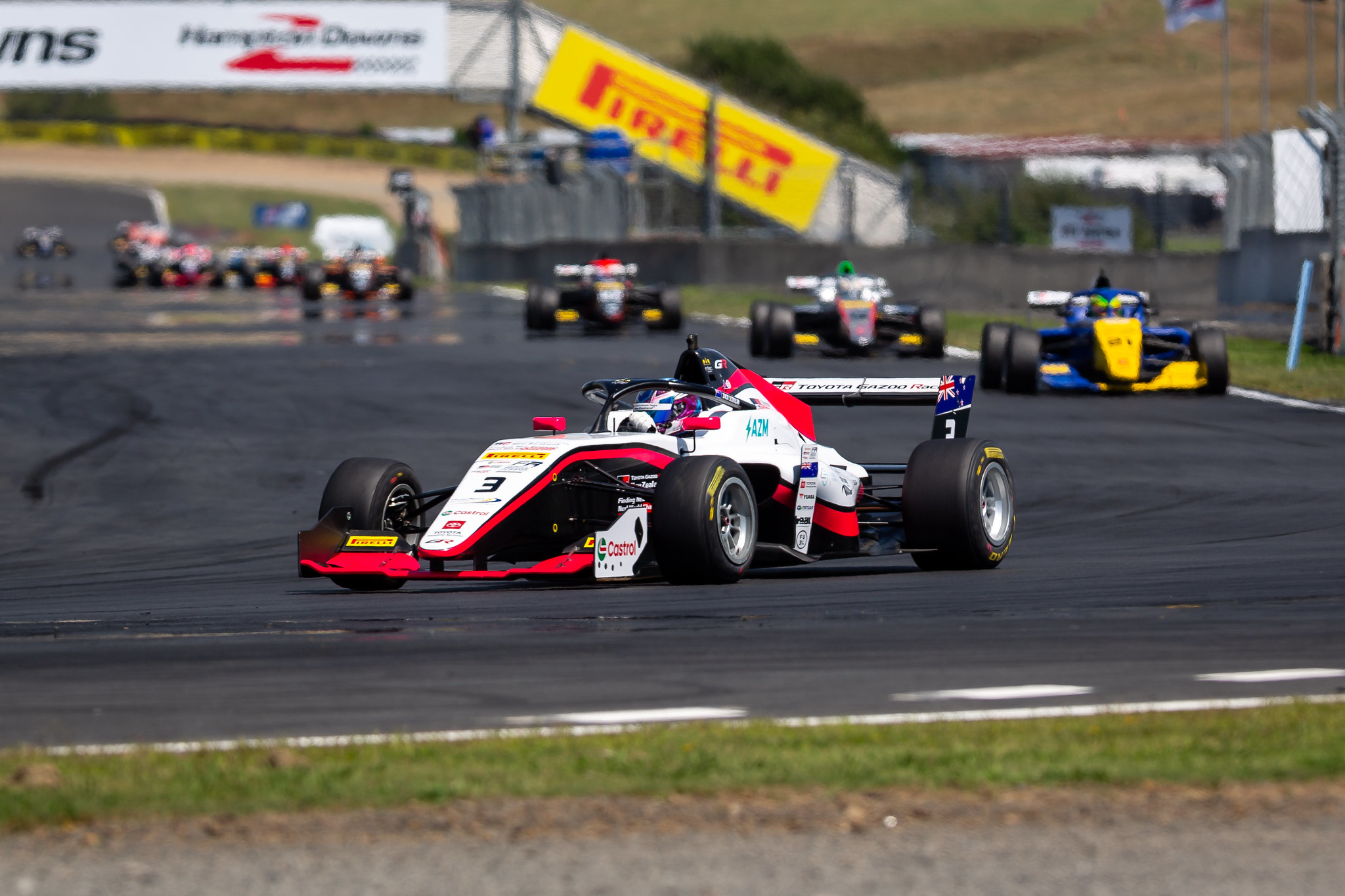
The opening round of the 2026 Castrol Toyota Formula Regional Oceania Trophy (CRFROT) introduced a fundamental change in how drivers approach racing in the championship. With the debut of the push-to-pass system, competitors gained access to a limited-use 25-horsepower boost designed to improve overtaking and inject greater strategic depth into each race. Combined with an increased tyre allocation, the system immediately altered decision-making across the field at Hampton Downs.
From the front of the grid to the midfield, drivers spent the opening day learning not only how to activate push-to-pass, but when restraint mattered more than aggression.
Racing opens up after the first laps
Zack Scoular, who capitalised on the reverse-grid format to win Race 2, noticed the difference almost immediately. He reflected on how previous seasons often settled into processions once the opening lap concluded. In contrast, the new system encouraged sustained attacking intent and forced drivers to defend throughout the race.
“Yes, obviously, we saw last year the racing we struggled with a little bit. There wasn’t too many overtakes after Lap 1, but today it’s pretty evident that the push-to-pass has changed that. And now it’s a lot easier to make a move, it feels a lot more competitive.”
Scoular also emphasised that push-to-pass influences more than just on-track battles. Under the championship’s revised weekend format, Race 3 grid positions depend on the two fastest laps recorded across the earlier races. As a result, drivers must consider when to deploy the system for clean air and lap time rather than position alone.
“But it’s not just for making moves. With how the new format works, with Race 3 being your two fastest laps from each race, you also have to be strategic when you use it to get your lap in and make sure you’re starting further up in the third race. But I think it’s pretty positive for the championship.”
This approach transforms push-to-pass into a multi-purpose tool, linking short-term race craft with longer-term weekend outcomes.
Managing push-to-pass under pressure
Meanwhile, Freddie Slater’s Race 2 performance provided a clear example of how push-to-pass affects defensive driving. Running with Ryan Wood directly behind him for extended periods, Slater had little margin for error. He explained that managing the system demanded constant mental calculation alongside physical control of the car.
“Yeah, definitely had to use it quite tactically, especially with Ryan [Wood] behind. I think we managed it quite well, to be honest, from my side. To kind of count the hundred seconds when you use it out of T1 or you use it out of the last corner when you can get it again, because there’s a limit. And also counting how many you’ve got, there’s nothing telling you how many you’ve used.”
Slater’s comments highlighted a unique challenge: drivers must track timing and usage without any live display, all while defending at high speed. Rather than using push-to-pass purely to attack, Slater described how he relied on it as a defensive tool. By choosing the right moments to deploy the boost, he maintained track position without exhausting his allocation too early.
“So quite a tricky thing to manage as a driver, you know, in racing. But I think we used it quite well today on the defence, I guess. And yeah, it’s a positive thing and nice to have it here.”
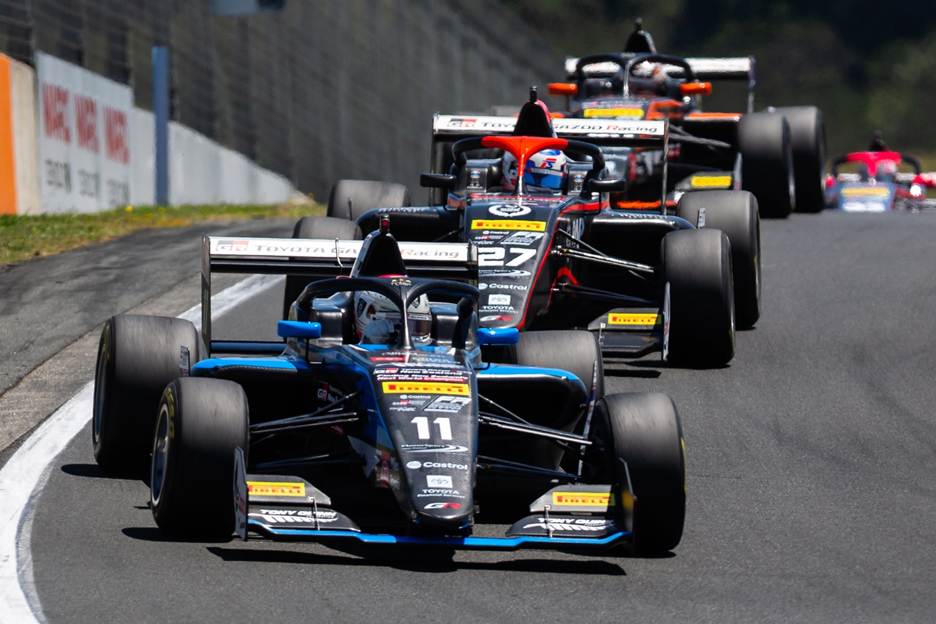
Protecting the lead in Race 1
Louis Sharp, on the other hand, approached push-to-pass from a different perspective, having led Race 1 from the opening lap. With Ugo Ugochukwu applying constant pressure, Sharp used the system primarily as a defensive safeguard. He explained that every activation carried consequences that extended beyond the current lap.
“Race 1, definitely. I think as the others have touched on, there’s a lot of strategy involved in it because you use it, let’s say, on the main straight, the first lap. On the second lap, it’s not available yet. So there’s a lot of strategy, a lot of thinking to be done.”
For Sharp, managing availability became just as important as maintaining outright pace.
However, like Slater, Sharp stressed that the absence of a usage counter significantly increases the cognitive demand on drivers. Each decision requires foresight and accurate self-monitoring.
“As Freddie said, you don’t know how many you’ve got left, so you have to count. But also you’ve got to be smart and know when you use it once, when you’re next going to be available to use again.”
Sharp offered a candid example of how easily miscalculation can punish a driver, even while leading.
“And especially for me in Race 1, you know, using it to defend, it’s also hard to know because you can’t tell if the guy behind you is on it or not either. So there was one time where I maybe used it when I probably shouldn’t have, and then the next lap, I was then compromised because it wasn’t available for me again.”
Adapting as conditions change
As the weekend progressed, Sharp adjusted his approach. In Race 2, traffic and opportunities encouraged him to use push-to-pass more aggressively.
“So there was a lot of thinking to be done. Race 2 as well, I used it a couple of times for a few overtakes.”
However, despite the learning curve, Sharp welcomed the system, particularly given the aerodynamic challenges of modern Formula Regional cars.
“So I think anything you can do to improve racing is always a positive, especially, you know, around these circuits, overtaking is difficult, but in these cars, especially with the aero wash. So I think it’s definitely a good, I guess, a good thing to have. And yeah, a lot of strategy behind it.”
Who decides when to deploy?
When asked about guidance from officials, Sharp clarified that while regulations define limits, execution rests with each team’s judgement.
“They obviously let you know how many times you’re allowed to use it. But in terms of strategy, it comes down to the driver and the engineer or the team to figure it out for themselves.”
This autonomy encourages innovation but also exposes drivers to the consequences of miscalculation. Sharp concluded by acknowledging that mastering push-to-pass will take time and experience rather than instant understanding.
“Yeah, as I said, there’s lots of different ways. I’m sure people have got a lot of different methods on when’s best to use it and when’s best to save, but I think already today I have a good idea or a good understanding already, but I think as the season goes on, I’ll probably learn more about it and be able to utilise it even better.”
A new strategic era begins
After just one round, push-to-pass has already reshaped the competitive landscape of the CTFROT. Hampton Downs demonstrated that success in 2026 will depend not only on speed, but on judgement, memory and strategic discipline. As teams refine their approaches, the system promises to remain one of the defining elements of the season.