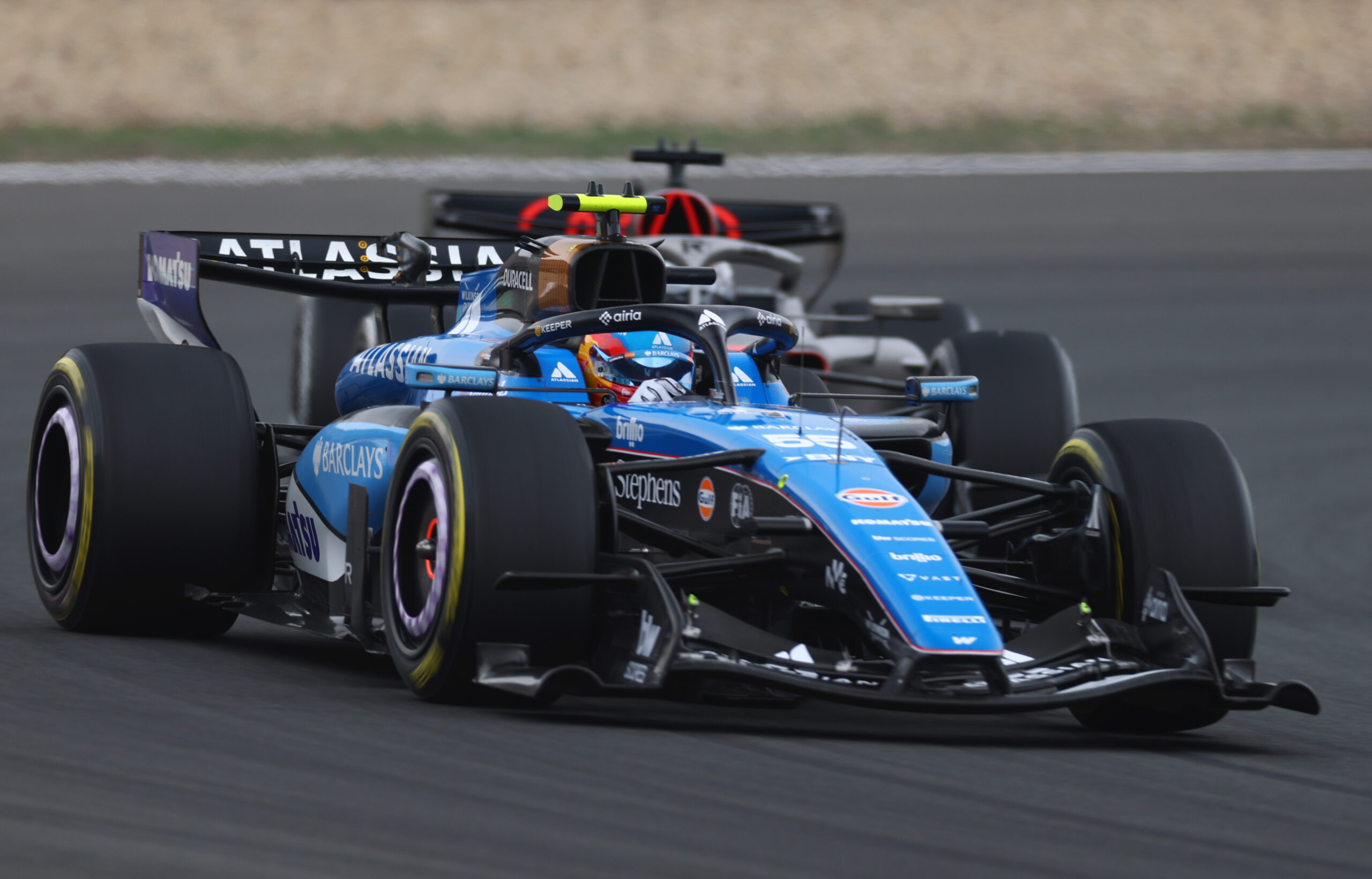
After the 2026 F1 Chinese GP, Carlos Sainz maintained his critical stance on the new regulations, citing safety concerns over energy deployment and reliability as key factors.
Since testing, drivers have been vocal about the impact of the 2026 F1 regulations on racing, particularly regarding the energy management of the new power units. After the 2026 season-opening F1 Australian GP, Sainz raised safety concerns over the active aero needed to counteract the limitations of the power-starved engines.
While the impact of these limitations wasn’t as gravely felt at the Chinese GP compared to the Australian GP, the Williams driver still believes a “rethink” is needed for tracks like Monza or Spa-Francorchamps. The Spaniard reckons that in-season development will alleviate some of the issues, though he remains firm in his belief that the current state of F1 is not what he imagines the sport to be.
“I think in a track like China, they’re not that bad because we are very energy rich and harvesting rich, which in the end means the engines behave very differently to last year, but not as differently as they did in Melbourne.
“I think Melbourne, Monza, Spa, it definitely needs a rethink. I think development will also do its part, but I’m also 100% sure this is not F1 the way I want to see it.
“I’m also quite sure the people at the top will also see that and know that.”
Sainz hopes that changes to the 2026 regulations will make F1 better
During the 2026 F1 Chinese GP, fans accused F1 of allegedly manipulating telemetry graphics. Sainz referenced the allegations in his post-race print media session, stating that F1 is doing “their best to sell” a regulation cycle that the Spaniard feels “is not the right formula for F1.”
While Sainz conceded in the print media pen that it is “okay” not to have the perfect formula from the start of the season, he hopes that changes will improve the experience, echoing a previous statement in which he urged the FIA and FOM to remain open-minded about the 2026 F1 regulations.
“When you look at what they’re doing with graphics and everything, they’re trying to do their best to sell something that I think we all know is not the right formula for F1. I’m really hoping that there’s going to be changes soon because it’s not the best formula, as I said.
“As long as everyone is aware, I think it’s okay to not get it completely right at the start of the season and then make adjustments to make sure it gets better.”
Sainz beliefs complexity and constrictive nature of the 2026 F1 regulations impact reliability
Another point of criticism of the 2026 F1 regulations arose from reliability concerns, as four cars, including reigning Constructors’ Champions McLaren, the Audi of Gabriel Bortoleto, and the Williams of Sainz’s teammate Alex Albon, recorded a DNS at the Chinese GP.
“For sure, it’s not a great look for everyone,” says Sainz, who cites the complexity and constrictive nature of the 2026 F1 regulations as reasons for teams struggling to provide a reliable engine.
“I think not having the two McLaren’s or Williams and Audi in the grid shows how difficult we make our lives to come up with super complicated engines. With extremely complicated software and battery usage.
“I still think it’s not a great look. We’re still not doing things to come up with a reliable engine, but the rules are too demanding and so constrained. It is very difficult to come up with something reliable because it’s extremely complex for everyone.”
Making it clear that the current state of F1 deviates from what Sainz envisions the sport to be, the Williams driver remains hopeful that car upgrades and refinement of the 2026 regulations will improve the status quo.
“I don’t know. I have in mind what the ideal Formula 1 should be, and this is very far from it. At the same time, I hope that development and fine-tuning of the regulations should make things better in the near future.”
Sainz on the safety implications of straight mode
After the 2026 F1 Australian GP, Sainz raised safety concerns over the straight-line mode (SLM) or straight mode (SM), introduced with the 2026 regulations.
During his print media chat following the conclusion of the F1 Chinese GP, Sainz was asked whether he still shared similar concerns. In response, Sainz explained that it was “fine” at the 2026 F1 Chinese GP due to the track’s characteristics, but maintained that the straight mode acts as a “plaster” to address other issues and poses a safety issue.
“I think SM (straight mode) is a plaster on top of a plaster. I think racing with your wings open on the straights at 340 kph, sooner rather than later, there’s going to be a big crash at very high speeds.
“In tracks like Australia on little kinks, places like Jeddah with open wings, I don’t like it. I don’t like having to race flat out at 340 kph with no downforce in the car and the wings open. Especially at those kinds of tracks. Here [Chinese GP], it’s a straight line, it’s fine, but in the other kinds of tracks, it’s not good.
“I think the SM is the plaster to a very demanding energy-poor circuit, or car as we have right now.”