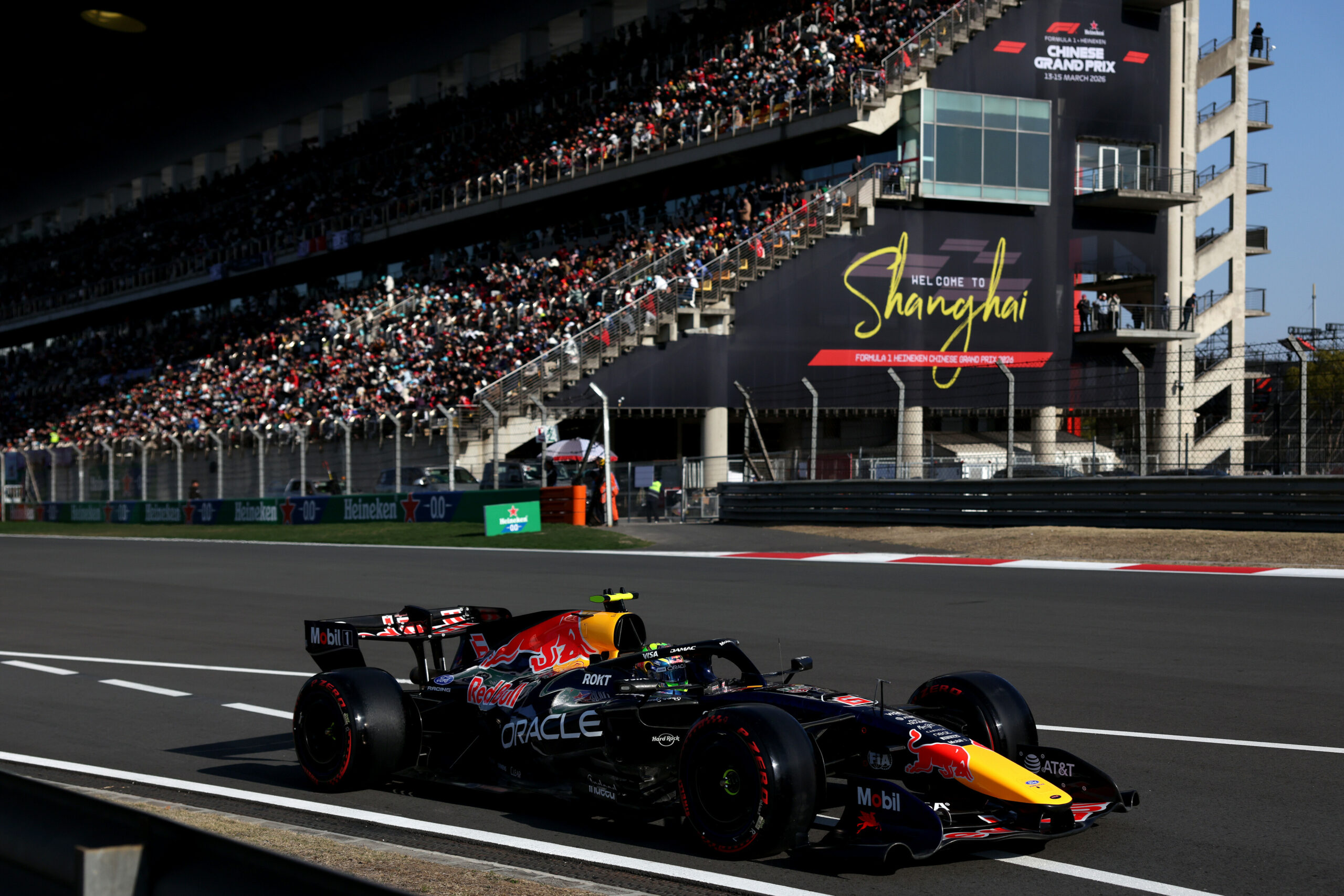
Isack Hadjar finished P9, right behind his Red Bull teammate Max Verstappen at the 2026 F1 Chinese GP qualifying.
The Frenchman said that he did everything he could in an interview in the print media pen. Nevertheless, he was still unsatisfied with the RB22’s balance overall. Although there is hard work going on behind the scenes at the Red Bull garage, the Sunday race looks more challenging and complicated compared to Melbourne for Hadjar and Verstappen, due to the discrepancy between the Chinese track layout and RB22’s design.
Need for more grip
Last weekend at the Australian Grand Prix, Red Bull executed a performance that looked capable of challenging or even beating the McLarens. Isack Hadjar took P3 in the Australian GP qualifying and started on the second row, though he couldn’t finish his race thanks to a massive engine failure when running in P5.
However, the Red Bull duo will start behind the Alpine of Pierre Gasly at the 2026 F1 Chinese GP. 4-time world champion Verstappen also expressed his discontent with the car’s performance after getting beaten by an Alpine, Pierre Gasly, although Gasly drove very well in a car that is not as competitive as the RB22.
When asked whether the car’s issue is solely based on its grip or if there are other weak parts in need of development, the Frenchman emphasised their need for more grip.
“We are just grip limited now. We just need more load everywhere.”
The disadvantages of the RB22 at the Chinese GP
After qualifying P3 in Melbourne, behind the two Mercedes, P9 at the 2026 F1 Chinese GP was a disappointing regression for Hadjar.
While Melbourne is a fast, flowing, energy-starved circuit with very few hard braking zones, China features long straights that end with very heavy braking zones, being energy-rich.
The new hybrid F1 cars recharge their batteries under heavy braking, which makes China a much easier track for the battery, where RB22 loses its engine advantage.
Red Bull’s challenger is particularly good at energy deployment so far, and in Melbourne, this was a critical weapon against other teams. However, the Chinese GP track inherently helps with the energy harvesting to all teams; therefore, as Hadjar mentions, its layout reveals what RB22 masks under its engine advantage, which is the limitations with their chassis.
“No, it’s not different. I think we were 8 tenths off in Melbourne, on a smaller track. Here it’s a lot bigger, which just exposes us a bit more. So the lap time loss is bigger, so I think we have the same performance. I think they really messed up last weekend. That’s all I can say.”
Nevertheless, Hadjar is optimistic that this situation won’t last until the end of the season and they will eventually develop the car.
“We are on the edge of what we have as a package. So we suffer for now, and then we are going to make progress anyway through the season. So, it’s okay.”