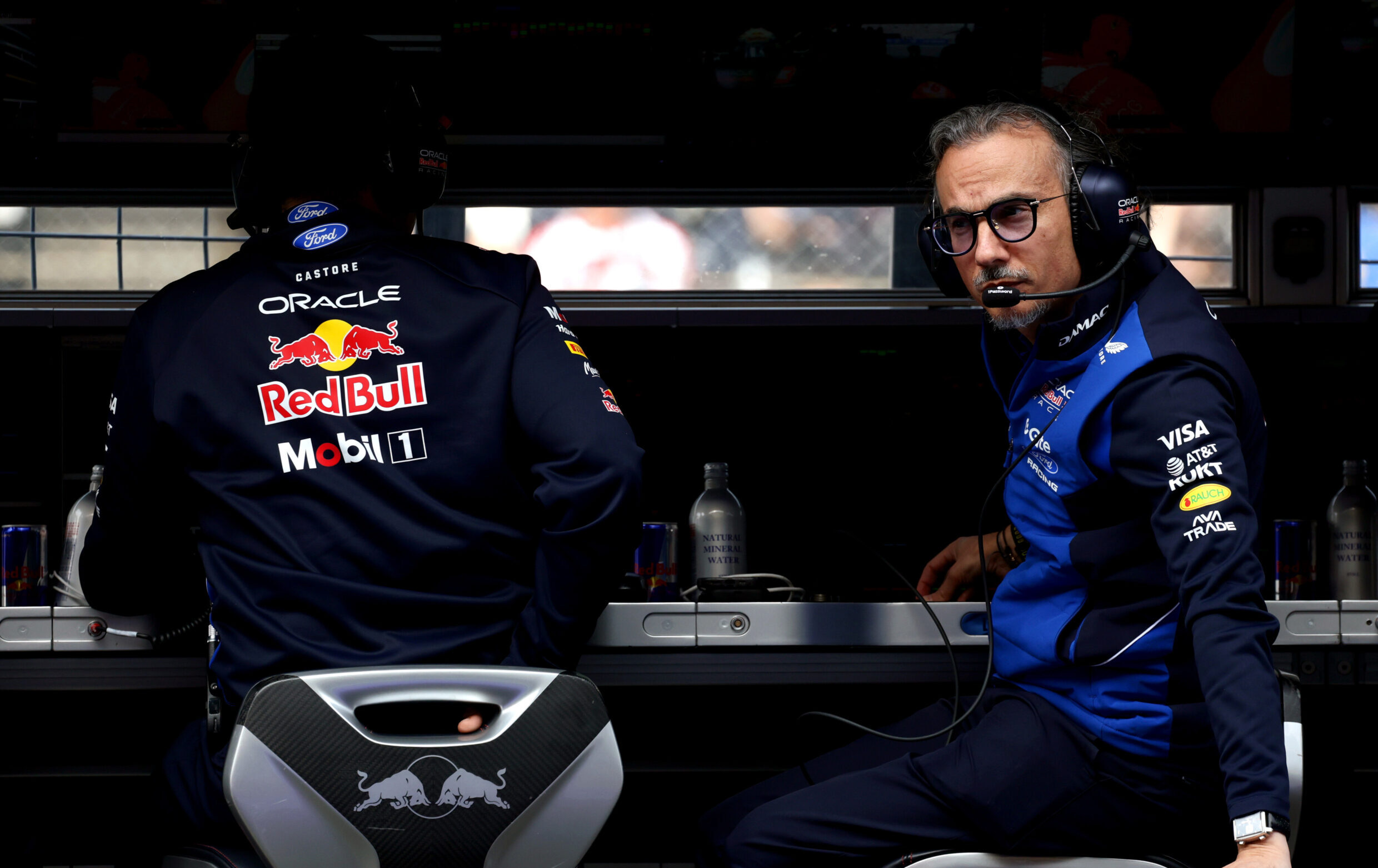
Laurent Mekies addressed Red Bull’s ongoing performance struggles following the 2026 F1 Japanese GP at Suzuka. The Red Bull Racing Team Principal spoke candidly about the team’s position behind Mercedes, McLaren, and Ferrari.
Kimi Antonelli claimed victory for Mercedes at Suzuka. Meanwhile, Max Verstappen and Isack Hadjar could only manage P8 and P12 respectively for Red Bull.
Mekies acknowledged the team faces both underlying performance deficits and difficulties extracting pace from the package. The challenges have persisted across multiple race weekends since a promising Melbourne qualifying performance when Isack Hadjar was P3 on the grid.
Mekies assesses Red Bull’s performance gap using Melbourne as the baseline
When asked about Red Bull’s pace relative to competitors, Mekies provided a detailed analysis of the team’s position following the 2026 F1 Japanese GP in his print media session. He referenced Melbourne as the baseline for measuring their deficit.
“So at first we left Melbourne thinking that we were one second off Mercedes and half a second off… I guess the biggest difference in Melbourne was that McLaren looked enriched there. And actually Max [Verstappen] came back from P20 to bump into what was the first McLaren, I think with Norris,” he stated.
Mekies suggested the gap has increased significantly since Australia. He noted the expanding performance deficit became particularly evident throughout in Shanghai as they were almost a second off pole position, with their cars in P8 and P9. It was even worse at Suzuka with 8th and 11th on Saturday.
Come race day on Sunday, the four-time World Champion was 32s away from the Italian at the chequered flag. Hadjar was 24s further back.
“Then we see that gap largely increasing in China. And you have seen us starting to scratch heads there about car balance and car characteristics. And then here, it also didn’t look good at all on Friday, Saturday, and certainly there is nothing to be happy about today in terms of overall gap to competitions.”
Mekies indicated Red Bull are approximately one second behind the leading teams. McLaren has moved towards Mercedes and Ferrari at the front of the field since Melbourne.
“It looked not to be similar to the Melbourne pictures in terms of one second to the best guy, half a second to the best Ferrari. But now McLaren is at that same level now. So we are a distant force, that’s the reality,” he stated.
Mekies points to a combination of development and extraction issues
Mekies identified two separate problems affecting Red Bull’s F1 Japanese GP performance. The team faces both fundamental development challenges and difficulties maximising the car’s potential.
Despite bringing an upgrade package to Japan, the chassis and aero side of the RB22 continues to make the car very difficult to drive.
“And I think it’s a combination of underlying performance, Melbourne or here. So some more work we need to do on the development of the concept. And a layer of us not being able to extract enough from the package and to give something Max [Verstappen] and Isack [Hadjar] can push with,” Mekies stated.
The extraction issues extend beyond simple set-up adjustments. Mekies emphasised the complexity of the problems Red Bull is wrestling with.
“And I’m not suggesting that it’s set-up tuning. I’m just saying there is something we are wrestling with that car that adds to our underlying lack of performance.”
Despite the challenging situation, Mekies expressed confidence in Red Bull’s ability to resolve these issues. He emphasised this type of problem-solving represents the team’s core competency.
“Now, trying to solve this sort of complex issues and trying to understand complex limitations is our core business. So as much as it feels bad when you are at the back of the top teams right now, that’s precisely what the whole compass is set up to do. To get to the bottom of complex limitations like that and nail them, bring development that can mitigate them and improve.”
The Red Bull CEO maintained optimism about the team’s ability to address the performance deficit following their Japanese GP struggles.
“And it feels bad now, but I have full confidence that’s exactly what our team is very good at,” he concluded.
Mekies says China marked a step backwards for Red Bull after Melbourne
When asked whether the performance differential related to circuit characteristics, Mekies acknowledged Red Bull took a step backwards in China. The regression extended beyond just losing ground to the leaders. In both Shanghai and Suzuka, Pierre Gasly had superior qualifying and race pace in his Alpine.
“It’s a fair question. We certainly think that in China we made a step back. And we measured that not only against the top guys but also against the midfield that got closer to us.
“So in China we for sure made a step back. So I don’t think it’s a product of the number of corners only.”
Mekies identified specific cornering conditions where Red Bull loses performance relative to the package’s potential capabilities.
“I think it’s somehow, as I said, there is a layer where in certain cornering speed and cornering conditions we lose some performance compared to what our package is supposed to give us. So this we need to work on,” he stated.
Mekies sees slight improvement for Red Bull during the 2026 F1 Japanese GP
The F1 Japanese GP showed marginal improvement compared to China, particularly during the race. However, the overall deficit remained substantial enough to obscure the progress.
“It was a touch better here compared to China, especially in the race. We didn’t see it because we were again a distant force and it doesn’t interest anyone to be a distant force.”
Mekies reiterated Red Bull’s current competitive position remains approximately one second behind the leaders. Ferrari represents the closest benchmark ahead of Red Bull.
“But I think the overall gap is what we have been talking about. It’s about a second to the best guys and half a second to the best Ferrari, is probably where we are,” he concluded.
Mekies’ assessment following the 2026 F1 Japanese GP highlighted the significant challenges Red Bull faces. The team must address both underlying performance deficits and extraction issues to close the gap to Mercedes, McLaren, and Ferrari. Red Bull’s next opportunity comes at the Miami GP after the April break.