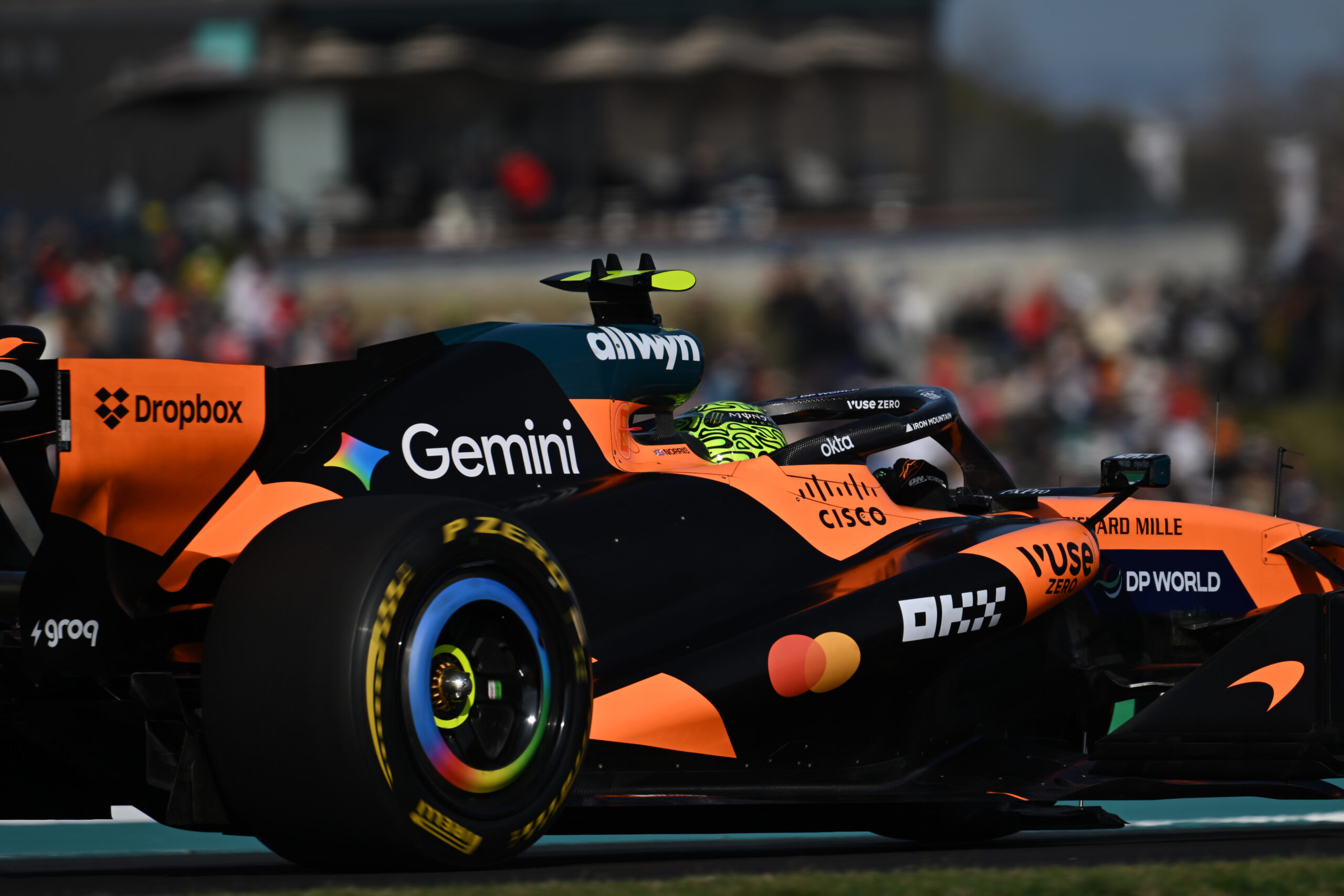
McLaren showed mixed pace during Friday’s practice at the 2026 F1 Japanese GP, with Oscar Piastri topping FP2 while Lando Norris’s running was compromised by technical issues.
Trouble began for Norris in FP1, as the Brit completed one lap with aero rakes fitted before the team removed them, costing him time; he had changes to the suspension. However, he later showed promising pace to claim P3, with Piastri 0.076 seconds behind in P4.
The second session brought another delay for Norris due to a hydraulic leak on his MCL40. Although he eventually returned to the track for FP2, he completed just 17 laps and finished P4. Meanwhile, Piastri completed a full programme of 29 laps, setting a 1:30.133 to go fastest.
Piastri positive after topping FP2
Reflecting on Friday’s sessions, Oscar Piastri explained that his P4 and P1 results felt encouraging, given the clear progress. However, he noted that there is still work to do, as the recently dominant Mercedes duo topped FP1 and finished FP2 in P2 and P3.
“Overall, it was a decent day for us. We felt like we made some good progress, particularly in the second Practice session, which was encouraging. The feeling is positive, and we’ve gathered some valuable data that puts us in a solid position,” he said.
“We know there’s still work to do, and it’s clear that some of our competitors, especially Mercedes, are very strong. However, the focus is on our own performance. We hope to build on the progress from today and carry that momentum forward to be even more competitive.”
Norris: “Pretty terrible start” to 2026 F1 Japanese GP weekend
On the other side of the garage, when Norris was asked about the cause of the delay and its impact, a less happy McLaren driver shared: “Hydraulic leak I think, I couldn’t do more than one lap at the beginning and then it seemed to get a bit better at the end, but I just lacked a lot of laps.”
Norris made his way out onto the Suzuka Circuit with less than 40 minutes remaining, running a delayed programme. He completed his first laps on medium tyres before switching to softs in the final 10 minutes, ultimately finishing 0.516 seconds behind his teammate.
He added: “I mean of course I had data to look at and things, but I ran the track like this, you just want laps, I don’t care what data I can look at, you just want laps under your belt to give you some confidence and good knowledge. Which I got some of at the end, but just two or three steps behind at the minute with set up, with no long running, not more than one lap at a time at the minute. Yeah, a pretty terrible start to the weekend, but we got the night to reset and try and fix some things.”
Singh on McLaren’s progress
Assessing Friday’s sessions at the 2026 F1 Japanese GP, McLaren’s Racing Director Randy Singh said: “Yes, I think we made the most of FP2, obviously we had the hydraulic leak with Lando, we weren’t able to fully fix that for the session but the team did a really good job to get as much running as we could and we tried to make the most of the learning we had there.”
“Oscar finished P1, which I think is always nice to see but similar to pace in Australia on Friday and I think the pecking order generally looks pretty much the same, like in broad terms.”
With the team picking up just 18 points across Australia and China, the 2026 Formula 1 season has not started as the recent back-to-back Constructors’ Champions had hoped. Notably, in China, neither McLaren driver made it out on track for the GP due to separate electrical issues.
Therefore, when asked about a possible comeback at the special Suzuka Circuit, Singh said: “Yes definitely, I mean all the circuits are special and our aim at the moment is just to maximise what we can over each race weekend, so a good opportunity to do that, harvest as many points as we can and see what we can learn to help develop the car.”
Additionally, for Suzuka, the FIA has reduced the maximum permitted energy recharge per lap in qualifying from 9.0MJ to 8.0MJ.
Speaking about this change, Singh concluded: “Yes, I think the regulations were a bit more complex this year, it’s hard for everyone involved, I think it was good that the FIA, power unit manufacturers, F1 got together and came up with that change. I think the lower harvest limit works better for this circuit.”