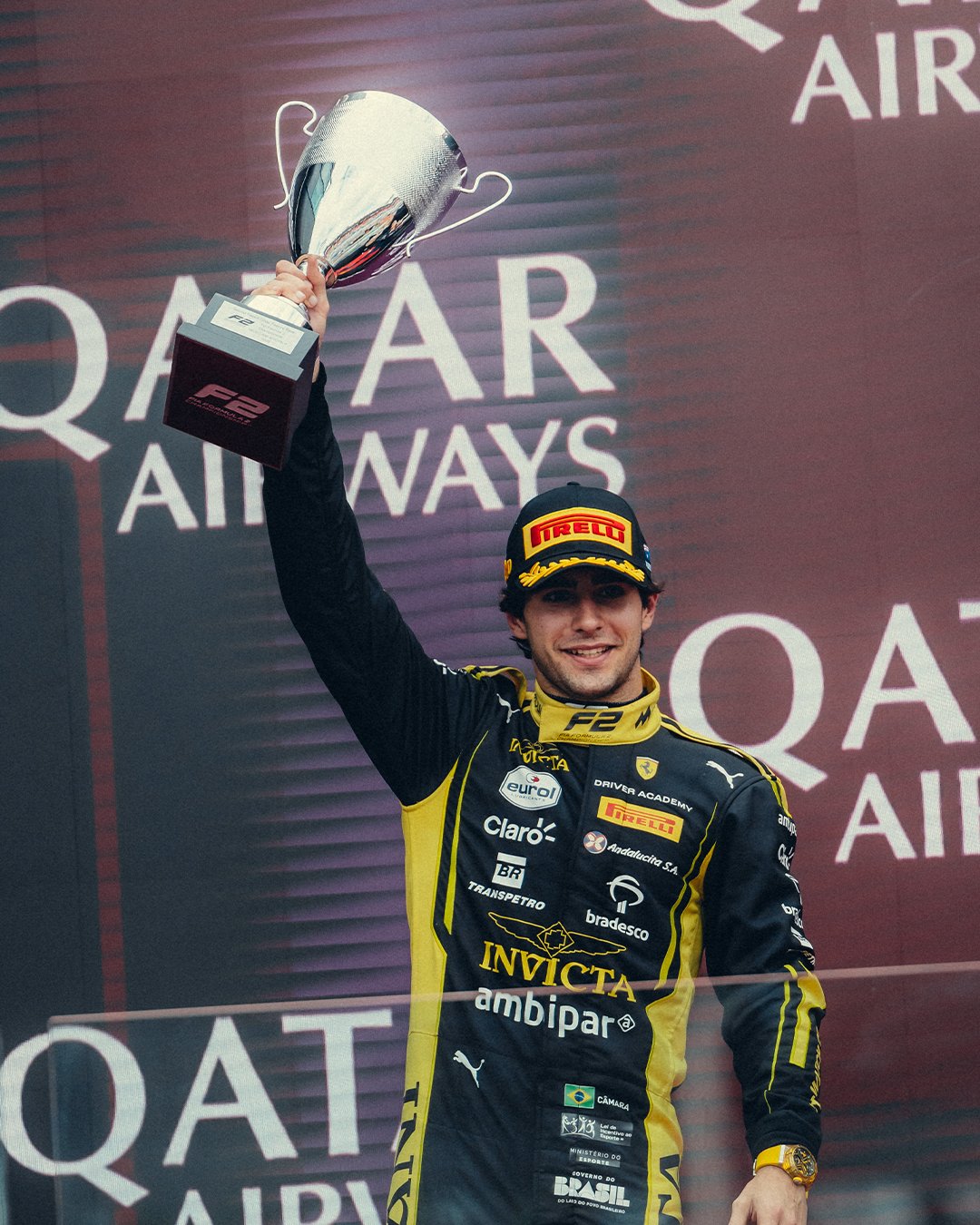
Currently racing in his debut FIA Formula 2 season with Invicta Racing, Rafael Câmara has opened up about his driving approach, with adaptability and execution emerging as the key factors to his success.
Since entering his single-seater career in 2022, Câmara has competed in various series, including Italian F4, ADAC F4 Germany Championship, F4 UAE Championship, Formula Regional European Championship by Alpine (FRECA), Formula Regional Middle East Championship (FRMEC), and FIA Formula 3 Championship. Notably, across all these categories, the Brazilian driver has consistently finished inside the top five in the drivers’ standings, claiming the FRECA championship in 2024 and the 2025 F3 Drivers’ Championship.
Now competing in his debut F2 season, the Ferrari Driver Academy Member has so far raced at the 2026 F2 Australian GP. There, Câmara has already impressed, having claimed his first F2 podium at the Melbourne Feature Race with a P2 finish.
A preference for precision
Before the 2026 Australian GP, Formula 2 interviewed the reigning F3 champion about his driving style, with Câmara explaining that, to begin with, he prefers a responsive and adaptable car.
“So, you always want to get a nice, comfortable and stable rear, because once you get that feeling it helps your confidence. Then you can start on a strong front,” he said.
“Of course if you have a little bit of rear instability, it’s still fine. But I always prefer a strong front and a car that reacts quick enough to where you want to put. I don’t really like a car that is lazy. I want something that’s sharp and quick, one that you really need to be smooth in your inputs and do things cleaner, that’s what I look for.”
In general, he admitted that he feels more comfortable managing oversteer than understeer:
“Overall I think for me it is easier to manage oversteer than understeer. Obviously, when it’s not a huge problem, I’m quite okay in adapting in both ways. But one that comes more naturally is fighting a bit with the oversteer.”
Learning to adapt at every level
Formula 2 marks the seventh racing series that Câmara has competed in, excluding karting. Throughout his career, he spent five seasons with PREMA Racing across multiple championships, while also racing for Mumbai Falcons Racing Limited in FRMEC, TRIDENT in F3, and now Invicta Racing in F2.
When asked about adapting to new teams and categories, Câmara pointed to adaptation as an important factor:
“I think one thing that has been quite nice and has felt more natural is the extra downforce you get when you move up in categories. It has felt more natural and fun to drive.”
“Obviously, you just have more grip, and things become nicer, you go into the corner faster. So, it is more enjoyable. But I think the skill of adapting is something that I really try to work on, especially from F4 and then to regional,” he noted.
He added that this process becomes more automatic over time: “I try to go through each process, looking at what you need to do to help the car. By working on that, it becomes more and more natural, and I think this is something that really helps you, especially in a season.”
“It helps you be consistent because it’s rare that you’re going to have the car you really like to drive. So, I think most of the time you’re just adapting to what the car needs, not what you like.”
Extracting performance in the car
Câmara further explained his process of maximizing performance with limited time and data:
“I think in F3 and F2, it helps you because we don’t have much time in Free Practice to understand the car. Sometimes you have a Red Flag, so you don’t really know where the car set up.”
“So in quali you need to kind of drive with what you have, finding the best solution at the moment. I think it’s something that I just try to keep working on and developing because the more you learn, the more it becomes natural.”
“In the end, if you’re able to execute well, you’re going to always be there. You might not always be P1, but I think you’re going to have a good consistency to be at the front. So I think that is the main thing that I try to work on myself.”
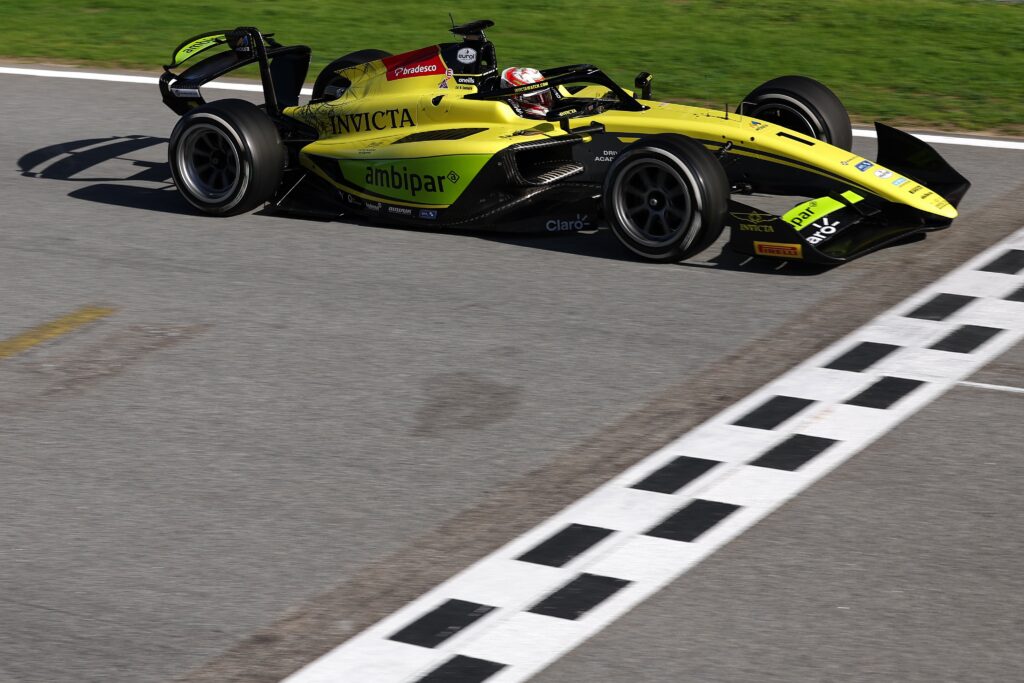
This was already visible at the 2026 Formula 2 Melbourne round, where Câmara qualified P6 before climbing to P2 in the Feature Race, highlighting his ability to maximize results despite not having the best qualifying position.
He continued: “With the team also, I think at the beginning of the weekend, normally you’re in a good place already, so you don’t want to be changing many things for quali, so you’re just fine-tuning.”
“But like I said, even if you don’t have the best car, if you’re already adapting, you can probably do 80% of the things you need.”
From instinct to teammate data
For Câmara, having a balance between trusting your own instincts and learning from teammates’ data is crucial, particularly in high-pressure, limited-time sessions.
“You can have your natural way of doing things, and I think this will be the one that helps you the most, especially in quali because you don’t have any time to really look at what your teammate is doing. You really need to figure it out by yourself.”
“But it helps to have good teammates to learn from them, to look at what you can do differently. You’re not always the fastest everywhere. So for sure, looking at what they’re doing better than you can help you do a better job.”
He further highlighted how, at times, analyzing different approaches can reveal new ways to extract lap times:
“So having good teammates, listening to their feedback, understanding how they think, how they approach things, is also something that helps you grow and understand what you can do better.”
“Also it helps you understand different ways to do the same thing you’re doing. Obviously, everyone has their own way to do things, so you just adapt in your own way.”
Câmara on his past and current teammates
Looking back at his previous and current teammates, Câmara gave examples of how he has learned new skills by observing others’ performances:
“I remember being teammates with Andrea Kimi Antonelli in F4, he was doing a very good job, and in Regionals as well he won. I learned a few things and then just started working on them, because I saw how much it helps the driver to have a certain skill,” he said.
“So I to learn from my teammates but also keep my own way to do it. Some things might not work for you, but it is good that you at least tried.”
“Also now I have Joshua Dürksen, and he is a strong guy, already two years in F2 and he has a lot of experience. So I am also trying to learn as much as I can from him, understanding the car, and just making sure that everything is tidy for the championship.”
While 2026 marks Dürksen‘s third F2 season, the Paraguayan driver is also new to Invicta Racing, having previously competed with AIX Racing. Like Câmara, he brings experience from multiple categories, allowing the pair to learn from one another as they adapt to the reigning F2 championship team.