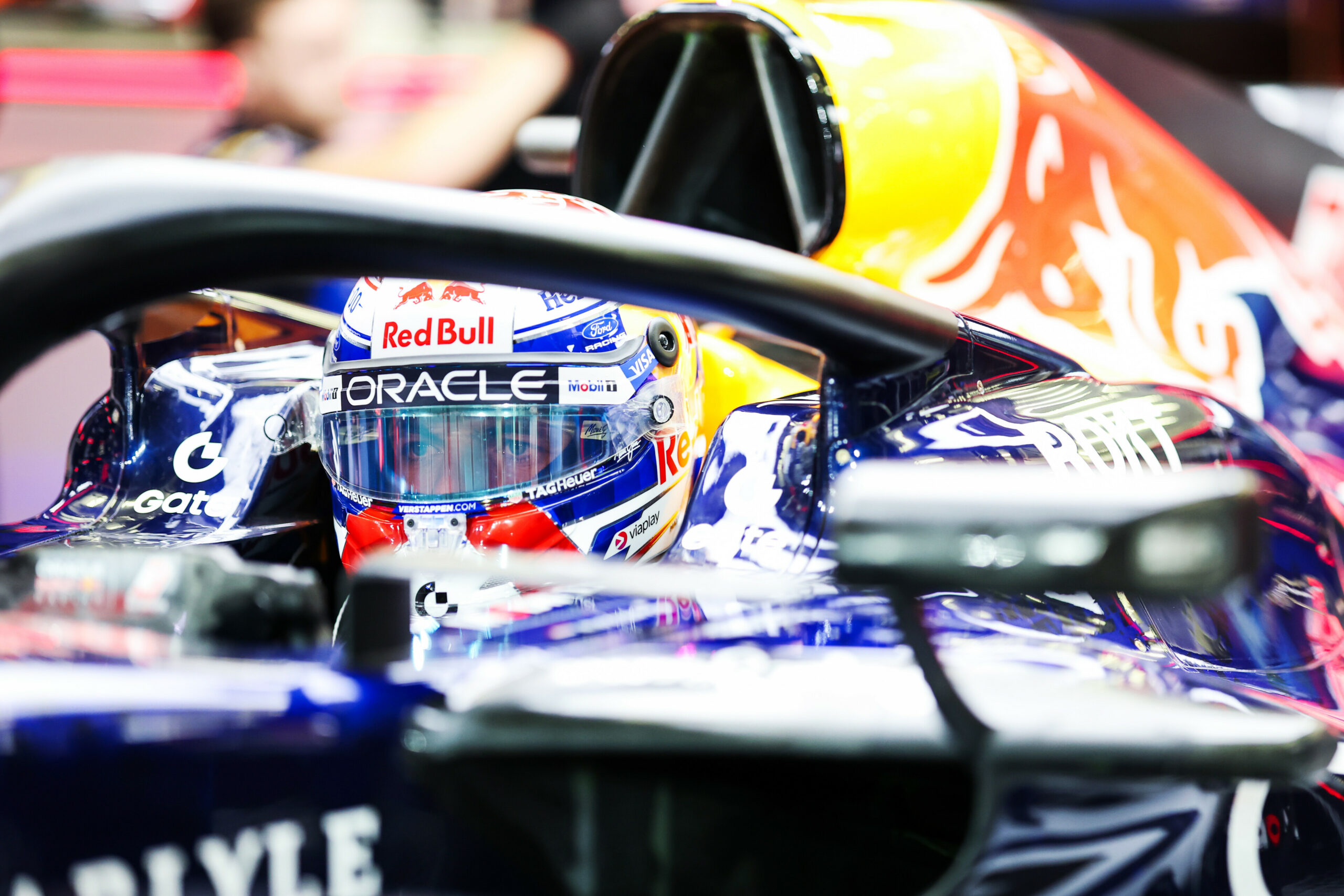
Following Red Bull’s performance on track on Day 1 of the F1 pre-season tests in Bahrain, the team’s 2026 engine was labelled as “the benchmark” by many of its rivals on the grid. Most notably, Mercedes’ Team Principal, Toto Wolff, has openly praised the Red Bull-Ford power unit’s performance on track.
A new era for Red Bull F1
Amid the technical regulation overhaul, another significant change in Red Bull was the change in power unit manufacturer. The Milton Keynes outfit had parted ways with Honda at the end of the 2025 season. The Japanese manufacturer had later revealed to be partnering with Aston Martin instead.
Red Bull then partnered up with Ford to produce the Red Bull Ford Powertrains power unit. For the first time since Red Bull’s debut in Formula 1, the team took on the task of producing and supplying its own power unit at its Milton Keynes headquarters. During the team’s rebrand, they had also poached several staff from other F1 engine manufacturers, including Mercedes. Many on the grid believed that Red Bull would face significant challenges entering the new technical regulation era with their debut 2026 engine.
The Red Bull 2026 engine defying all odds
Despite the initial expectations of the 2026 Red Bull engine, it displayed promising potential on track at the Barcelona Shakedown. The DM01, named as a tribute to Red Bull’s late chairman Dietrich Mateschitz, surprised both the team and its rivals on track with its reliable performance.
Mercedes had been the pre-season favourite following the 2026 Barcelona F1 Shakedown. However, after Red Bull’s Max Verstappen‘s dominant performance during the morning session on Wednesday, Wolff shared that in his opinion, Red Bull was a step ahead of the rest of the grid. This was in regard to the DM01’s ability to extract performance from the energy deployment. Wolff claimed that Verstappen’s dominance on track was due to the winning combination of the Dutchman’s race craft and the 2026 Red Bull engine.
“Well, I was hoping that they were worse than they are, because they have done a very good job. The car, the power unit are the benchmark at the moment, I would say. And then obviously you have Max in the car, that combination is strong.”
Wolff’s observation of the 2026 Red Bull F1 engine
This sentiment extended to the performance of Red Bull’s sister team, Racing Bulls. Wolff had praised both teams’ performance on track at the Bahrain International Circuit. He highlighted the increase in energy deployed on the straights, which was evident throughout the session. The German concluded that the teams’ performance set the 2026 Red Bull engine as ” the benchmark” on the grid.
“Look at the energy deployment today. They are able to deploy far more energy on the straights than everybody else. I mean, over consecutive laps.
“On a single lap we have seen it before, but now we have seen it on 10 consecutive laps with the same kind of straightline deployment. I would say that as per today, on the first official day of testing, which is always with a caveat, they have set the benchmark today.”
Wolff added that the initial hype around Mercedes’ F1 power unit was magnified by the grid. He also clarified that he did not share the same sentiment regarding the team having a technical advantage.
“I think everybody was a little bit too excited about the performance of the Mercedes engine-powered teams. And I think that our colleagues from the other brands have been carried away a little bit, that this could be embarrassing, which I don’t think it is at all.”
A clear step ahead of the grid
Williams’ Carlos Sainz shared a similar sentiment to Wolff regarding Red Bull’s 2026 engine. The Mercedes customer team driver shared that it is evident from the GPS data that Red Bull’s power units have a clear advantage over the rest of the grid.
The Spaniard added that Red Bull’s progression was “mighty impressive”. Especially since the DM01 is not only Red Bull’s first under the new technical regulations, but also the Milton Keynes outfit’s maiden in-house produced power unit.
“It’s still extremely early days, but if I would have to judge by the GPS data of yesterday, right now it is true that whatever Red Bull Ford Powertrains were doing yesterday was a clear step ahead of anyone else. Not only a small step, but a clear step and it was mighty impressive.
“If they manage to turn up to race one with a completely new set of regulations, with a completely new engine, new people, and turn up to be the fastest and most reliable engine, you will have to take your hat off to them and say what they’ve come up with, because at least what they were showing yesterday was very impressive.”
Data-backed praises for Red Bull’s 2026 engine
Verstappen’s on-track GPS data backs the praise from Sainz and Wolff. The data show that on longer runs, the Dutchman recharges his battery to the extent that allows him to deploy sufficient energy on the straights, resulting in him achieving higher top speeds compared to his rivals on each lap.
However, Sainz pointed out that it is still too early in the season to determine the true performance due to the nature of pre-season testing. There are still 5 days left of pre-season testing coming up for teams to identify the optimal power unit strategy, which is key to nailing the new F1 technical regulation.
Optimising energy harvesting techniques
The 2026 F1 power unit regulation saw a shift from a fuel-dominant system to a 50/50 split between internal combustion and electrical power. Despite this, the battery capacity remained the same. This means drivers are more likely to deplete their total energy storage several times per lap. The effect was evident on track in Bahrain as many drivers were seen downshifting to lower gears in slow corners. This was done to keep the revs up and harvest as much energy as possible wherever they could.
Sainz shared that the key to maximising the car’s potential on track is for drivers to find an energy harvesting technique that would not sacrifice cornering. He added that Red Bull seemed to be the only team on track thus far to have achieved this.
“The key to these regulations is not going to be separating both, but integrating both of them together. From what I could see yesterday, it seems like Red Bull has done exactly that, without having to give the driver a compromise.
“When the car is telling you to downshift a certain way, you just do what the car is asking you to do. That’s why all drivers, after we will end up doing maybe 300, 400 laps in Bahrain, we try to sort every kind of technique to try and help the driveability and the performance of the car.
“That’s why I’m insisting that the integration of power unit versus gearbox versus driver preferences, it all has to be a closed circle. The moment one of the two or three things are not exactly how you want is where you start facing issues, so everyone’s going to need to adapt and find the right way.”
Praise amid the controversy
For many, praises of the 2026 Red Bull engine from Mercedes-powered teams came as a surprise. Mercedes has been the centre of controversy regarding their interpretation of the regulation around compression ratio. Many rival teams, including Red Bull, have called out Mercedes and demanded a rule change. Should the FIA agree to the demands of the rival teams, this would leave Mercedes and its customer teams, such as Willams on the back foot. It seemed like a convenient time for Mercedes and its customer teams to bring up Red Bull’s 2026 engine’s alleged advantage.