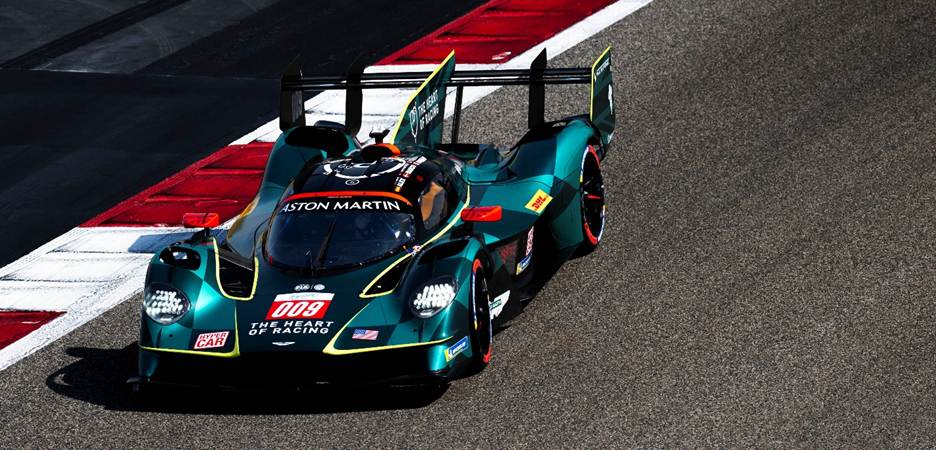
Despite leaving the 2025 FIA World Endurance Championship (WEC) finale in Bahrain with a sense of unfinished business, the Aston Martin THOR Team heads into the off-season encouraged by clear signs of progress. Over the course of the campaign, the revolutionary Valkyrie Hypercar steadily evolved from an intriguing newcomer into a genuine contender capable of challenging the established manufacturers in the Hypercar category.
While the Bahrain result ultimately failed to deliver the podium finish the team had hoped for, the race provided compelling evidence of the car’s developing pace and potential. Drivers, engineers, and management alike have emphasised that the lessons learned during the debut season have laid a strong foundation for the programme as it prepares for the next stage of its development heading into 2026.
Building momentum through the season
The Valkyrie’s upward trajectory became increasingly apparent during the latter stages of the season. A standout moment came at Fuji, where the car achieved its best finish to date with a strong fifth-place result in the highly competitive Hypercar field. That performance gave the team confidence that the package was beginning to unlock the speed necessary to challenge more consistently near the front of the grid.
Arriving in Bahrain for the season finale, the British manufacturer was determined to end its inaugural campaign on a high note. The early signs during qualifying were particularly encouraging. Ross Gunn and Marco Sørensen demonstrated the car’s one-lap pace immediately, placing the two striking green prototypes in the top two positions during the first part of qualifying.
Their performance ensured both Valkyries progressed to the Hyperpole session for the first time since the programme’s debut, a milestone that highlighted just how quickly the team had developed its understanding of the complex Hypercar machinery.
Although the team ultimately had to settle for sixth place on the grid for the #009 entry and ninth for the #007 car in the fiercely competitive 18-car Hypercar field, the qualifying session confirmed that Aston Martin was now firmly within striking distance of the front-runners.
A breakthrough moment during the race
The race itself provided one of the most memorable moments of the Valkyrie’s debut campaign. Alex Riberas produced an aggressive and spectacular charge through the field during the middle stages of the race, demonstrating both the car’s performance potential and the driver’s determination to capitalise on every opportunity.
A mid-race Safety Car period compressed the field and created a strategic window that the team was ready to exploit. With fresh tyres at his disposal, the Spaniard launched a series of decisive overtaking moves against some of endurance racing’s most experienced drivers.
He first dispatched Peugeot driver Jean-Éric Vergne and Ferrari’s Alessandro Pier Guidi—already crowned world champion-elect—before turning his attention to the Toyota pair of Nyck de Vries and Sébastien Buemi. The decisive move came at Turn Seven, where Riberas boldly overtook Buemi to seize the race lead.
In doing so, the V12-powered, road-car-derived Valkyrie led an FIA WEC race for the very first time, marking a significant milestone in the programme’s short but rapidly evolving history. To underline the pace of the car, Riberas simultaneously set a new fastest lap of the race while building a gap of around ten seconds to the chasing pack.
A penalty ends podium hopes
Unfortunately for the Aston Martin squad, the breakthrough moment proved short-lived. Race control issued a drive-through penalty to the #009 Valkyrie for a Virtual Safety Car infringement, forcing the car down pit lane and effectively ending any realistic chance of securing a maiden podium finish.
The setback dropped the car down the order, and by the time the chequered flag fell, Riberas, Sørensen, and Roman De Angelis had to settle for seventh place. Despite the disappointment, the performance demonstrated that the car now possessed the outright speed to challenge for wins under the right circumstances.
Reflecting on the race afterwards, Riberas emphasised that the performance in Bahrain provided clear evidence that the Valkyrie programme is progressing in the right direction.
“Definitely a lot of positives came out of Bahrain,” Riberas reflected. “While we didn’t have a lot of luck, at times we were the fastest car out there. It was one of those days where you could clearly see the progress we are making and the potential that is growing in the car.
“We are getting better on the small details and when we learn how to race against the competition more, we will be even better still. Whether the Valkyrie will be ready to fight for victories at the beginning of next year is not for me to say, but I know it is more a matter of when than if.”

Drivers confident in the programme’s progress
Riberas’ optimism is shared by his teammates, who believe the results achieved in the latter stages of the season indicate that Aston Martin’s ambitious Hypercar project is rapidly approaching the level required to compete with the category’s established powerhouses.
Marco Sørensen, a multiple GT class world champion with extensive experience in endurance racing, pointed out that the Valkyrie demonstrated podium-capable pace during several of the final races of the season.
“We should be proud of what we have achieved this year for sure,” agreed Sørensen. “If you look at the last three races, we have had a car that had the pace to finish on the podium. Now, we have to take these learnings into next year and build on that progress. We go into the winter with a lot of motivation, and we just want to push everyone so that we are ready to fight from the start of next season.”
Misfortune for the sister car
The second Valkyrie entry, shared by Harry Tincknell, Tom Gamble, and Ross Gunn, endured a more frustrating afternoon despite running strongly for much of the race. The #007 car remained firmly within the points positions until a poorly timed Virtual Safety Car intervention shortly after its final pit stop proved costly.
Because the neutralisation occurred immediately after the car had completed its stop, the trio lost valuable track position and ultimately fell a lap behind the leading group. As a result, they finished the race in 15th place—an outcome that did not accurately reflect the pace they had shown throughout the weekend.
For Gunn, however, the weekend still provided several positives, particularly given that it marked his return to the FIA World Endurance Championship after an absence since June’s 24 Hours of Le Mans.
“Sometimes it goes your way, sometimes it doesn’t,” mused Gunn. “At certain points during the race, the car really came into its own, but we got very unlucky with the last VSC. I really enjoyed coming back to FIA WEC and obviously being fastest in qualifying was a highlight of the weekend, but also seeing the progress season-long and knowing we are going in the right direction is really satisfying.”
Important milestones for the programme
Team Principal Ian James highlighted the significance of the Valkyrie leading its first laps in FIA WEC competition. While the result itself fell short of expectations, he stressed that the performance represented a key milestone in the development of the programme.
“Leading our first laps in FIA WEC was a good milestone,” echoed Team Principal Ian James. “The VSC came at the wrong time in terms of our strategy, but the speed we had was very strong. In Qatar, we were a couple of seconds off the pace and people were writing us off, so to get to a place where we were genuinely competing for pole position and the podium shows what a good job everyone has done. I can’t wait for 2026 to come around so we can keep up this momentum.”
Continued development for 2026
For Aston Martin’s endurance racing leadership, the progress made during the Valkyrie’s first season is a testament to the dedication and expertise of everyone involved in the ambitious project. Bringing such a unique and unconventional Hypercar to the FIA WEC grid was always going to be a formidable challenge.
The Valkyrie stands apart from many of its competitors due to its close connection to the road-going hypercar, as well as its distinctive naturally aspirated V12 powertrain—an increasingly rare configuration in the modern hybrid-dominated prototype landscape.
Despite the complexity of adapting such a machine for top-level endurance competition, Aston Martin’s Head of Endurance Motorsport Adam Carter believes the team has demonstrated both the capability and determination required to succeed.
“FIA WEC is a magnificent series with manufacturers, teams and drivers that have been at the pinnacle of the sport for, in some cases, decades,” noted Carter. “To have brought such a unique car as Valkyrie to the stage, to start where we did and to consistently improve our performance shows the ability and desire of everybody that is part of this programme. We have made satisfying progress in 2025 and will continue to build upon that next season.”
Looking ahead to 2026
With a full season of experience now behind them, Aston Martin and the THOR Team head into the winter break determined to build on the momentum generated during the closing races of the campaign. Development work will continue intensively during the off-season, as engineers focus on refining performance, improving operational efficiency, and strengthening the team’s race-day execution.
If the trajectory seen in the latter stages of 2025 continues, the prospect of the Valkyrie fighting for victories—and perhaps even the championship—may arrive sooner than many initially expected.