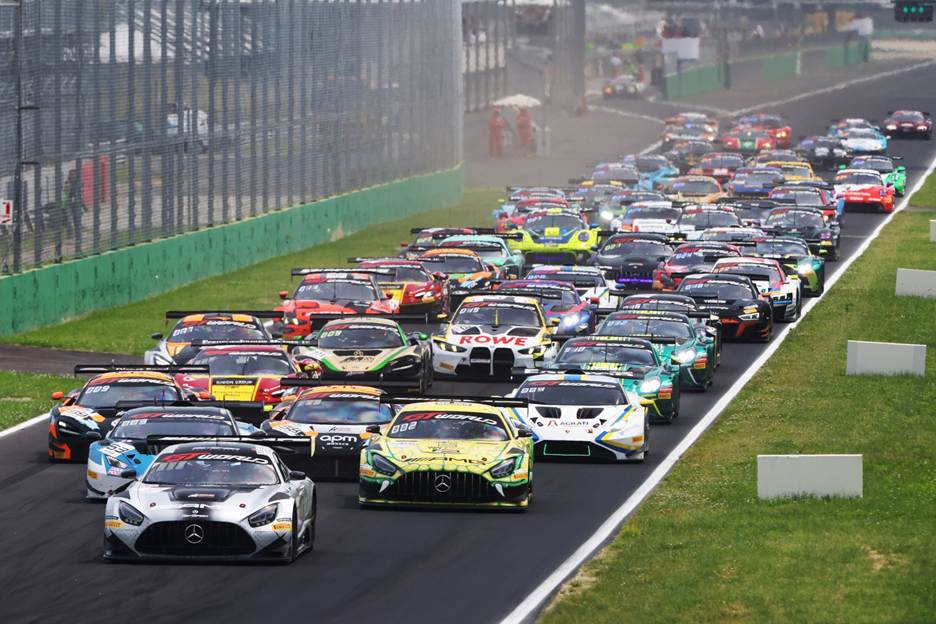
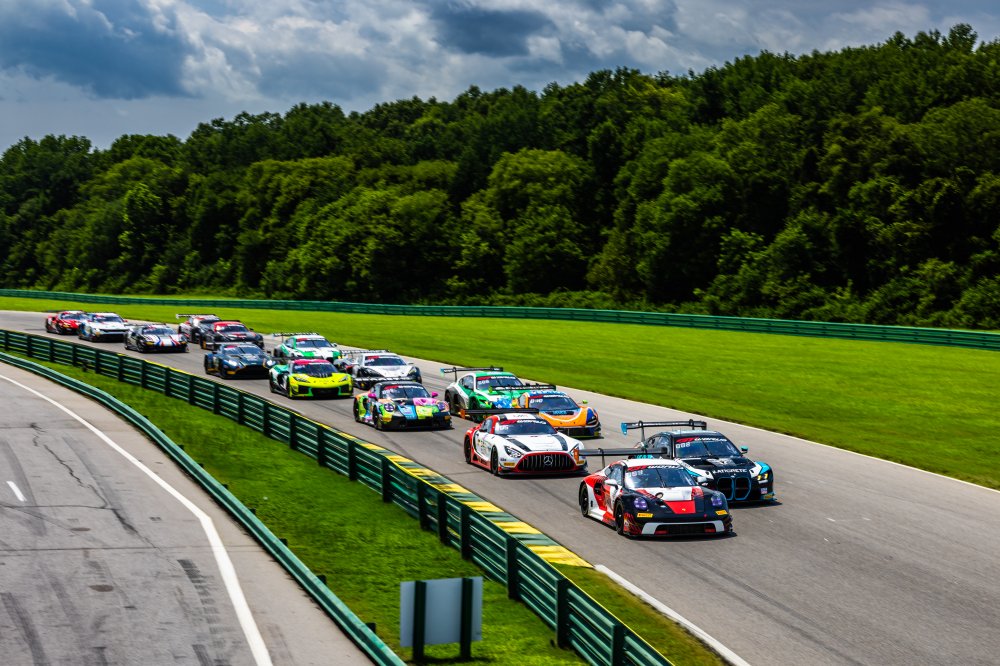
SRO America has published the draft sporting regulations for the 2026 GT World Challenge (GTWC) America powered by AWS season, introducing significant updates alongside the shift to a single three-hour race format.
The revisions reshape qualifying procedures, driver requirements and pit stop regulations, while also clarifying several sporting matters that generated debate during 2025.
Expanded Practice, single Qualifying
Under the new framework, organisers will add a third 30-minute practice session to each event weekend. In contrast, teams will contest a single 15-minute qualifying session to determine the grid for the headline three-hour race.
Most notably, Driver 1 in the Pro-Am class must now be the amateur (Bronze-rated) competitor. Officials did not enforce this designation over the past two seasons, which previously allowed Regulator Racing to qualify its professional driver, Philip Ellis, and deploy a reverse driver strategy.
As before, Driver 1 must qualify and start the race. However, from 2026 onward, Bronze-rated drivers in Pro-Am entries must fulfil those responsibilities.
Revised pit stop structure
Although organisers will not mandate a fixed number of pit stops during the three-hour race, they will remove the requirement to change all four tyres at each stop.
Furthermore, if a team completes a stop without refuelling, officials will impose no minimum pit stop time. In contrast, full-service stops that include refuelling will carry a declared minimum time, which race control will communicate at the start of each event.
Teams may continue to perform driver changes, refuelling and tyre changes simultaneously.
Defined driver time requirements
SRO America has confirmed that Bronze-rated drivers must complete a minimum of one hour and 15 minutes in each three-hour race. Meanwhile, the maximum stint length stands at 50 minutes, extending to 55 minutes if a safety car or Full Course Yellow interrupts that stint.
If a competitor exceeds the permitted stint time by up to four minutes and 59 seconds, officials will issue a drive-through penalty. Any infringement beyond that threshold will result in a stop-and-hold penalty plus an additional time sanction.
Red Flags and points clarified
The regulations also clarify race interruption procedures. The official session clock will not stop during a red flag. If the leader completes less than 50 per cent of the official race time, officials will award half points. Conversely, they will grant full points once the leader surpasses the 50 per cent mark.
In addition, at least two cars must enter an event for a class title or trophy to be awarded. Previously, a provision allowed titles if three cars participated in at least three rounds and two competed in all events.
Tighter testing restrictions
SRO America has further restricted private testing. Competitors may not test within seven days prior to paddock load-in. Previously, the restriction began at 12:01 a.m. on the Monday of the event week.
Finally, as in previous seasons, organisers will publish a separate set of sporting regulations for the season-ending Indianapolis 8 Hour presented by AWS at Indianapolis Motor Speedway, the only round that falls outside the new three-hour race format.
With these updates, SRO America has firmly defined the competitive framework for 2026, placing greater emphasis on Bronze driver accountability, strategic flexibility and regulatory clarity.