As the Formula 1 teams start to gradually reveal pieces of their 2026 challengers, from liveries to aero packages, it’s timely to revisit one of the strangest pre-season testing occurrences in F1 history.
Coming into the 2015 F1 season, Lewis Hamilton was a defending two-time world champion with Mercedes whilst his former McLaren teammate Alonso was beginning his return to the Woking team after leaving Ferrari at the end of the 2014 season.
Unlike 2026, no new regulations preceded the 2015 pre-season testing events, but the FIA later introduced changes that allowed Manor Marussia to use a modified 2014 chassis that complied with the updated safety requirements.
How the crash unfolded for Fernando Alonso in 2015 F1 pre-season testing in Barcelona
On February 22nd, 2015, the ten F1 teams arrived at the Circuit de Catalunya in Barcelona for the final day of the second pre-season test.
The crash happened when Alonso’s McLaren-Honda found the barrier at the long-right hander of turn three.
The two-time world champion was airlifted to hospital with a concussion and consequently missed the season opener in Australia, with former McLaren driver Kevin Magnussen stepping in to take his place on the grid.
With pre-season testing carried out behind closed doors and no televised footage, it remained a mystery up and down the paddock to what had been the exact cause for Alonso’s incident.
McLaren blame winds for Fernando Alonso’s crash in 2015 F1 pre-season testing
Following the accident, McLaren denied it was caused by a mechanical failure and instead blamed “unpredictably gusty winds” for Alonso’s peculiar crash in Barcelona.
Their statement said: “(Alonso’s) car ran wide at the entry to Turn 3 – which is a fast uphill right-hander – allowing it to run onto the Astroturf that lines the outside of the track.
“A consequent loss of traction caused a degree of instability, spitting it back towards the inside of the circuit, where it regained traction and struck the wall side-on.
“It was a significant lateral impact…the car slid down the wall for about 15 seconds before coming to a halt. All four wheels remained attached to the car, but no damage was sustained by the bodywork or crash structure between the front and rear wheels.”
They denied any rumours of mechanical failure causing the accident as they said: “We can categorically state that there is no evidence that indicates that Fernando’s car suffered mechanical failure of any kind.
“We can also confirm that absolutely no loss of aerodynamic pressure was recorded, which fact indicates that the car did not suffer any aerodynamic loss, despite the fact that it was subjected to a significant level of g-force. Finally, we can also disclose that no electrical discharge or irregularity of any kind occurred in the car’s ERS system, either before, during or after the incident.
“That last point refutes the erroneous rumours that have spread recently to the effect that Fernando was rendered unconscious by an electrical fault. That is simply not true. Our data clearly shows that he was downshifting while applying full brake pressure right up to the moment of the first impact – something that clearly would not have been possible had he been unconscious at the time.”
One month later
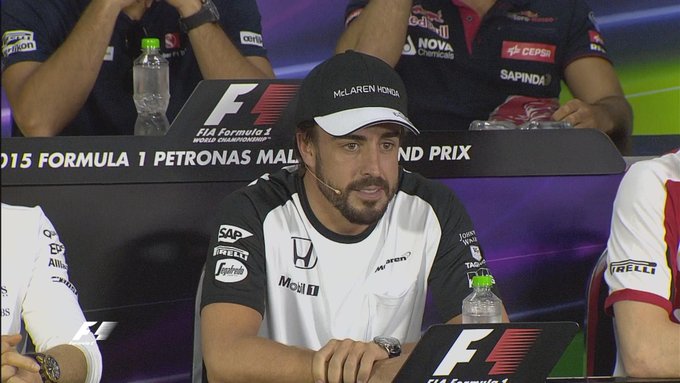
When he returned to the paddock for the 2015 F1 Malaysian Grand Prix, Alonso insisted that a steering problem had caused his accident and denied McLaren’s initial claims that no mechanical issue had contributed to the crash.
Alonso did support McLaren’s statement that he not gone unconscious following the crash but did say that he had lost consciousness as a result of his medication.
He went on to describe how McLaren’s statements had not helped speculation about his health and rejected Ron Dennis’ suggestions about gusty wind causing the accident.
Alonso’s standpoint
Alonso explained how the steering “locked to the right…I approached the wall, I braked in the last moment, I downshifted.
“After the hit, I was kissing the wall for a while. I switched off the radio and then the master switch and then the ERS (hybrid system).”
He blamed McLaren’s data acquisition on that part of the car for why the team could not see any evidence of the steering locking.
On his consciousness, he said: “I was perfectly conscious at that time. I lost consciousness in the ambulance or clinic but the doctors say this is normal for the medication and the checks they put on you for the MRI.
“Everything was more or less normal concussion. I went to the hospital in good conditions.
“There is a time I don’t remember in hospital from two o’clock to six o’clock in the afternoon that day but that is normal due to the medication. Then everything was normal.”
He described the immediate statements as “not a help” and admitted: “Some of the confusion comes from the early quotes when the pressure was very high and I was in intensive care and there was an urgency to say something.”
On the memory loss rumours, he said: “I didn’t wake up in 1996, didn’t wake up speaking in Italian; all these things that were out there. I remember the accident and everything from the accident.”