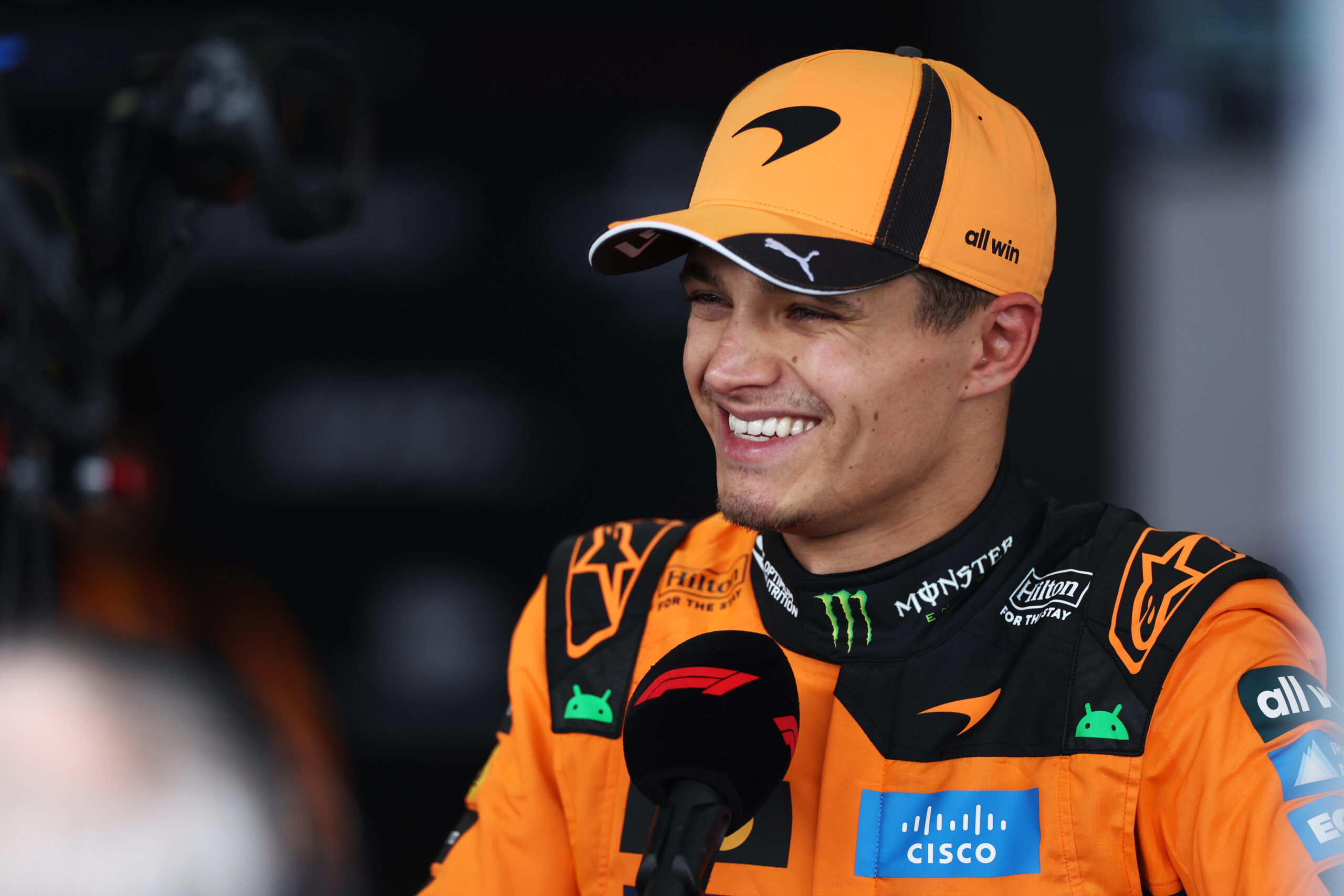
Lando Norris opened his 2026 F1 campaign with a hard-fought but underwhelming fifth place at the Australian GP.
The reigning World Champion never quite found the pace to challenge the dominant Mercedes and Ferrari runners at the front, and instead spent much of the afternoon locked in battle further down the order.
Managing strategy and tyre life, Norris ultimately held off a late challenge from Max Verstappen in the closing laps to secure valuable points, limiting the damage on a difficult day for McLaren at Albert Park.
Race management key for Norris during challenging 2026 F1 Australian GP
Norris admitted in the written media pen afterwards that the race had been an “even worse” experience than he had anticipated following qualifying. The McLaren driver suggested the current cars felt less engaging to race than last year’s machinery, though he acknowledged that the team had still extracted the maximum possible result from the afternoon.
With the pace of the frontrunners unreachable, the Brit focused on managing his race and defending his position, particularly against Verstappen, who had carved through the field after starting further back. Despite expecting to lose the place at several points, Norris managed to keep the Red Bull behind while McLaren gathered valuable data and made incremental improvements during a challenging 2026 F1 Australian GP.
“I don’t know, just not as fun as last year, but it is what it is, and I think we maximised today.
“Yeah, clearly we’re a long way off. We’re a long way off, the car’s ahead, but I put up a good fight with Max. I didn’t think we were going to stay ahead at that half-way point because he was already behind me, and he started last.
“I didn’t have much hope, but we managed to do it, and we made some improvements on the way. We improved, we learnt along the way, and that was an important thing for us today. So we got better, but still just a difficult race.”
Tyre graining and traffic complicate Norris’ race in Melbourne
Norris also stressed that the large gap to the leaders did not fully represent McLaren’s true pace. Much of the time loss, he explained, came from fighting in traffic, which forced him into battles that quickly hurt the tyres and made it difficult to manage the race cleanly. He pointed out that the team continued to struggle with familiar front tyre graining early in stints, an issue that has carried over from previous machinery.
While McLaren still held a comfortable advantage over the midfield, the distance to the leading teams made it clear that the car remains well short of the level required to fight at the front, leaving plenty of work ahead for the team.
“Yeah, but following and overtaking and all those things makes a big difference. Some pure pace, only 50 seconds behind, no. If I had a clean race like George did and didn’t have to battle as much, that would be a better look for us, but we had to.
“So I don’t think it’s dreadful, but we killed the tyres after three laps, and we have our front graining issues like we always have. That’s not changed from one car to the next, so we have a lot to try and figure out. The good thing is we have a big gap to the cars behind. It’s similar to the Red Bull, the bad thing is we have a big gap to the cars ahead. Today was more of an understanding that we’re nowhere near where we need to be with the car, and we’ve got to improve that.”
Unpredictable overtaking leaves Norris frustrated with racing at 2026 F1 Australian GP
Voicing frustration with the racing itself, Norris described the overtaking dynamics as overly artificial and unpredictable. He suggested the system created chaotic situations on track, where drivers often found themselves waiting for incidents rather than racing naturally.
According to Norris, the behaviour of the power unit and energy deployment could sometimes decide moves almost randomly, leaving drivers powerless to defend or attack in certain moments.
While he admitted there was little the drivers could do to change it in the short term, he made it clear the current situation did not offer a particularly satisfying racing experience from behind the wheel.
“Way too much. It’s chaos, you’re going to have a big accident, which is a shame. You’re driving, and we’re the ones just waiting for something to happen and something to go quite horribly wrong, and that’s not a nice position to be in. There’s nothing we can really do about that now.
“It’s a shame, it’s very artificial, depending on what the power unit decides to do and randomly does at times. You just get overtaken by five cars, or you can just do nothing about it sometimes. There’s nothing we can change about it, so there’s no point saying any more. Not for me.”
Norris highlights potential safety dangers of F1 speed differentials
Norris also raised concerns about the potential safety implications created by the large differences in closing speeds caused by energy deployment. He warned that the speed variation between cars could reach several dozen kilometres per hour, creating dangerous situations if drivers made contact.
In such scenarios, Norris suggested the consequences could be severe, with the risk of cars being launched into the air and causing significant harm to those involved.
“Depending on what people do, you can have a 30, 40, 50 kph speed, and when someone hits someone at that speed, you’re going to fly, and you’re going to go over the fence, and you’re going to do a lot of damage to yourself and maybe to others, and that’s a pretty horrible thing to think about.”
McLaren F1 improvement key as Norris acknowledges rivals’ stronger execution
When asked about possible solutions, Norris stopped short of offering technical fixes, noting that such decisions ultimately lie with the engineers and regulators rather than the drivers.
Instead, he emphasised that McLaren’s priority must be improving its own performance. Norris acknowledged that other teams had executed the new systems more effectively, particularly at the start of the race, and admitted McLaren still had significant work to do to match their rivals’ level.
“I don’t know, that’s not my job. Of course, we’ll say what we need to say as drivers. Of course, some will be happier than others, and I understand that, of course. But at the same time, it’s what we have.
“We’ve clearly not done anywhere near as good of a job as some other teams. Even on the opening lap, we didn’t do as good of a job compared to some of the teams around us. It’s not just that. We need to improve ourselves first.”