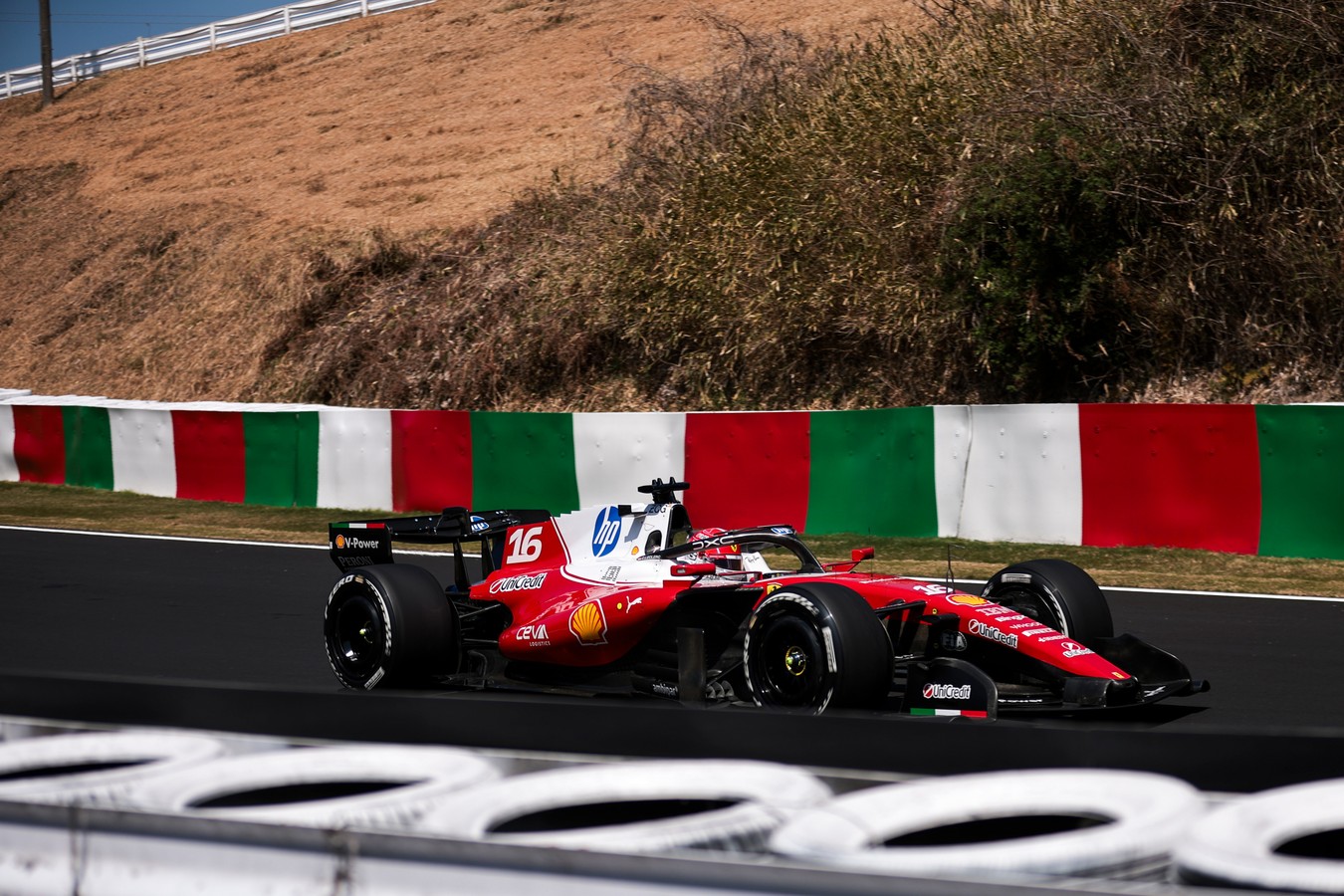
Ferrari drivers Lewis Hamilton and Charles Leclerc will be looking into improvements to close the gap to the front after Friday practice for the 2026 F1 Japanese GP.
Finishing both FP1 and FP2 in P5 (Leclerc) and P6 (Hamilton) behind McLaren and Mercedes, both Ferrari drivers will be looking to improve their pace for the remainder of the 2026 F1 Japanese GP weekend. Together, the duo completed 103 laps across the two practice sessions, collecting valuable data that should help Ferrari identify areas for improvement.
Leclerc gives his thoughts following 2026 F1 Japanese GP Friday practice
In a press release by Ferrari, Leclerc described the start to the 2026 F1 Japanese GP weekend as “more tricky” for the team. While the pace was overall satisfying in FP1 and FP2, Leclerc pointed to the gap to the front-runners and preparation for tomorrow’s Qualifying as key areas to focus on. The Monegasque was slightly faster than his Ferrari teammate, ending FP2 with a 1:30.846 in P5, seven tenths adrift from McLaren’s Oscar Piastri in P1.
“It was a more tricky day for us as a team, compared to the last two races, but it’s only the first day of the weekend. Our race pace seems to be good so far, although there is still quite a gap to the front runners. Our focus going forward will be on working on the qualifying performance for tomorrow.”
Ferrari is not fast enough
In the print media pen following the conclusion of the 2026 F1 Japanese GP Friday practice, Hamilton shared similar sentiments, noting that the feeling inside the car was “OK”, but that Ferrari was currently not quick enough. Pointing to the SF-26’s balance, Hamilton said the team would focus on the set-up ahead of FP3 and Qualifying.
“I think it’s just something similar that we’ve experienced before here, and it’s an amazing circuit. The car generally feels OK, it’s just not quick enough at the moment. I think it’s just balance. We’ve just got to work hard overnight to try and figure out how we can set the car up better.”
Improvements in set-up and deployment are vital to close the gap, says Hamilton
At the end of FP2 for the 2026 F1 Japanese GP, Hamilton sat in P6 with a 1:30.980 over eight tenths separating him from the front-running McLaren of Oscar Piastri.
“Difficult to say,” says Hamilton when asked about how Ferrari can reduce the gap to the front. Compared to McLaren, Ferrari records time losses on the straights, arriving at Turn 1 with a deficit of four tenths. On top of finding the optimal set-up window, Ferrari will thus also have to improve deployment, says Hamilton.
“Ultimately, there’s a lot of time on the straights; it’s four-tenths into turn one at the moment compared to McLaren. So, deployment is part of it. I’m sure we can do a better job in improving on that, and then I think there’s more performance in the car to extract if we can get the set-up right.”
Clipping is the “least enjoyable” aspect of the 2026 F1 regulations
With several drivers complaining about engine clipping after the 2026 F1 Japanese GP Friday practice, particularly through the legendary 130R, Hamilton was asked about his own experience. In response, Hamilton described the clipping as the “least enjoyable” aspect of the 2026 F1 regulations but noted that he overall enjoyed driving around the Suzuka Circuit.
“Super clipping is definitely not great. It’s not great when you have super clip, it’s actually charging stuff. Then you arrive in some places, and you’re kind of coasting in because you can’t make out. That’s probably the least enjoyable part of the rule change on this circuit.
“Otherwise, the track was really good through all the sections, and it’s still awesome to drive.”
Ferrari Sporting Director Diego Ioverno identifies areas for improvement after 2026 F1 Japanese GP Friday practice
During his discussion in the print media pen, Ferrari Sporting Director Diego Ioverno shared that the gap to the front is in line with what the team expected following the opening rounds of the 2026 F1 season. In preparation for the remainder of the 2026 F1 Japanese GP weekend, Ferrari will analyse data to improve energy management and fine-tune the setups for Hamilton and Leclerc.
Another focus area for Ferrari, identified by Ioverno, is to ensure the tyres are in optimal working condition from the start of the lap.
“I think the gap was more or less where we expect it to be. Also quite in line with the first few pieces, especially in the short runs, let me say. Nevertheless, we have to try to improve.
“We do what we can do, analysing data and trying to fix some small issues that we had with the car management. Drivers are not fully happy, and so on. I think you heard the news, complaining about the lack of confidence.
“Track is difficult, you lose your pace in the second part. Key factor would be to make sure the tyres are working from the first half. Nothing unexpected, let me say.”
Multiple elements factor into on-track performance
As teams across the grid still struggle to get on top of energy management, Ioverno feels that fundamental elements, such as set-up and tyre management, can’t be ignored. The Ferrari Sporting Director believes it is vital to strike the right balance between all elements to extract maximum performance from the car.
“Fundamentals are always a key factor, so we don’t have to forget tyre management, setup, driver confidence and so on. But energy management and energy usage is still a factor, the straights and so on. It’s not really up to manage them, it’s to make sure that you extract the best in every part of the track and every, let’s say, aspect of the car.”
Ferrari has work to do to improve performance over the 2026 F1 Japanese GP weekend
The Japanese GP marks the third round of the 2026 F1 season, and teams, including Ferrari, gain more knowledge on what these new cars require, leading to potential areas for improvements being identified more quickly. Nevertheless, Ferrari has work to do to improve the SF-26’s performance, says Ioverno.
“Step by step, I think we are all learning how these cars need to be operated. So the process is becoming quicker and quicker. Nonetheless, there is still some job to do, at least for us, for tomorrow to be even more performant.”