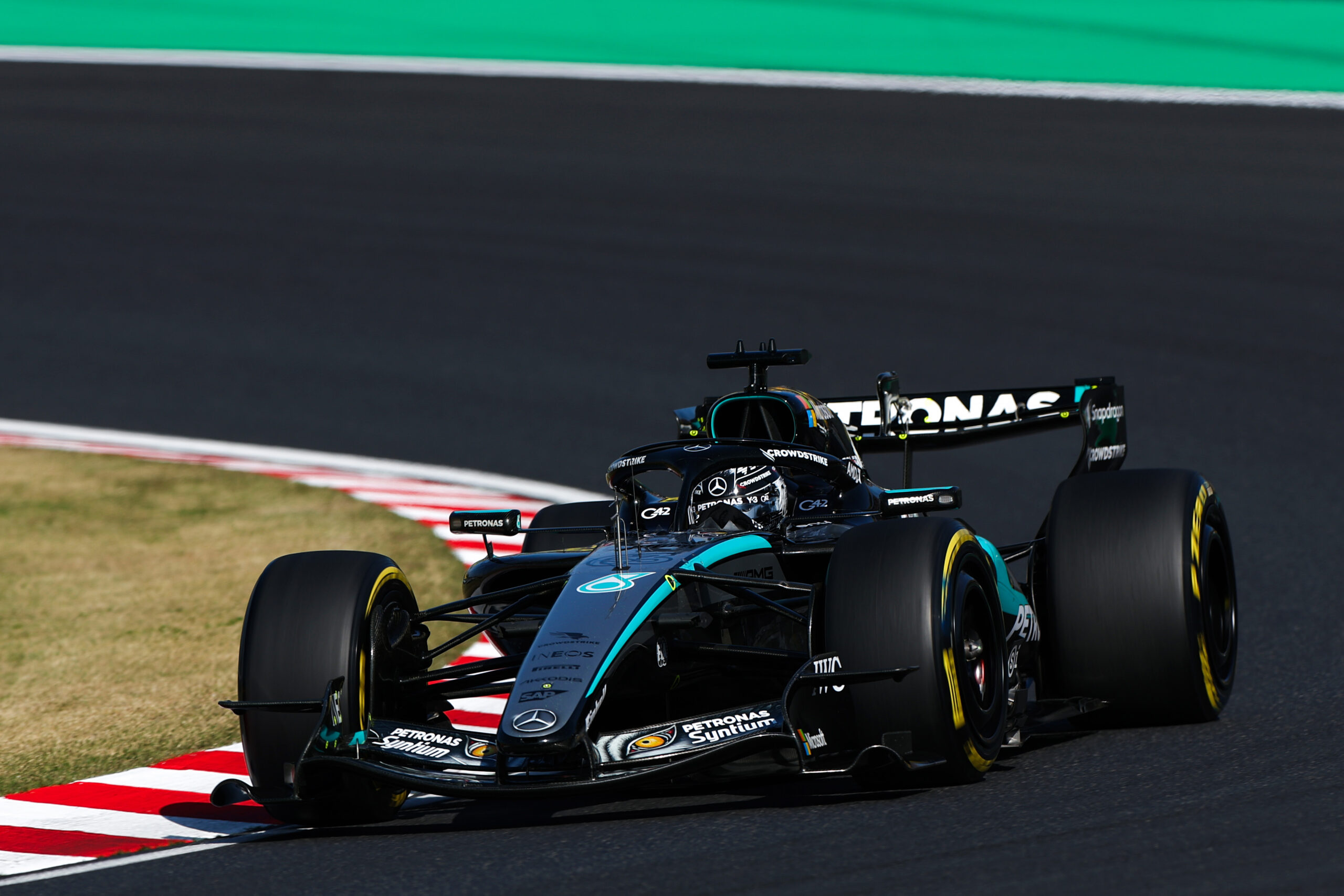
Mercedes showed steady promise across Friday’s running at the 2026 F1 Japanese GP, with George Russell leading the team’s charge and Kimi Antonelli continuing his upward trajectory.
Russell ran with confidence from the outset, delivering consistent pace and positioning himself among the front-runners in both sessions. Antonelli built into the day, steadily improving his lap times. As his confidence grew, he closed the gap to his teammate. Mercedes may not have been dominant, but they looked composed and competitive—firmly in the fight at the front heading into the rest of the weekend.
Encouraging progress, but work remains for Mercedes at Suzuka
Antonelli described the day as productive, but far from complete. Mercedes worked through its full programme, collecting valuable data across all tyre compounds and building a solid foundation. Even so, he admitted there’s still ground to cover. Rivals, most notably McLaren, showed strong pace, keeping the pressure on.
Inconsistent wind conditions made things tricky, while keeping the tyres in the optimal window proved challenging. That, in turn, made it harder to extract clean laps and highlighted areas where the car’s balance still needs improvement. With overtaking traditionally limited at Suzuka, Antonelli underlined the importance of overnight progress to ensure Mercedes F1 remains firmly in contention for pole at the 2026 Japanese GP.
“We’ve had a decent Friday here at Suzuka. We got through our full programme and managed to gather data across all three compounds. Whilst we’re pleased with what we’ve accomplished, we’ve got work to do. McLaren in particular have looked very quick, and several other cars are not too far away either.
“The W17 feels good but with changeable wind conditions and cooler tyres, it’s been tricky to put our laps together. Improving the overall balance is therefore an objective overnight and, if we can do so, then hopefully we can make sure we’re in the fight for pole position on Saturday. That could be key given the difficulty we usually face in overtaking here. Let’s see what we can do tomorrow.”
Positive direction maintained as Russell reflects on Friday running
Russell, meanwhile, remained largely encouraged despite a small issue affecting his performance. A problem with energy deployment out of the final corner cost him a few tenths in F1 Japanese GP FP2, though he downplayed its significance and expected a straightforward fix ahead of qualifying.
He also supported the team’s adjustment to the energy settings, describing the shift as the correct call in improving overall drivability, even if it came at a slight cost to lap time. Russell suggested there may still be room to refine the approach further, but overall felt the changes helped create a more manageable balance, particularly through the high-speed sections of the lap.
“The deployment issue out of the last corner probably cost me two to three tenths and I think it’s pretty easy to rectify for tomorrow so I’m not too concerned about that. The nine megajoules to the eight megajoule change was 100% the right decision. Arguably, we could have gone even further. It would have reduced the lap times a little bit, maybe in the order of one second a lap but having this really high peak top speed and then derating and clipping down to quite a slow speed into the first corner as an example would be less extreme, so I think we can afford to drop it but generally it was the right decision to change.”
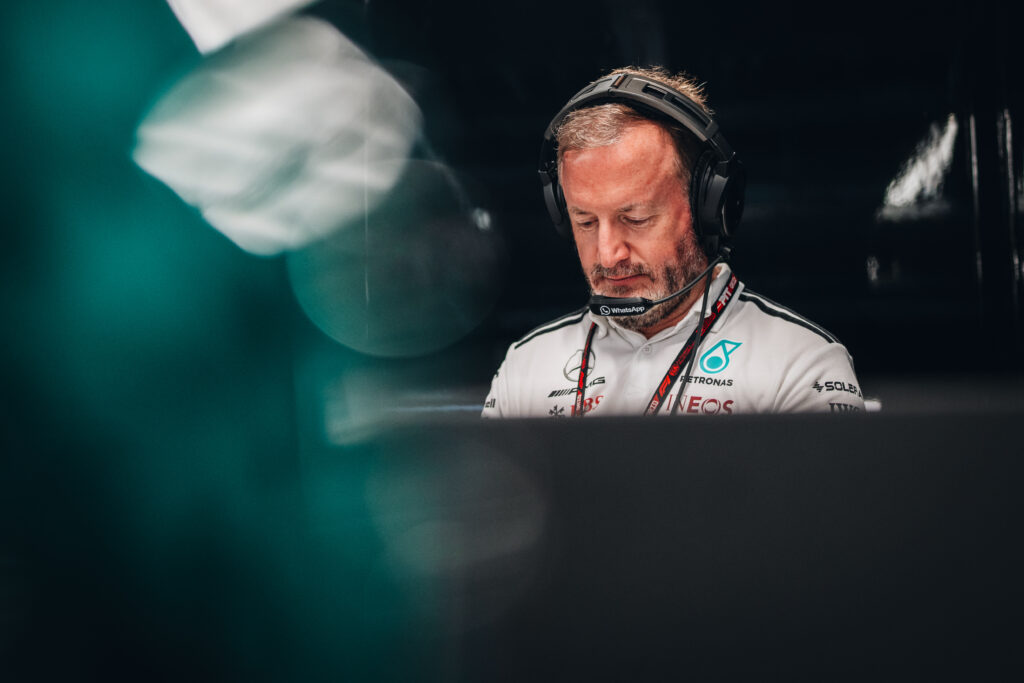
Productive running lays groundwork as Mercedes refine key systems at 2026 F1 Japanese GP
Speaking after the session, Bradley Lord described the day as productive, with the team successfully completing its planned programme while addressing key areas of concern. A particular focus lay on improving the reliability of the front wing system, which appeared to function more consistently than in previous rounds.
He added that the late adjustment to energy management had integrated smoothly, aided by prior simulator work, allowing both drivers to adapt without disruption. While further refinements remain necessary, the overall changes were handled efficiently, giving Mercedes F1 a stable platform to build on heading into the rest of the weekend.
“Yeah, good day, got through the programme. I think one of the big focusses for us was the reliability improvements on the front wing, to make sure that was operating as intended, returning from straight mode to corner mode. And that all seems to be better under control than it was in China, which is positive.
“On the energy management, I mean, it was relatively transparent as a change. It came through late, but we’d obviously been able to work on the simulator back at base, and the drivers both had a good idea of what that would do. And so there’s still fine-tuning to be done, still improvements to find, but overall, yeah, I think that was pretty transparent.”
Overnight refinements planned after energy management setbacks
Lord also addressed the deployment difficulties that affected Russell during the session, linking them to the complexities of energy management across a full lap at Suzuka. He explained that the team had already been pushing towards an optimal configuration for peak qualifying conditions, which introduced certain trade-offs earlier in the weekend.
Differences in driving approach through Spoon Curve led Russell to reach the energy harvesting limit sooner than his teammate, ultimately compromising his run onto the main straight. The team identified the issue clearly and expected to refine the approach overnight ahead of Saturday.
“Yeah, well, you’re trying to work out with the energy management what it’s going to be like for sort of those final laps in Q3, when you’re absolutely at what’s likely to be peak grip at the weekend. So that sometimes introduces some compromises earlier in the weekend as well.
“And as you say, one of those was just the driving style through Spoon, meaning that George was hitting the maximum energy harvest limit earlier in the lap than Kimi, and that was then costing him out of the final corner. But that’s something that will be looked at overnight and will come together for tomorrow.”
Changing winds and balance issues challenge Mercedes at 2026 F1 Japanese GP
Lord noted that changing wind conditions played a significant role in the drivers’ balance struggles across both sessions. A shift in direction during FP1 unsettled the car through Suzuka’s high-speed sections, while FP2 still exposed areas for improvement. He explained that it remained easy to push the front tyres beyond their limit, leading to a loss of grip that proved costly over a lap. Overnight work would therefore centre on achieving a more neutral balance, allowing both drivers to manage tyre wear effectively while maintaining confidence on both short and long runs.
“Yeah, I think the wind direction shifted during FP1, so there was more of a tailwind through the Esses and then into Spoon as well, which brought a few people out in FP1. In FP2, again, there’s still improvements to be found. It’s quite easy to overload the front axle here and end up with the car washing out in the high-speed corners, and that costs you a lot of lap time.
“So that’s something we need to look at overnight, to try and just get a nice neutral balance for both drivers so that we’re looking after the tyres, but they’re also really able to lean on the car in the long run in a single lap.”