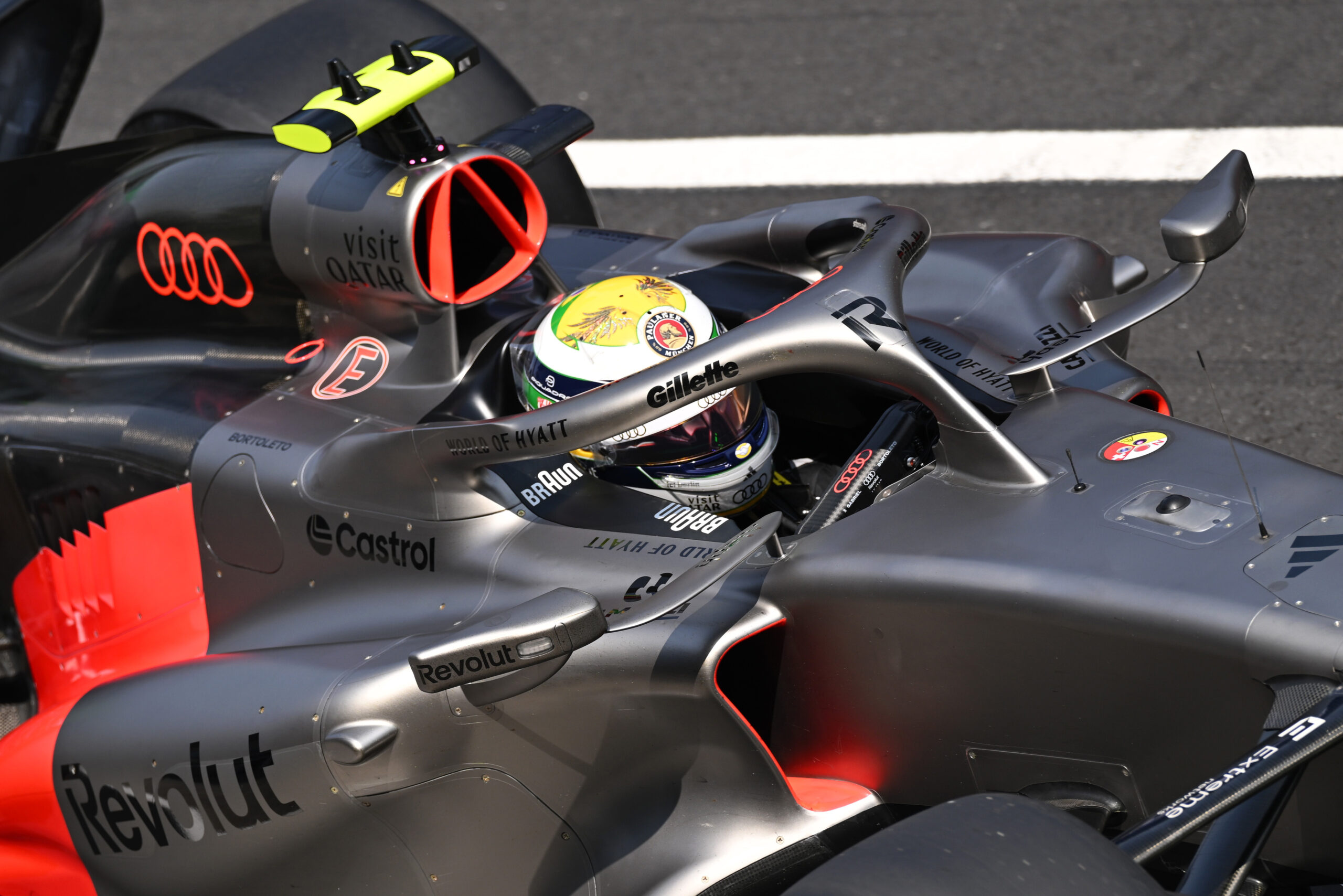
Gabriel Bortoleto secured a P9 finish in Qualifying for the F1 2026 Japanese GP. With a strong lap, the Brazilian delivered a good performance and a solid starting point for Sunday’s race.
Bortoleto believed a better position was possible in F1 2026 Japanese Qualifying
While he finished 1.4 seconds behind pole sitter Kimi Antonelli, he still qualified ahead of Audi teammate Nico Hülkenberg, who finished P13. The young driver’s season has had its ups and downs, as he scored points in Australia but retired in China. This weekend, Bortoleto aims to fight for points.
In the written media pen, the Audi driver explained he thought a better position was possible as he lost almost 0.3s to his middle segment benchmark.
“Yeah, indeed. I thought after I got to Q3 that maybe that [P7] was possible. It just didn’t really click in Q3. In Q2, I just felt great with the car, with my balance, with my driving. In Q3, I feel like there were some improvements, but I didn’t get the improvement that I should probably to step up the level in Q3. Also, there is a few things we need to fine-tune as well.
“That with all this energy as well, going faster through the corners, you need to compensate this somehow. So, it’s not easy. We are working on that. I’m working on my driving as well to help to fix these things, but I think today what we have done is a great job. I think the whole team should be proud. Putting a car in P9 and the other one is quite close, it’s P12 [P13], it’s there fighting for points tomorrow.”
Gabriel Bortoleto’s qualifying form has been brilliant almost instantly since his F1 debut last season. With one year of experience under his belt, his form is expected to continue improving.
Audi and Bortoleto continue to impress in F1
When asked how encouraging it is to come to a track where getting energy management right is complicated, when the team is good, Bortoleto was positive. The driver explained that Audi has quickly handled every hurdle thrown their way. As the gaps between the midfielders are narrow, Audi continues to progress.
“It’s encouraging because I see how much the team progresses. I think it’s just incredible how Audi has been able to have a problem and fix them so quickly. I’m not even saying this because obviously, it’s my team and I’m proud of them, but I think everyone is impressed by out team. At least, this is what I hear outside and I can see that in the inside. It looks like sometimes a mess that everyone is rushing to fix problems, but when we put the car on track, most of the things I request, it’s there. So, again, a lot of work still to be done, but I think we are in the right direction.”
Understanding energy management as the midfield gets closer
As the new regulations took effect with the 2026 season, energy management has become a new hurdle to understand. When asked if it’s been more confusing to understand the deployment challenges at Suzuka than even Australia, Bortoleto explained that the team is learning more and more.
“I think it’s different. Australia was the first time, so I think there was a lot of changes in shifts of deployment. This weekend was complex on the details. So, I think we are starting to get to the moment that we are fighting for the details that the midfield is also getting closer and closer. So, the team that is able to go to Q3 faster in the corners and still save the energy is the team that is able also to make the difference. I think for us, it’s not easy. We have only two cars that are running our power unit and we need to learn everything from two cars. So far, I think we achieved a lot with only two cars running the power unit and learning every session.”
As the Brazilian mentioned, Audi has only two cars running their power units. With Ferrari, Red Bull, and Mercedes, the teams have customer teams using the same power unit. Giving those teams the option of more comparison, while Audi only has themselves to rely on.
The difference for Bortoleto between F1 in 2025 and 2026 at the Japanese GP
Asked about his impression of the challenge of the two Q3 corners, the Audi driver explained:
“It is still extremely enjoyable, I would say. I can feel like when I’m doing the high-speed corners and when I get out of that session, like I start to breathe even better. It is still incredible how quick we go through the corners and how precise you need to be. Also the way I like my car, it’s normally quite on the limit. So, you need to be extremely precise, especially in a Q2 or Q3 lap, to not make a mistake and put a great lap out there.”
When asked if there is any part of the track that is especially different compared to last year in terms of how you approach it, Bortoleto said:
“I mean, everywhere because of the energy right? So, you are coming maybe in some places much slower. Let’s say the concept of the corners are very similar.”
As the Suzuka track can be immensely difficult to handle, understanding energy management becomes another step for the drivers to tackle. While Bortoleto had a strong performance in Qualifying, he will need to fight for points in the 2026 F1 Japanese GP.