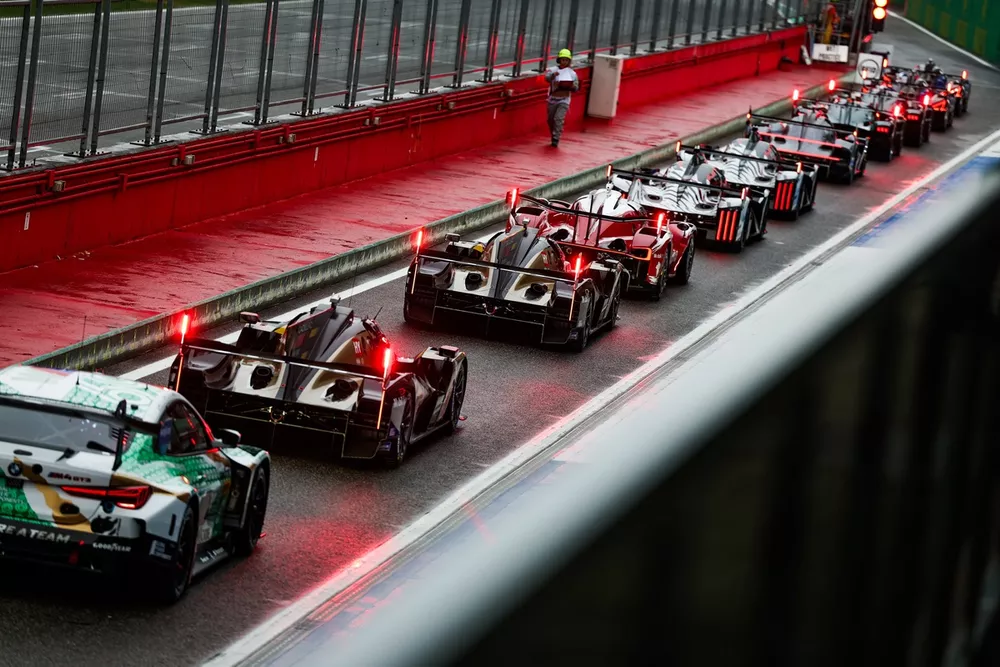
As reported by Motorsport.com, starting in 2026, the FIA and ACO will no longer publish the Balance of Performance (BoP) tables for the World Endurance Championship (WEC) and the 24 Hours of Le Mans. This decision was revealed during a media briefing at Imola, ahead of the season-opening 6 Hours of Imola. The change is designed to curb speculation and misinterpretation of the performance balancing process, which has been a key feature of WEC for several years.
Bruno Famin, who recently joined the ACO, and Marek Nawarecki, FIA circuit sport director, explained that the decision was made to avoid any misunderstandings among the public and media regarding the complexities of the BoP system.
The purpose of BoP in WEC
The primary aim of BoP in WEC is to ensure that different car concepts, despite their variations in technical specifications, can compete fairly and at similar performance levels. By regulating factors such as aerodynamics, weight, centre of gravity, fuel consumption, and drivetrain, BoP allows a diverse range of manufacturers to compete without excessive costs or development risks.
Initially, the homologation process defines each car’s technical parameters, but these are then refined through on-track assessments. However, with teams using the BoP during testing, the exact details — such as weight, power, and energy allocation — will now be kept confidential.
Famin clarified the reasoning behind this change, saying:
“We want to avoid any misunderstanding, because it is difficult to explain to the public the details and differences applied to each car and its characteristics.”
“The initial balancing is done during homologation, then we go to the track and assess the real performance of the car, fuel and tyre consumption, the quality of the drivers and so on. But drivers are also very good at managing situations, so the variables multiply.”
Famin pointed out that BoP is just one small element of the final result, with numerous other factors contributing to race outcomes.
“BoP is only a very small part of the final result. We also have to consider setup, strategy and specific race situations. There are many factors that influence performance, and not all of them are within our control.”
“Results are also a product of driver ability, merit and the quality of the team’s work. What we can do through the regulations is ensure this is applied equally to everyone, while avoiding the kind of spending seen in the LMP1 era.”
Why WEC BoP data will no longer be public
The decision to keep BoP data hidden has been driven by the difficulty of communicating the intricacies of performance balancing to the public. Nawarecki expanded on this point, noting that there are numerous variables involved in assessing performance, from track-specific factors to driving styles.
He said: “We have to ‘clean’ the data to analyse it properly, based on the parameters Bruno mentioned. Every track is different, every driver approaches each sector differently – using kerbs more or less, managing tyre wear, slipstreaming on the straights, and so on.”
Nawarecki stressed that, ultimately, the issue is not the lap time itself, but rather how that lap time is achieved. He said, “In the end, the issue is not lap time itself, but how it is achieved. If we tell the public that one car has 20kg more or less, it can lead to incorrect interpretations.”
He further explained that the public does not have access to the homologation parameters or the data gathered by the teams, which makes it impossible to fully understand the rationale behind the decisions made.
“That’s because the public doesn’t have access to the homologation parameters or the data we collect, so it cannot fully understand the decisions being made.”
As a result, the BoP data will now be available only to teams, who can better understand the context of the performance adjustments through their in-depth knowledge of each car’s specifications and the real-world data collected during testing and racing.
No success handicap for Hypercars in 2026
Along with the BoP changes, another significant topic discussed during the briefing was the potential introduction of a Success Handicap in the Hypercar class. This concept had previously appeared in draft 2026 regulations, but it has since been dropped.
Nawarecki explained that with the introduction of BoP, there was no need for additional variables like a Success Handicap. He also noted the shorter WEC calendar — only eight races in 2026 — which could lead to competitors holding back if too many performance limitations were added.
He said: “We already have enough variables with BoP, so we decided not to introduce more. With only eight races, there is a risk that competitors would start to hold back, and we want everyone to push at the limit at all times.”
Nawarecki highlighted that the concept of Success Handicaps had been successfully implemented in series like the World Touring Car Championship (WTCC), where a larger number of races allowed for more flexibility in managing performance over the season.
He explained: “It existed in WTCC, but there were 16 races, so managing results was part of the game. Here, it doesn’t make sense.”
The shorter calendar makes it essential for BoP to be adaptable to each specific event, rather than applying a set of fixed performance parameters across the entire season.
Adapting BoP to each event
Given the diverse nature of the WEC calendar, Famin explained that it would be difficult to apply a consistent, season-long BoP. Instead, adjustments will be made as necessary, depending on each event’s characteristics.
He said: “With only eight events, it’s difficult to apply a season-long BoP. If we had 20 races, that might be possible. But given how different each circuit is, it makes more sense to adapt the BoP for each event.”
Famin also confirmed that there would be no changes to BoP once a race weekend had started. Adjustments might be made before events if specific tests are carried out — for example, in the case of the 24 Hours of Le Mans, where dedicated pre-race testing could provide useful insights.
He added: “At most, adjustments could be made before an event if there are dedicated tests, such as for Le Mans. But for the 24 Hours, it’s too early to say anything. We will wait and see how the first two races go.”
Famin further clarified that the goal is to avoid creating any unnecessary uncertainty or suspicion about BoP, particularly as the season opens. He stated:
“Again, we want to avoid speculation and any risk of teams holding back at Imola or Spa, or thinking that we might be hiding something for Le Mans. For now, we prefer not to comment further and will see how things evolve.”
Looking ahead to the 2026 WEC season
This shift in BoP transparency is expected to reduce speculation and give teams more freedom to focus on strategy and performance, without being distracted by public interpretations of BoP data. By controlling the flow of information, the FIA and ACO aim to create a more balanced and fair competition, allowing teams to push the boundaries of innovation and performance within a controlled, sustainable framework.
As the 2026 WEC season gets underway, all eyes will be on how these changes influence the racing landscape, with the first test of the new BoP strategy set to unfold at the 6 Hours of Imola.