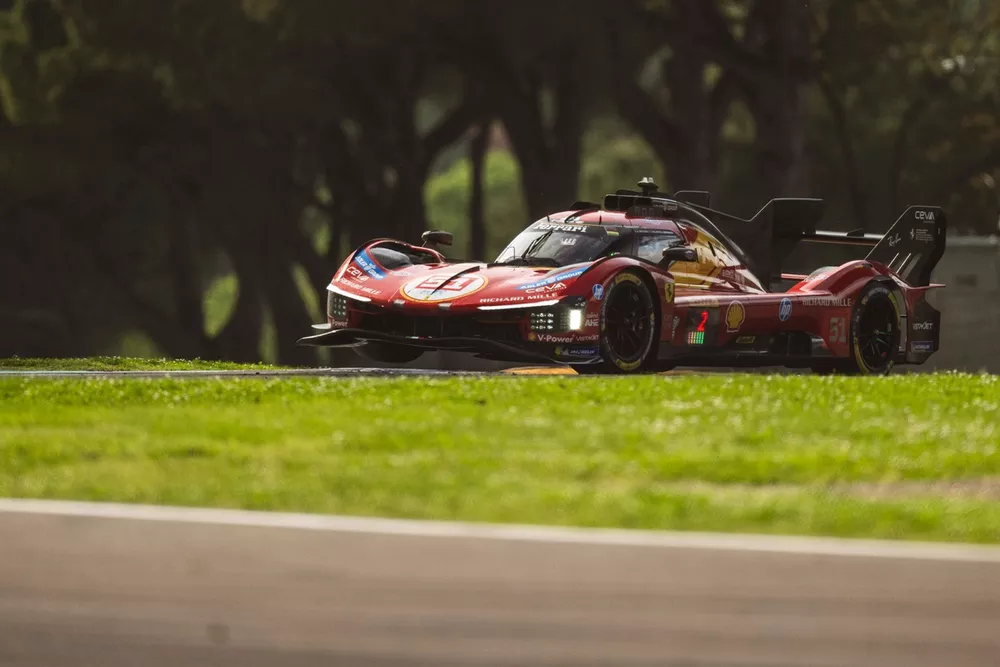
As reported by Motorsport.com, Ferrari has identified traction and tyre management as the decisive factors behind its defeat to Toyota in the opening round of the 2026 FIA World Endurance Championship (WEC) at Imola Circuit.
Although Ferrari did not arrive as the outright favourite, it quickly established itself as Toyota’s main challenger in the Hypercar class. The battle between the two marques unfolded from the very start and evolved into a contest shaped by strategy, tyre performance, and race management.
Early promise gives way to Toyota advantage as tyre advantage proves the decisive factor
Initially, Ferrari controlled the race, locking out the top two positions in the early stages. However, the momentum shifted decisively in the third hour when Toyota capitalised on strategy and track position.
While Ferrari demonstrated competitive pace in clean air, it struggled to maintain pressure in traffic. Notably, poor acceleration out of corners prevented its drivers from staying close enough to launch overtaking attempts on a circuit where passing opportunities remain scarce.
However, tyre management ultimately defined the outcome. Toyota executed an effective triple stint on a single set of tyres, gaining a clear strategic edge. Furthermore, a well-timed stop during a Virtual Safety Car period allowed Toyota to strengthen its position without losing track time.
Ferrari, by contrast, could not replicate this approach without taking excessive risks. Consequently, it found itself unable to respond once it lost track position.
Pier Guidi reflects on missed opportunity as Ferrari missed out on win at 2026 WEC 6 Hours of Imola
Despite securing pole position and finishing second, Alessandro Pier Guidi acknowledged that Ferrari had extracted the maximum possible result under the circumstances.
“I think these are good points. A second-place finish today and the point for pole position at the start of the championship is definitely positive. We know that consistency is the key to this championship,” said Alessandro Pier Guidi, who finished second in the #51 Ferrari 499P LMH he shares with James Calado and Antonio Giovinazzi.
He emphasised the importance of consistency early in the season, while also recognising the emotional weight of competing at home.
“Obviously, we wanted to win at Imola, in front of our fans – that’s undeniable. But I believe we gave it our all to do so. Maybe we weren’t unlucky, but Toyota was certainly lucky with the virtual safety car, which allowed them to change tyres for free, but that’s part of racing. These things are unpredictable.
This moment proved pivotal, as Toyota used the opportunity to gain track position and strengthen its strategy.
“I don’t think we could have done better. Then, when you’re behind on this track, with our car’s lack of acceleration preventing us from staying close to the Toyota, it was difficult, and overtaking was impossible. It’s not that we didn’t try; on the contrary: I tried for an hour and a half, and the only result was increased wear on the rear tyres.
Limited options to fight back seals Ferrari’s fate
Ferrari’s struggles in close combat became increasingly evident as the race progressed, particularly when tyre wear compounded the challenge.
“That’s because I stayed close to the Toyota for so long, then ‘Giovi’ tried it for another hour. But if we consider that he had new tyres while Toyota was on its third stint on the same set… You realise just how practically impossible it is to overtake here. I think in the end we did what we could.
Ultimately, the combination of tyre strategy and track characteristics left Ferrari with limited options to fight back.
“I’ll say it again, we lacked a bit of acceleration; I don’t think there’s anything else in particular to highlight. We need to figure out what it was, but just as people could see the situation on the screens, we saw it from the cockpit too. Under acceleration, Toyota gained several meters of an advantage, which then allowed them to defend very well at the end of the straight.”
Challenges continue for the sister car as #50 Ferrari suffers difficult Imola race at 2026 WEC opener
Meanwhile, the #50 Ferrari endured a more difficult race. A drive-through penalty for a yellow flag infringement dropped the car out of contention, leaving it to finish sixth. Antonio Fuoco pointed to similar performance limitations, particularly in wheel-to-wheel situations.
“A little rain was expected, but in the end there was very little. Aside from that, we couldn’t have hoped for it. We knew from the start of the weekend that it would be a tough race,” said Fuoco.
Despite stable conditions, Ferrari could not fully exploit its pace due to its shortcomings in acceleration.
“The most frustrating thing is not being able to compete in acceleration with our main rivals; we couldn’t overtake, and there were few overtakes during the race, so that’s a shame.
This lack of overtaking opportunities further highlighted the importance of tyre performance and straight-line speed.
“The hard thing to understand – even though it’s really not hard at all – is how one of our rivals [Toyota] had absolutely no tyre degradation. They did three stints on one set of tires. So it’s pretty clear what the factor is.
Toyota’s ability to maintain tyre performance over extended stints continued to stand out as a decisive advantage.
“Acceleration was the problem. Once you lose those 20 meters, you can’t make them up. On our end, we were very happy with the balance; especially on a clear track, we showed we had good pace when pushing to the limit. But when we got close to a car, we couldn’t stay in its slipstream during acceleration, and at that point, it’s impossible to overtake. We would have had to go even further than necessary to pass: maybe it works out, but if it goes wrong, you get zero points.”
Team management acknowledges Toyota’s edge
Ferrari team manager Giuliano Salvi admitted that Toyota executed a superior race strategy, particularly in tyre and fuel management. This efficiency allowed Toyota to extend stints and maintain track position during critical phases of the race.
“In the race, Toyota, in the long run, proved better at managing fuel consumption when we were on equal footing,” he admitted. “We need to analyse what happened, but it must also be said that they were much better at pulling off the triple stint on the same tyres. At one point, they even seized the opportunity to pit during the Virtual Safety Car. It was a winning gamble, so kudos to them. When you find yourself behind, you try to do the opposite to gain position. Finding themselves in front after the VSC, they then had a clear track to control the situation.
Ferrari considered similar strategies but ultimately opted against taking early risks while leading.
“We had also considered doing the triple stint, but at the start we didn’t need to take any risks because we were in the lead, whereas they did it while trailing. We gave it our all, but we knew Toyota would be superior.”
Ultimately, Ferrari leaves the 2026 WEC 6 Hours of Imola with valuable points but also clear areas to address. While its pace remains competitive, improving acceleration and tyre management will prove crucial in future rounds. Thus, as the championship progresses, Ferrari must translate these lessons into performance gains if it hopes to challenge Toyota consistently for overall honours.