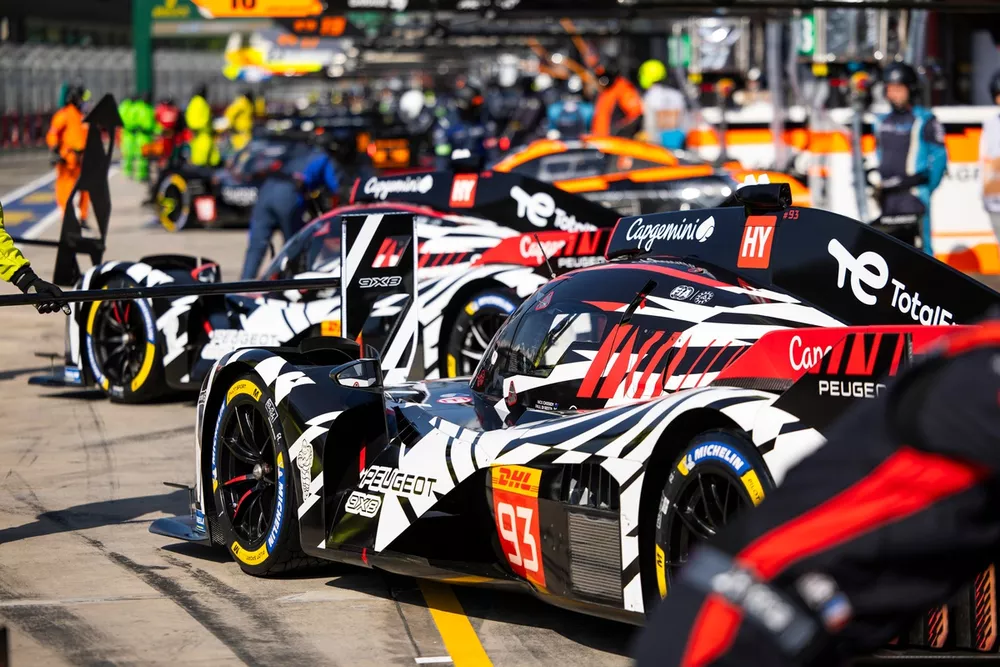
As reported by Motorsport.com, Peugeot has confirmed plans to reignite its ambitions in the FIA World Endurance Championship (WEC) by developing a new Hypercar to compete through to 2029.
Although the manufacturer returned to top-level endurance racing with high expectations, its current Peugeot 9X8 has struggled to consistently match its rivals. Consequently, questions emerged about its long-term future in the championship. However, Peugeot now appears firmly committed to turning its fortunes around.
New homologation strategy takes shape
Rather than building an entirely new car from scratch, Peugeot will adopt a revised homologation strategy. This approach will allow the team to retain proven elements of its current package while addressing its weaknesses.
Peugeot CEO, Alain Favey outlined the plan clearly, saying, “The rule change will take place in 2030, but our priority was to have certainty for the next three years, and this has been granted to us. We want to stay until the end of 2029, and to be competitive we must work on developing the current car.
“The plan is this: it will involve a new homologation that will enable us to be more competitive. We’ll start with the current car we’re familiar with, so it won’t be completely new, but we’ve used up all the Joker Evo options available for the 9X8, so we’ll have to homologate a car from scratch.”
Peugeot will now focus on preparing the updated car for a projected debut in 2027. To achieve this, the team will implement an extensive testing programme over the coming months.
“We are working on it and I am very confident that we can achieve a good result. I don’t know when we’ll be out on track for testing, but clearly, to be ready in time for 2027, we’ll need to schedule test sessions over the coming months.”
At the same time, Peugeot continues discussions with the FIA and the Automobile Club de l’Ouest regarding future regulations. These talks aim to move towards greater technical convergence between LMH and LMDh platforms.
Stability fuels long-term commitment
Importantly, regulatory stability through to 2029 has played a key role in Peugeot’s renewed commitment. With a clear framework in place, the company can now invest with greater confidence.
“The important thing for us was to have a three-year plan based on stable rules, before the regulations change, and I can say that it’s worth investing. We’ll assess what happens next from a strategic perspective.’
Favey also defined the team’s competitive targets, stating, “Our focus will be on 2027–2028–2029; the future will also depend on the car’s performance during those years. Our ambition is to be consistently in the top four; should that not happen, we will see if and how to proceed.
Heritage and Le Mans at the core of developments for the WEC Peugeot Hypercar
Peugeot’s strategy also reflects its deep-rooted connection to endurance racing, particularly the iconic 24 Hours of Le Mans. As the brand marks 100 years since its first participation, it remains determined to build a lasting legacy.
“It is important for a brand to have a history, and Peugeot does not want to be the one constantly entering and leaving various championships. This is the centenary year of our first participation at Le Mans, an important milestone that also lends credibility to the brand.
He acknowledged both the challenges and aspirations ahead, emphsising the significance of Le Mans above all else.
“Right now we are writing a story, with both positive and negative chapters; we would like to achieve a happy ending, and this can be achieved with a good performance throughout the championship and at Le Mans, but we will assess the situation at the end of 2029.
“For Peugeot, the 24 Hours of Le Mans is undoubtedly more important than the world championship, in which we nevertheless compete with commitment. But in France, that race is a huge celebration and therefore takes on a special significance.”
Ultimately, Peugeot’s renewed plan signals a clear intent to remain a serious contender in endurance racing. By combining technical evolution with long-term stability, the manufacturer aims to close the gap to its rivals.
If successful, this next phase could transform Peugeot’s recent struggles into a sustained challenge at the front of the grid — and potentially deliver the success it has long targeted at Le Mans.