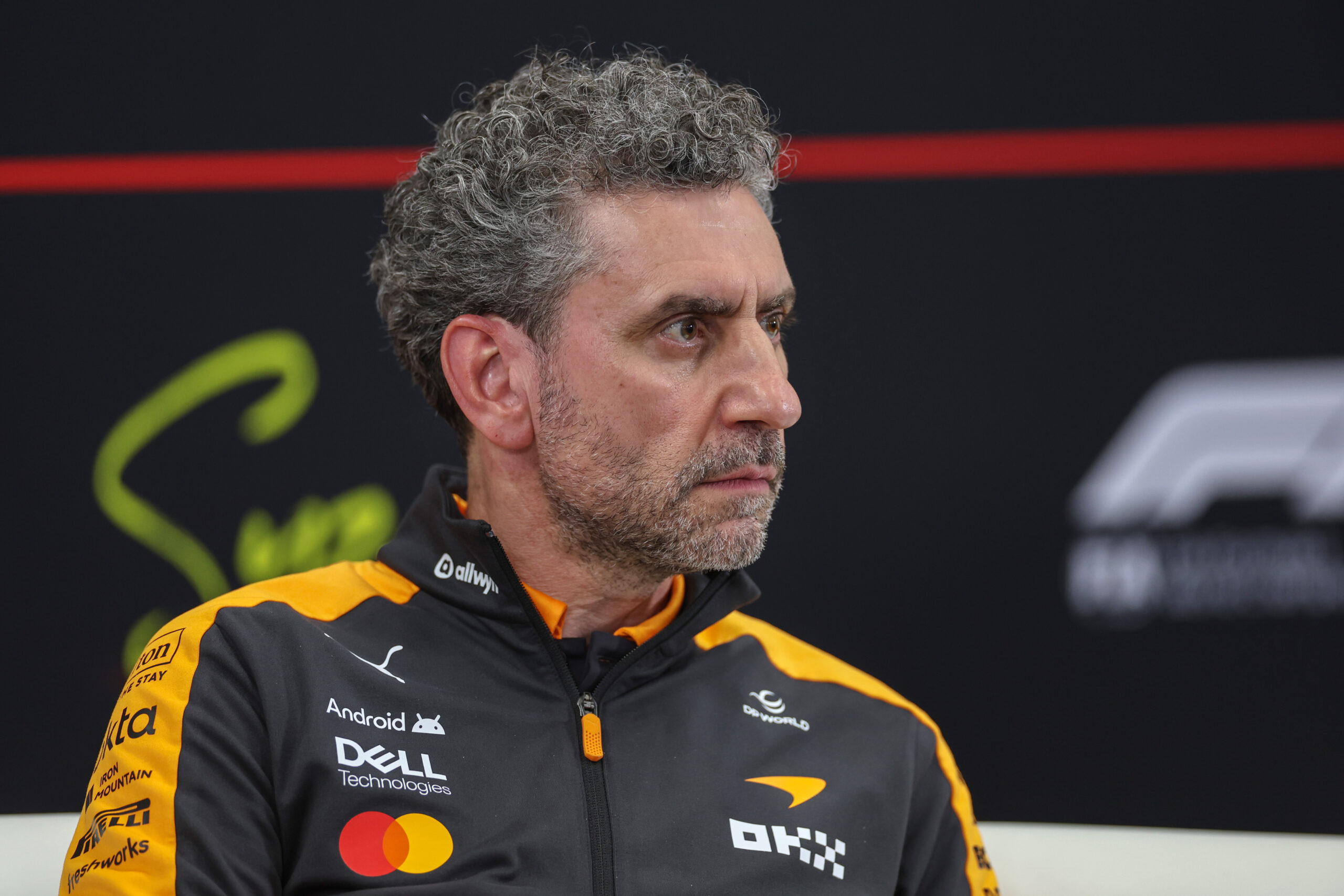
During a media session in Woking, McLaren technical director – performance, Mark Temple, and team principal, Andrea Stella, commented on the most recent changes to the 2026 F1 regulations.
Earlier this week, Formula 1 and the FIA agreed on changes to the 2026 regulations, which will take effect at the upcoming Miami Grand Prix. Safety concerns and criticisms prompted the changes after the initial rounds of the 2026 F1 season. One key point of criticism of the 2026 F1 regulations was the energy management system, which prevented drivers from going flat out without risking running out of energy.
Temple says certain “aspects” of PU energy management will remain
When asked about the level of counterintuitive driving expected after the 2026 F1 regulations change, McLaren’s technical director for performance, Mark Temple, indicated that some aspects of power unit energy management will remain unchanged.
“I think there are still some aspects of driving with the new PUs which will remain. Because it is still an energy style, perhaps too strong a word, but a formula where you want to use the energy that you have in the most efficient places. Which is slightly different to previous years where you could disregard it and just, in a way, not worry about the power unit and the energy available.”
Given that energy management was not a big factor under the previous F1 regulations, Temple notes that managing fuel was a factor then, perhaps even to a greater extent than the energy management introduced with the 2026 F1 regulations.
“That said, we have had in the previous set of regulations situations where fuel management was a very significant part of how you drove the car and how you raced, to a greater degree in some cases than we’ve seen with the electrical energy management. So it’s just that in the last couple of years of regulations, the fuel management wasn’t a big factor. It was still a small factor in racing.”
The goal should be to eliminate “more abstract” aspects of the 2026 F1 regulations
While certain “aspects” will continue in the amended 2026 F1 regulations, Temple feels the goal should be to remove the “more abstract” side effects, such as drivers having to lift and coast or wait to recover power.
“So yes, there are still some aspects that remain, but the more abstract ones, like this kind of lifting off, being inefficient and wanting to come back on power, some of those things that were particularly counterintuitive I think should be eliminated, or at least the aim is to eliminate as many of those as we can. As I said earlier, there may be some things that we haven’t anticipated that we’ll need to review and then revisit.”
Stella believes that “adjustments” to the F1 regulations are crucial for improvements
When asked if there were discussions about letting teams manage their engines freely before amending the 2026 F1 regulations, McLaren team principal Andrea Stella stated:
“I think if the FIA left you entirely free to use the power unit, or within the regulations that we have had for the first three races, the reality is that teams would use this to make the car as fast as possible in terms of lap time.”
Stella argues that keeping the 2026 F1 regulations unchanged would not have resolved issues, such as drivers being unable to drive “flat out” during qualifying or the problems with speed differentials. He emphasizes that these changes were essential to enhance the driving experience.
“And lap time doesn’t necessarily would take, with this sort of objective, some aspects of natural driving, or driving flat out in qualifying, or not having a very high differential of speed while two cars are racing in the race.
“So I think these adjustments are required to make sure that teams operate the power unit in a way that improves some of these objectives, driving flat out, reducing the speed differential in the race.”
Stella confirms talks about “hardware” improvement already underway
The amendments to the 2026 F1 regulations agreed to earlier this week are only a first step. However, Stella points out that “more substantial improvement” to the F1 regulations would require the teams to introduce changes to the “hardware” either on the side of the battery or combustion engine. Implementing these changes will take time and cannot happen overnight. However, Stella confirms that they are already discussing potential modifications to regulations that could impact the “hardware.”
“I think in order to have a more substantial improvement, whereby we reduce some of the, for instance, shortage from an energy point of view, or the fact that in high-speed corners sometimes you don’t have much deceleration between the braking point and the mid-corner speed, there may be some need to act on the hardware.
“But once you act on the hardware from a battery capacity point of view, for instance, or in terms of the ICE accepting more fuel flow, then this requires more time than from one race to the other, and possibly more time even than from one season to the other.
“There’s certainly conversations already happening as to how the hardware can be more fundamentally improved such that the regulations allow more margin to fulfill the various objectives which are required for the spectacle and entertainment. But also for making sure that the drivers can drive in a traditional sense of pushing the car to the limit.”