For Frédéric Bertrand, the conversation around Mahindra Racing’s Season 12 keeps returning to a single word: consistency. With his team sitting third in the Teams’ Championship and Edoardo Mortara holding second in the Drivers’ standings, the Mahindra boss arrived in, keen to keep ambitions grounded and the points flowing.
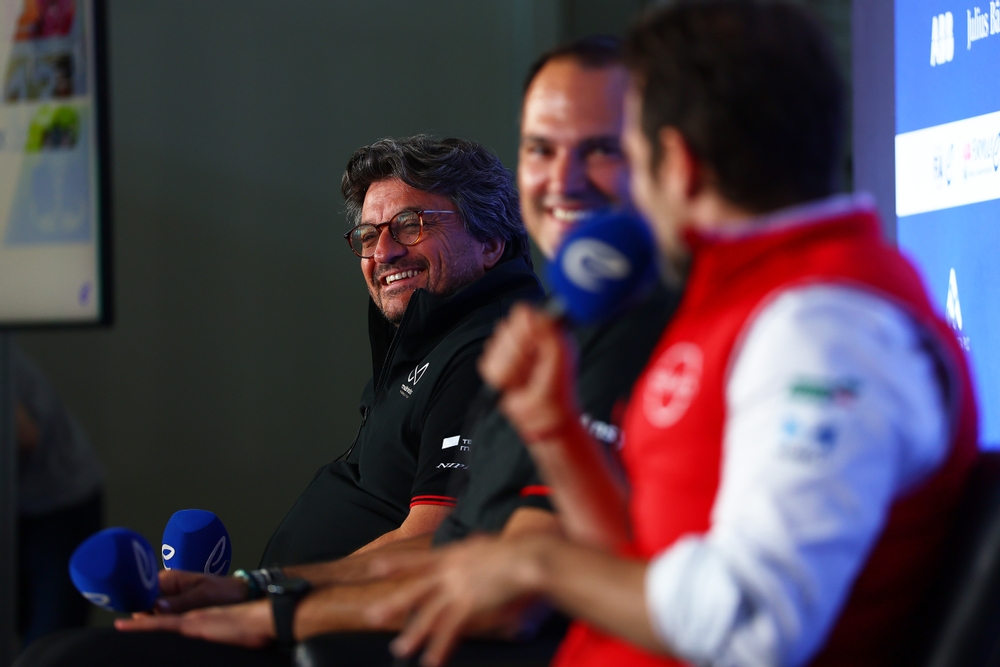
Speaking to the media, including Pit Debrief, in the press conference ahead of the Berlin E-Prix, Bertrand reflected on Mortara’s standout campaign so far, the steps the team is taking to bring Nyck de Vries up to the same level, and the strategic complexity that makes Tempelhof’s double-header such a fascinating test.
Consistency over victories for Mortara
Mortara currently sits second in the Drivers’ Championship, having scored points with relentless regularity since the season opener. He remains, however, the only driver inside the top five yet to register a race win this year. Asked how important converting that pace into victories would become, Bertrand kept his focus on the bigger picture.
“I think first of all we are very happy with the job Edo [Mortara] is doing since the beginning, very consistent, fast in quali and good to bring good points after the races,” said Bertrand ahead of the first Berlin E-Prix practice session. “So I would say winning is the cherry on the cake but at the moment target is consistent points scoring at each race for the two drivers and that’s probably where we need to improve and then if we win for sure we will be happy and I think India will be very happy to hear the national anthem but on our side consistency in scoring point is the target.”
Lifting de Vries to the same level
The Mahindra garage tells two slightly different stories so far in 2025/26, with Mortara’s points haul considerably outstripping that of his teammate. Bertrand was honest about why that gap exists, and he placed the responsibility firmly on the team rather than the driver.
“We just wanted to keep a bit of the suspense our way, we would be in front of those guys,” he joked, before turning serious. “No, I think seriously the job of Nyck [de Vries] is good and we need to do a good job. We gave him in too many races a car which was not reliable enough and then for sure it puts the guy under specific pressure that we didn’t want to put and we unfortunately didn’t do good enough to give him all the tools to perform at the level he can.”
The Mahindra boss is confident that the underlying speed has always been there, and that giving de Vries a reliable platform will unlock the results to match.
“So that’s the goal and we know that when he’s already in the good mood, he’s fast, he has been fast in most of the quali sessions. We just need to make sure that he has a good car for the race and he’s transforming this into good points.”
Two races, two strategic puzzles
The Berlin E-Prix double-header presents teams with markedly different challenges across the two days, with one race featuring the Pit Boost mechanic and the other leaning more heavily on energy management. Bertrand believes both demand meticulous preparation, but neither can ever be fully predicted.
“I think the two definitely are different but what is probably the excitement or the specific particularity of Formula E is to have those races where even when you have prepared a lot, you always have an extra surprise during the race that is changing a little bit the strategy again,” he explained.
“So I would say both are very demanding on how you prepare them and how you try to anticipate what could go wrong and that could create an additional strategy to deal with during the race and that’s probably what is very particular with the pit boost one because if you do a little mistake there, you maybe lose too many positions and you fight hard to recover.”
He pointed out that even a single safety car at the wrong moment can rewrite the entire afternoon, and that the rhythm of one race feeds directly into the strategic approach for the next.
“If a safety car is happening at the wrong moment, everything is changed and for the day after it depends on a lot from the rhythm. If the race is starting a little bit higher or lower than, it has a big impact on the way you will have to deal with the efficiency and the energy management.”
Praise for the engineers behind the scenes
For Bertrand, the unpredictable nature of Formula E is precisely what draws fans in, and it is also what makes the people supporting his drivers so vital to the team’s success.
“That’s probably what the people also like when they watch. You really never know what to expect except to be surprised. I love when the surprise is ending up good for Mahindra. That’s definitely what I love the most but it’s very specific to Formula E and that’s also why we speak about the high quality of our drivers but we also have to speak about the high quality of our engineers.”
He paid particular tribute to the speed and clarity with which Mahindra’s engineering team makes decisions in the heat of battle.
“They are so good on anticipating, working, reacting and then proposing the best strategy to the driver live in a very short period of time during a race of 40–45 minutes. It’s not like a six hours race.”
With Mahindra carrying genuine momentum into the Berlin E-Prix and a driver pairing capable of fighting at the front, Bertrand’s pursuit of consistency could yet deliver the kind of weekend that pushes the squad even further up the standings.