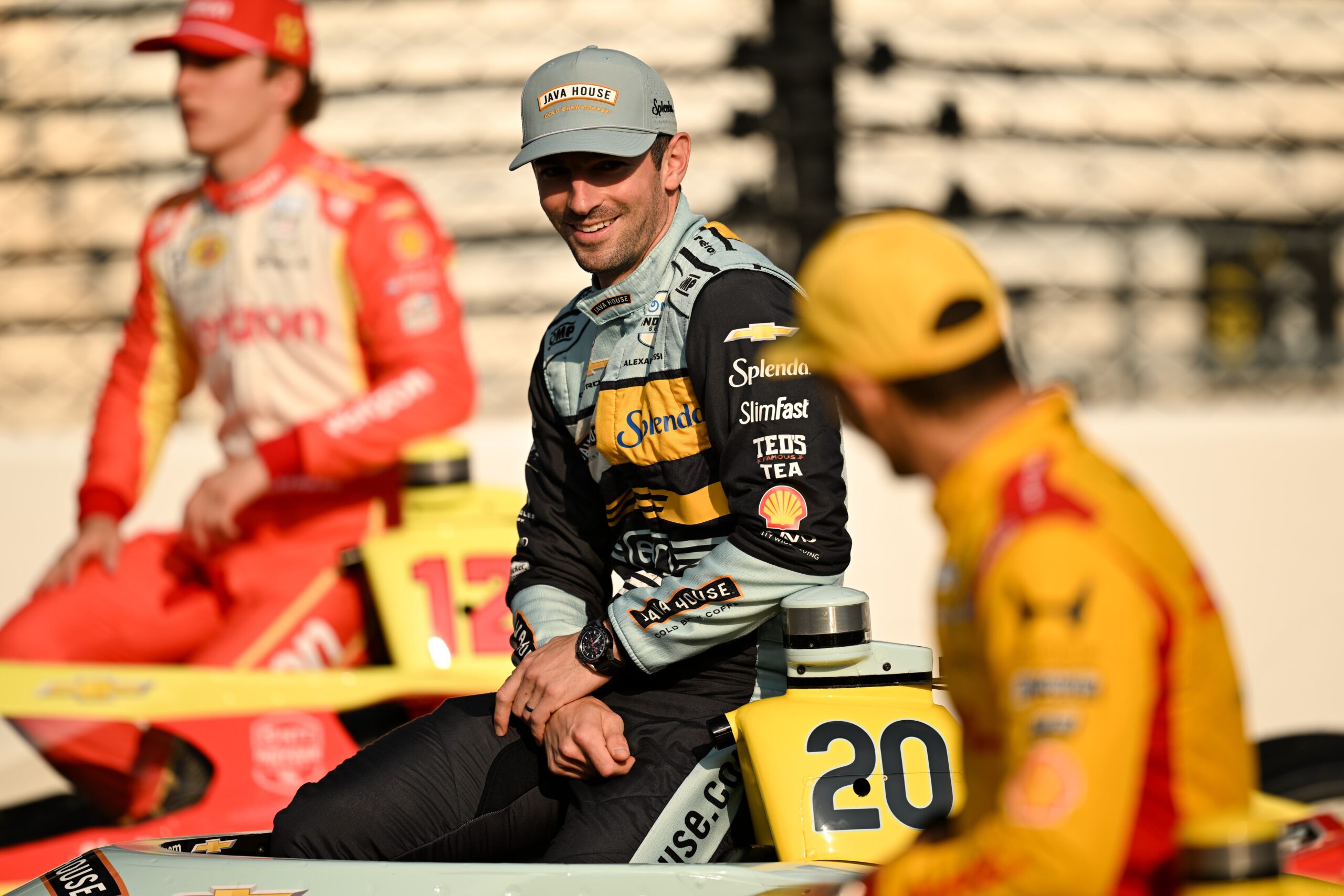
After securing a front-row start on Sunday ahead of the 110th running of the Indy 500, Ed Carpenter Racing’s Alexander Rossi experienced a nasty crash the following Monday during the practice session at the Indianapolis Motor Speedway.
The former Indy 500 winner encountered a risky moment after losing control of the No. 20 ECR Chevrolet while exiting Turn 2 — a corner notorious for such incidents. Rossi’s car crashed into the protective SAFER barrier wall, and in the process, involved Arrow McLaren driver Pato O’Ward, who spun while trying to dodge the ECR driver.
Speaking on the latest episode of his podcast, Off Track with Hinch and Rossi, alongside former driver James Hinchcliffe, Rossi detailed the bizarre reason behind the crash that left him with an injury on his right ankle and a finger on his left hand.
Rossi shares that Turn 2 remains one of IndyCar’s biggest mysteries
During the podcast, Rossi shared that Turn 2 remains a huge “mystery for everyone”, especially since all the corners on the 500-mile speedway are the same, but somehow Turn 2 always catches drivers off-guard with its precarious disposition.
The driver revealed that this weird phenomenon was a frequent topic of conversation between himself and former IndyCar driver James Hinchcliffe.
“It’s very weird that I would say, at least in my career in IndyCar, aside from starts, more than 70 percent of the incidents occur in Turn 2,” Rossi explained. “The two times I’ve had a crash at Indy is Turn 2.”
The ECR driver also referred to the infamous “bump” that drivers encounter while entering the corner, recalling how there was an entire YouTube series dedicated to removing it. However, Rossi insinuates that the issue may not be as straightforward as it seems.
“You know how there was a whole YouTube series on fixing the bump in Turn 2?” The No.20 driver asked his co-host. “So the bump ain’t it? That wasn’t the problem.”
To bring some humour to the situation, the California-native revealed that the Speedway did manage to make efforts to address bumps on the track; however, they weren’t exactly the ones he expected.
“Well, no, but like the bump that I thought they were fixing, they didn’t. So they went through that whole effort, multiple bumps and didn’t fix all of the bumps.”
Practice crash caused by slow speeds and dirty air during pack running
In what he described as the “lamest way to crash”, Rossi explained that the accident occurred during group running while drivers were fuel-saving in practice conditions that differ significantly from the actual race scenario.
“We were just in kind of group running. It’s kind of the lamest way to crash, but we were fuel-saving.”
According to the 2016 Indy 500 winner, the slower pace and repeated “checkups” in traffic ultimately created an aerodynamic situation where the car became unstable mid-corner.
“The way that the packs work in practice is everyone’s quite nice to each other because you’re trying not to hang anyone out. In a race, the cadence and the flow is a lot faster and more aggressive. This was like the second lap of it. My previous lap was a 207-mile-an-hour lap, so that goes to show how kind of big the checkups were.”
Finally, Rossi described the key factor behind the crash: the car was operating below its ideal aerodynamic window. During the practice pack, speeds dropped roughly 20 mph compared to his earlier laps, which upset the balance of the car in dirty air.
“You get to the middle of the corner and it’s very similar to when you do ROP or a refresher, the cars don’t work at that speed. I know it sounds counterintuitive, but there’s a perfect window where the cars are working well. If you go above that, you’re obviously going to have problems, and if you go below that, I guess in some situations you also have problems.”
Rossi ultimately described the incident as a crash caused by “going too slow and dirty air.” “It was about 20 miles an hour slower than I had gone through there in practice on Tuesday with the same car,” he added.
A massive advancement in IndyCar safety
The crash resulted in significant contact, including a secondary impact involving Pato O’Ward, though Rossi said the incident once again highlighted the safety advancements made in current IndyCar racing that helped ensure that both Rossi and O’Ward avoided any major injuries.
“It was one of those incidents where you’re just blown away repeatedly by the safety of IndyCar and all of the advancements that they have made, and considering, you know, some of the forces that went on in the first impact and then the secondary impact with Pato, the fact that there’s no head, shoulder, neck issues.”
Rossi confirmed the only injury sustained was a small bone issue in his ankle, though he joked about the size of the protective boot he was wearing during recovery, “The only thing that we’re dealing with is a very small bone on the inside of my ankle, which this very large club foot will come off tomorrow.”
While he shared that all of this seemed very “dramatic”, the only instruction that the ECR driver must follow is to avoid as much weight as possible on his left ankle to control the swelling and hopefully make it for Friday’s Carb Day practice session.
“This all looks very dramatic, but you basically can’t be weight-bearing for this process while they try and control the swelling. Assuming when they take that off, it’s as expected, then Carb Day. Well, I mean, it’s going to be wet. So we’ll see you on Sunday.”