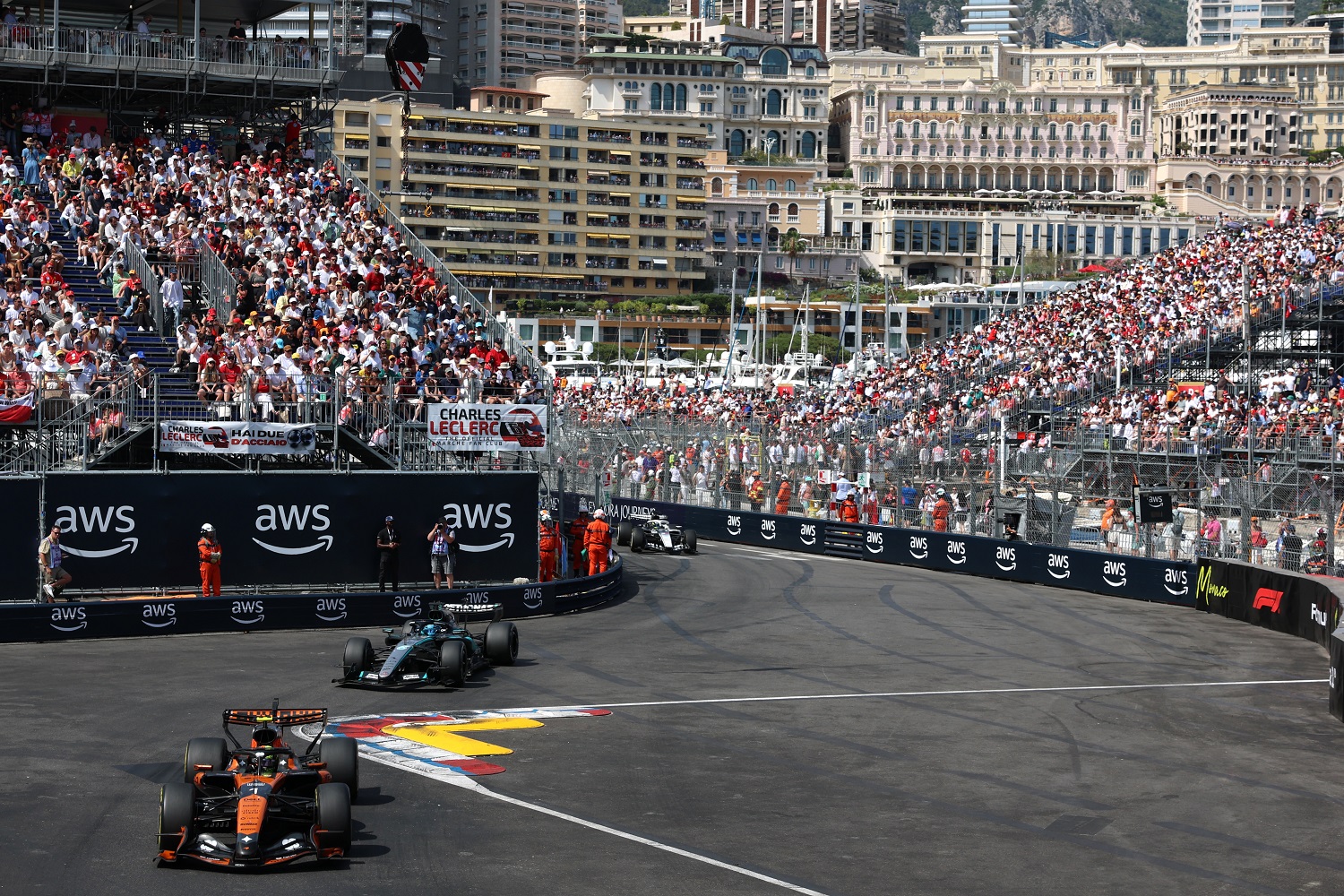
Andrea Stella is not pinning down all the McLaren reliability problems to Mercedes HPP after another setback in F1 Monaco GP, as he notes of ongoing review and discussions.
McLaren’s F1 2026 season has been derailed by reliability issues so far. They have had double DNS in China along with retirements for Lando Norris in Canada and Monaco, while Oscar Piastri has had another DNS in Australia. Additionally, they have faced issues in practice and qualifying sessions too.
In fact, Norris is on the brink of getting penalties for power unit parts after another suspected ICE issue in Monaco. Even though the Mercedes power unit has been on the quicker end, reliability problems has hurt the factory F1 team as well, especially on George Russell’s side.
Stella doesn’t blames Mercedes HPP solely
However, McLaren team boss Stella is not pinning sole blame on Mercedes HPP. He feels there have been issues on the chassis side as well, which has hurt them. He hails the relation between McLaren-Mercedes, which has secured F1 world championships in recent times.
“Well, first of all, the issues are many related to the power unit but there’s some, like the gearbox problem on Lando’s car in Canada, which are purely on the McLaren side,” said Stella in a print media session post F1 Monaco GP.
“So I just want to be totally fair to our power unit supplier, with whom we had a fantastic relationship, very successful. And still, the relationship is great. The great relationship allows us to review item by item, learn from each item and solve it technically.
“But when you don’t know what’s coming, it’s not sufficient to simply address item by item,” summed up Stella, who highlights ongoing review with Mercedes HPP as they collect more information. Since it is an all-new regulation on power unit side as well, things take time to understand and resolve.
New regs makes it lengthy process to analyse and review
“You need to review ultimately the depth and the intensity and the effectiveness of the various meetings, engagement, sharing of information, processes, both from factory to factory, track to track, track to factory, and so on,” continued Stella.
“So the review that is ongoing is, in a way, punctual in terms of each item by item. But it’s also a wider review in terms of what do we have to enhance. Because in 2026, there’s so much novelty, there’s so many new things, and we kind of have to operate at a new level of collaboration compared to what we were doing before.
“These conversations have already started for some months now. But like everything in Formula One, there’s always a lead time. It’s not like you see the effect the day after you integrate. So this is already happening, and it’s relatively wide as a conversation,” summed up Stella.
Stella says Norris’ issues in FP and race different, unrelated
When asked about Norris’ issue specifically in F1 Monaco GP, the Italian clarified that it was a new problem faced by them on Sunday. The issue that the Brit had on Friday was different to Sunday’s, which they are in the process of analysing and reviewing.
Once again he didn’t wish to put sole blame on Mercedes HPP without any conclusions. He wanted to be hesitant as he felt integration of power unit with chassis could have caused the issue as well. “So the issue was not on the battery side [in Monaco],” said Stella.
“The issue was on the internal combustion engine side, or let’s say not on the electrical. Because when you think about the internal combustion engine, actually in this generation of power units, we also have the turbocharger.
“But I would say it’s on this non-electrical side of things, while, for instance, the problem we experienced on Friday, it was more on the electrical side and the ERS part. This issue is kind of new, so we need to look more into the details as to why this happened, Landos power unit problem.
PU, chassis integration can be a problem too
“And I’m always quite respectful and hesitant, because even operating a power unit is closely linked to the fitting and the integration with the chassis. So I just want to be very careful. The problem happened to the power unit components, but the kind of responsibility or the reason, it could be the integration.
“It could have to do with the chassis side in terms of the way we operate the power unit. So we need to be cautious. It goes back to having a great relationship, but also a way of working together such that we can forward think and anticipate issues rather than only being in a responsive position,” summed up Stella.