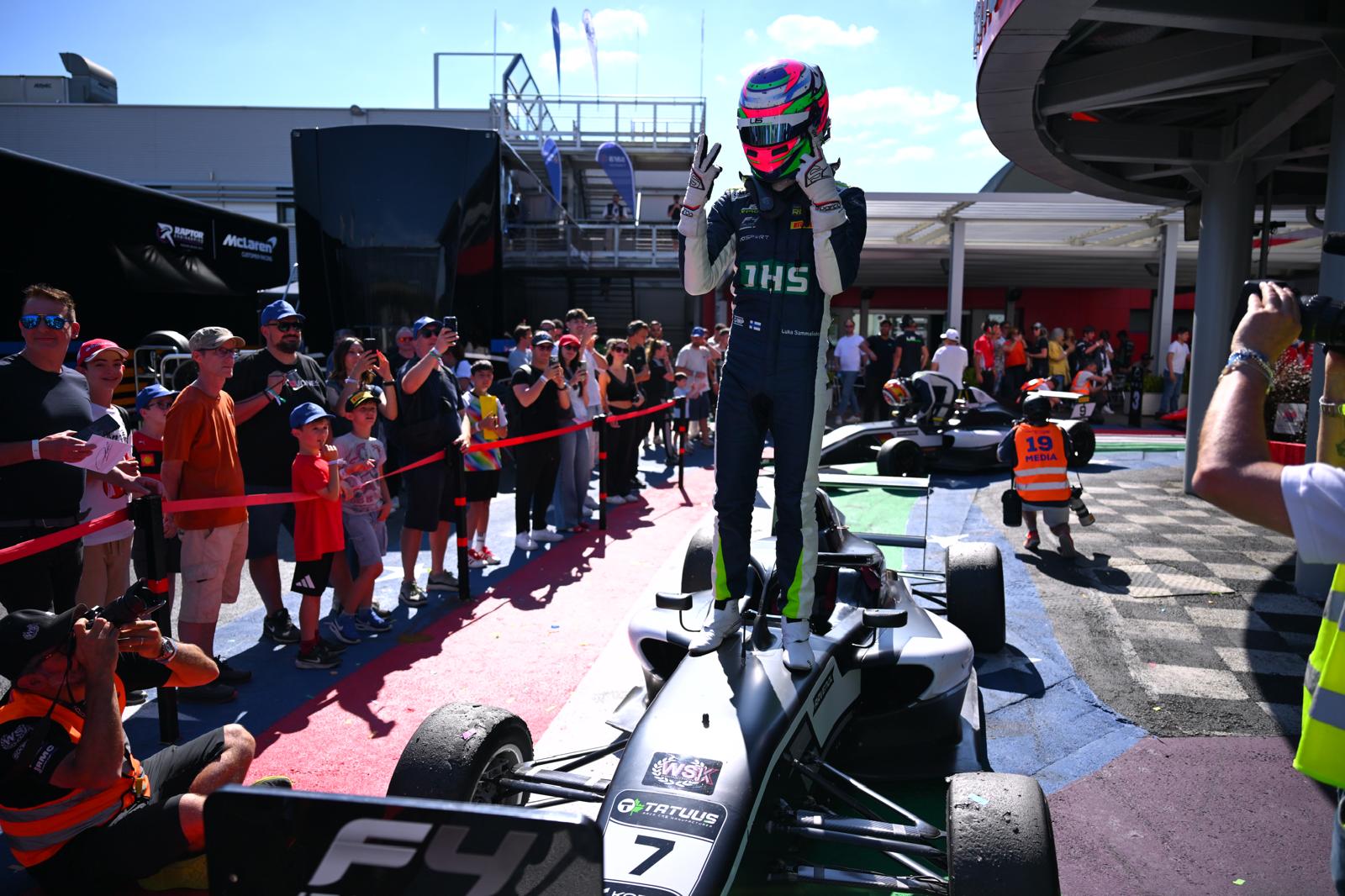
Luka Sammalisto has already built much of his teenage life around racing. As he continues his Formula 4 journey, the Finnish driver must balance training, travel, school, friendships and long-term ambition while still navigating the realities of life away from the track.
That balance demands discipline. Motorsport can open doors for young drivers, but it also asks them to make sacrifices early, particularly when racing calendars clash with education and ordinary routines. For Sammalisto, school has created the biggest challenge, while training and racing continue to shape his daily structure.
In an exclusive interview with Pit Debrief, Sammalisto discussed how he manages life as a teenager in motorsport, the career paths he may consider beyond Formula 1, and the achievements he hopes to look back on when his racing career eventually ends.
Balancing training, friends and life at home
For Sammalisto, life away from the circuit still revolves around preparation. Training remains a central part of his routine, especially as he continues to develop physically for Formula racing. However, he also makes time for friends and normal teenage experiences when his schedule allows.
“Yeah. So for me, I think the main thing, especially at home, is to [get] the training done for formula. Of course, almost every day I see my friends in some way or somewhere.
That balance gives him some normality between race weekends. Although his career demands focus, Sammalisto still finds moments to disconnect from the pressure of competition and spend time with people close to him.
School as the biggest challenge
However, school has created the clearest difficulty in his attempt to balance ambition with teenage life. Racing commitments mean he spends significant time away from the classroom, which has affected his route through education.
“I think the main challenging thing for me is the school, because I’m still at school. If I were a normal guy my age, I should graduate [soon]. But I will not do that because I have some issues from the racing, because I’m always at the racing and I’m not at school.
“So I think the main challenging thing for me is school. And when I will finish school, I’m not sure yet. I think maybe in half a year I will finish school. But I think it has been the most challenging thing for me. Everything else except the school has not been so hard, because when I go, I come home after every race.
Even so, Sammalisto recognises that he still needs to complete his education. While he may not enjoy school as much as racing, he understands its importance and continues to work towards finishing it.
“So basically I do the training in the morning when I wake up or in the day. Then maybe I go see my friends for a bit. And then I can chill out for the rest of the day almost. And then same again. Then I need to, of course, go to school also. But I think it’s not hard. I think the only hard thing for me is school at the moment, because also I don’t like the school so much, but I need to finish school.”
Formula 1 as the main dream
While Sammalisto handles the demands of the present, he also keeps a clear view of the future. Formula 1 remains his main dream, and he continues to approach his development with that pathway in mind.
“I think for sure, yes. I think the main dream is Formula 1, but of course there are other options, like GT cars, LMP, and also Formula E. But the one that I like less is Formula E because I don’t like all the electric stuff. I think, for me, it’s not a car that I really like. So I think the main thing is Formula 1. And then we have GT cars, LMPs, of course, which I also like, but I think the main goal is Formula 1.
At the same time, he understands that motorsport careers can take different shapes. Although Formula 1 sits at the centre of his ambitions, he remains open to other categories if those opportunities arise.
“But of course, if we don’t achieve that and we have other opportunities from other categories, of course we will go for them, or we will see how things will go, [but] the main goal, for me, is Formula 1.”
Defining success through winning
Looking further ahead, Sammalisto links success with winning at each stage of the ladder. He wants to compete for championships in every category he enters and, ultimately, fight for the biggest title in motorsport.
“I think I realise I would want to be almost champion in every category and then go for the big one, Formula 1. But yeah, I think I would want to be champion in every category, but I think it’s also quite hard to really become champion in every category, to be honest. But I think the main goal is also to be the Formula 1 World Champion.
For Sammalisto, that ambition carries personal meaning. He wants people to recognise him as a winner, not only as someone who reached certain levels, but as a driver who achieved something tangible within them.
“So I think just to be champion almost in every category is, for me, the biggest thing. Or let’s say, be the champion. People can call you the champion because you won it and you drove. So that would be really cool. I think just to be a winner in every category would be so cool.”
A young driver building towards a bigger future
Sammalisto’s reflections show the demands that sit behind a young racing career. He continues to manage school, training, travel and ambition while still trying to experience parts of ordinary teenage life.
Nevertheless, his goals remain clear. Formula 1 leads his long-term vision, while GT cars and prototypes represent possible future routes if his career moves in a different direction. Above all, Sammalisto measures success through winning. As he continues his development, that desire to become a champion continues to guide both his present sacrifices and his future ambitions.