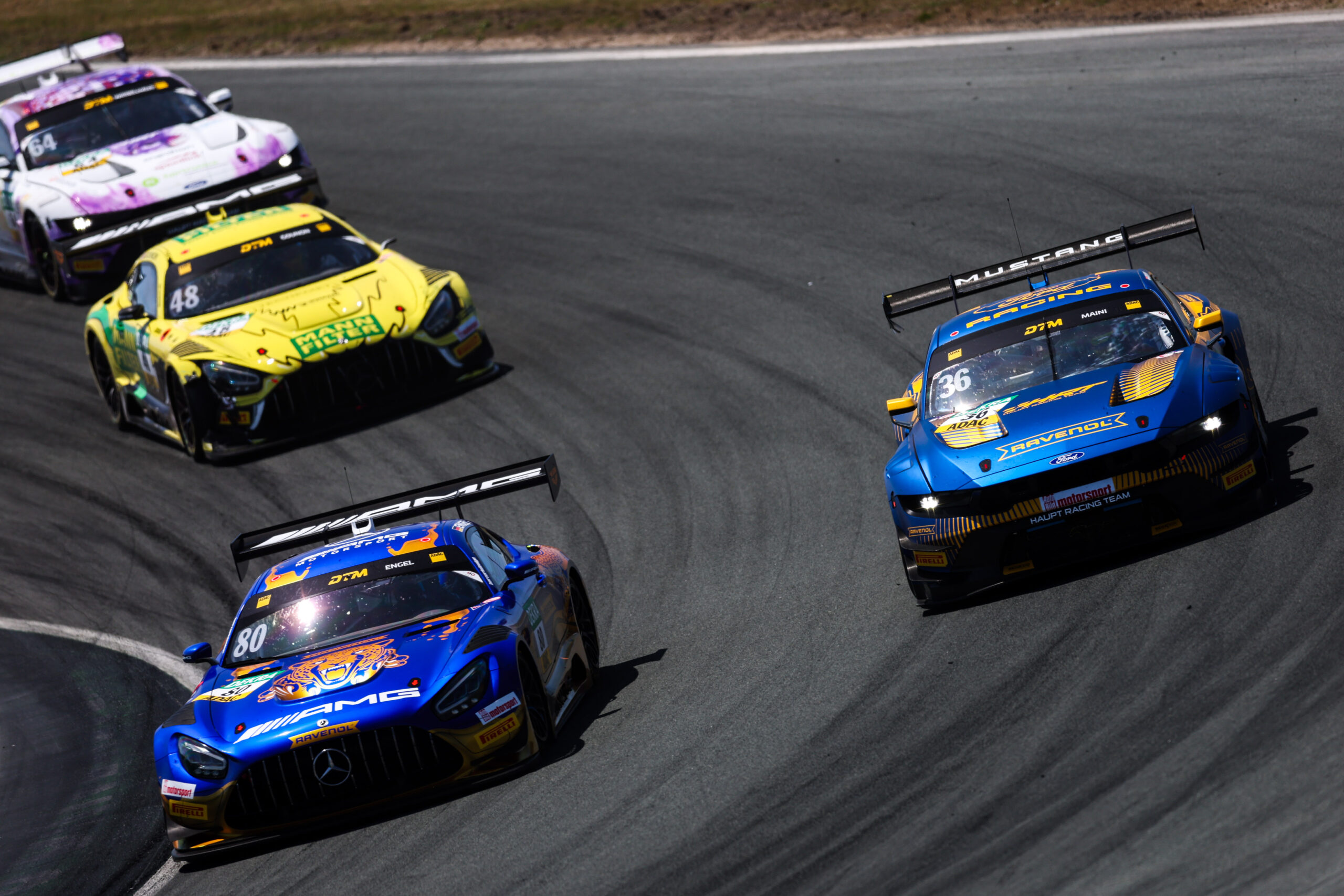
Maro Engel and Jules Gounon brought years of shared experience and success into their DTM partnership at Winward Racing with Mercedes-AMG Motorsport, but neither driver believed that familiarity had stopped them from learning from one another.
The Mercedes-AMG Performance Drivers had competed together in some of endurance racing’s biggest events and developed a close friendship away from the circuit. However, DTM placed them in a different working environment, where they operated as individual competitors while continuing to contribute towards the team’s overall progress.
In an exclusive interview with Pit Debrief, Engel and Gounon discussed how their contrasting approaches helped drive development, the small differences between their driving styles and why DTM required them to become more selfish with car setup.
Engel and Gounon continued to learn from each other
Engel said that drivers could never afford to stop developing, regardless of their experience or previous success.
“Every single day. The day that you stop learning and improving is the day you go backwards,” Engel said. He added that their different approaches helped Mercedes-AMG Motorsport explore several setup directions during practice before identifying the strongest option.
“And also in DTM, I think we are quite complementary because sometimes we try different setup philosophies, see how it goes in FP1, and then we can converge,” Engel explained.
Gounon agreed that their contrasting approaches benefited both drivers and the wider team.
“And also in DTM, I think we are quite complementary because sometimes we try different setup philosophies, see how it goes in FP1, and then we can converge on whatever feels best for each other and whatever looks the most competitive,” Gounon said.
He added that a competitive teammate pushed a driver to improve while also giving the team more information to support its development.
“So, actually, I think having a very strong teammate next to you in whichever championship is very important because it drives you to perform better, but it also helps the team to develop and try to reach a higher potential,” Gounon added. “If you have only one car you can rely on, it’s always a bit more difficult.”
Shared experience created respect and raised standards
Engel and Gounon had known each other for several years and had already achieved major results together before becoming DTM teammates.
Their friendship and shared success created a strong foundation, while the respect they had for each other’s careers helped strengthen their working relationship. Engel said that working closely together allowed them to better understand each other’s strengths and encouraged both drivers to keep improving.
He also believed Mercedes-AMG Motorsport benefited from the depth of its wider driver line-up. At endurance events such as Daytona, Bathurst and the Nürburgring, drivers could learn from each other through data, driving style and their different approaches to racing. Engel felt those individual personalities ultimately helped raise the overall standard across the programme.
“I think, I mean, we’ve known each other for a very long time. We’ve been friends for a while, and we’ve had great successes together, which always helps.
“I think the respect has been there from day one for what the other has achieved in his career. When you then get to work with someone, that’s obviously where you see how strong they are and where the other driver’s strengths lie.
“So, like Jules just said, it’s something that pushes you and makes you improve. I think that’s something, in general, at Mercedes-AMG Motorsport where we can be very happy that we have such a strong driver line-up.
“When we go endurance racing in Daytona, Bathurst or at the Nürburgring, you’re always learning from one of the drivers through the data and the driving, but you’re also seeing how they approach racing. Everyone has their own personality, which is great and has to be like that, but you’re always learning from each other, and that pushes the overall level up.”
Contrasting personalities produced similar performance
Gounon agreed with Engel’s assessment but highlighted the noticeable contrast between their approaches.
He described Engel as highly organised and consistent in the way he completed tasks. Gounon even noticed that discipline when the pair played golf, where Engel followed the same routine and kept everything in order.
Gounon considered himself more spontaneous and less structured. Those differences extended beyond their sporting preparation and became visible in simple details, including how they organised their belongings inside the changing room.
Their driving styles also differed, although only through relatively small details. Engel preferred the Mercedes-AMG GT3 to behave in one way, while Gounon looked for slightly different characteristics from the car.
Despite those contrasting preferences, both approaches often produced almost identical lap times. Their work therefore focused less on copying one another and more on understanding how different techniques could reach the same level of performance.
“Yeah, I fully agree. I think, at the end of the day, we have different ways of approaching things. Maro is very—how do you say?—clean. For example, when we play golf, it’s also a good way to see how you approach stuff. Maro would always put the coin back on the hat, put the glove in the bag, and follow the same routine. Whereas I’m a bit more freestyle. Even the way we pack our stuff and our clothes in the changing room follows the same philosophy.”
“So, it’s still different for me, but in the end, we also have different driving styles. The differences are very small details, which most of the time result in the same lap time. But Maro likes the car a bit more one way, and I like the car a bit more another way.”
DTM allowed drivers to prioritise individual setup preferences
The move between endurance racing and DTM also changed how Engel and Gounon approached car setup, even though in the end they race in the same Mercedes-AMG GT3.
In endurance racing, several drivers shared one car, so the team needed to find a balance that gave everyone confidence. A setup that perfectly suited one driver could create problems for another, which often required compromises across the line-up.
DTM gave each driver more freedom to shape the car around his own preferences. With a dedicated crew working on each entry, Engel and Gounon could pursue different setup directions that better matched their individual driving styles.
Gounon said the format therefore required drivers to become slightly more selfish about what they wanted from the car. Although teamwork remained important, each driver took greater responsibility for directing his own setup while still exchanging data and feedback with the other side of the garage.
“When you’re in endurance racing, you try to create something that works for both of you. When you’re in DTM, you actually go much more in the direction you prefer. That’s also something different you have to understand about DTM: you have a whole crew around you, so you have to be a bit more selfish in terms of the setup, what you really want and what you prefer in terms of driving style.”
“In endurance racing, if one of the three drivers doesn’t really like the car, you need to make some compromises to try to make everyone feel good in the car because it’s teamwork and a team effort. It’s the same in DTM—it’s still teamwork—but it’s something where you focus a bit more on yourself in terms of how you approach the weekend.”
Gounon and Engel strengthened Mercedes-AMG Motorsport through contrasting approaches
Gounon and Engel combined their different working styles, setup preferences and experience to help Mercedes-AMG Motorsport develop while continuing to push each other forward.
Their partnership showed how two experienced drivers could share data and feedback without losing their individual identities. Endurance racing required them to compromise for the benefit of a shared car, while DTM allowed each driver to pursue a setup more closely suited to his own preferences.
Despite those differences, the foundation of their work remained the same. Their mutual respect, openness and willingness to learn from one another helped raise the performance level across the team.