F1 is currently undergoing a comprehensive operational transition to meet its target of becoming Net Zero by 2030. As the championship expands to 24 races, the sport is shifting from a traditional, location-independant schedule to a more efficient, regionalized model, while simultaneously investing in sustainable technology.
Achieving this requires a fundamental balancing between the sports’ surging global popularity, now reaching 826 million fans, and how to move people, equipment and technology across five continents.
The FIA’s environmental strategy for Net Zero by 2030
In 2020, the FIA established a clear environmental strategy to reach Net Zero. The FIA and Formula 1 distinguish between “carbon neutral” and “Net Zero”. While carbon neutrality involves offsetting emission, Net Zero requires the absolute reduction of emissions at the source, complemented by methods to remove remaining carbon from the atmosphere.
The sport uses a 2018 baseline to measure its progress. If the sport had continued with its previous model, the expansion from 21 races in 2018 to 24 today would have caused a spike by 10% in emissions.
Instead, F1 has worked to separate the growth of the sport from its environmental impact. As of the 2026 report, the sport has achieved a 35% reduction in its total carbon footprint compared to the 2018 baseline. This progress shows that emissions can be managed even as the race calendar and global audience expand.
Optimizing global operations
Logistics and travel represent the largest portion of F1’s carbon footprint, accounting for approximately 73% in total. Moving thousands of tonnes of specialized freight for 24 events is a massive task. To address this, the sport has implemented a multimodal transport strategy.
F1 increasingly relies on slower, more efficient transport methods like shipment by sea for non-essential equipment, such as hospitality suites, fan zones and structural kits.
While air travel remains necessary for cargo that has to arrive on time like cars and engines, the sport is transitioning to more efficient Boeing 777 aircraft. Furthermore, there is an expanded use of Sustainable Aviation Fuel (SAF) to lower emissions per flight.
Additionally, in Europe, F1 has successfully transitioned its logistics fleet to trucks powered by biofuel, resulting in an 83% reduction in emissions for those specific operations.
Lastly, F1 has shifted its operational model by centralizing data and broadcast functions. By allowing over 140 personnel to work remotely from team bases, the sport avoids thousands of miles of unnecessary air travel.
In total, F1 has reduced its emissions for travel by 27% and by 9% for logistics compared to 2018.
Rationalizing the race calendar
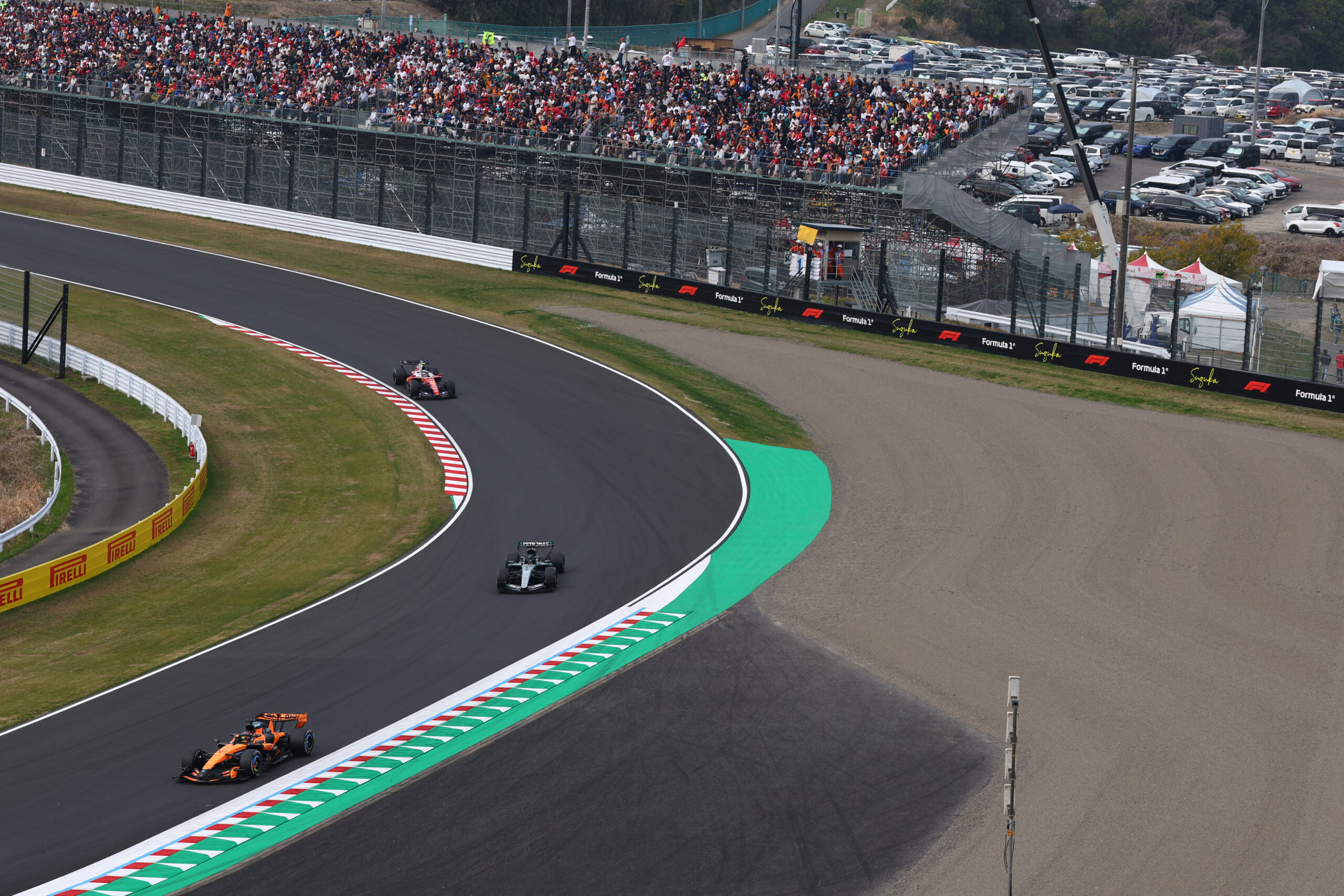
Historically, the F1 calendar was organized based on commercial and traditional factors. Today, the sport prioritizes geographical efficiency. The sport groups races by region, such as adjusting the Japanese GP to align with the Asia-Pacific segment or the Canadian GP. By doing this, F1 significantly reduces the need for repeated long-distance flights on their road to Net Zero by 2030.
The “regionalization” does more than decrease emissions. It simplifies the logistical flow for the entire paddock, creating a more sustainable cycle for the movement of heavy freight.
The 2026 technical pivot
Technology is the final column of F1’s sustainability plan. From the 2026 season, all F1 cars will transition to 100% advanced sustainable fuels. These fuels are engineered from non-food biomass and municipal waste, designed to be “dop-in” solutions that work with existing internal combustion technology.
This innovation serves two purposes. First, it allows the current high-performance internal combustion engines to run with a fraction of their previous carbon impact.
Second, it creates a blueprint for the wider automobile industry. These fuels are compatible with existing vehicles. Consequently, F1 is acting as a global laboratory to provide scalable, sustainable solutions for the millions of internal combustion cars on roads worldwide.
F1’s progress and the road ahead to Net Zero by 2030
F1’s sustainability progress is measurable and significant. The sport has successfully reduced its footprint from 228,793 tCO2e in 2018 to 148,715 tCO2e in 2026. F1 teams have worked to transition factories and facilities to 100% renewable energy, achieving a 64% reduction in site emissions compared to 2018.
While a 35% reduction in total emissions has been achieved, the sport still has a 15% gap to close to hit its target of a 50% minimum reduction by 2030.
F1’s sustainability strategy is a structured approach to a multifaceted problem. The sport is combining regionalized calendars, improved freight logistics and sustainable fuel technology. Through these initiatives, the sport is demonstrating how a major global industry can reduce its environmental footprint.
While the 2030 target remains a significant challenge, the data indicates that the current operational changes are creating a measurable and durable impact.