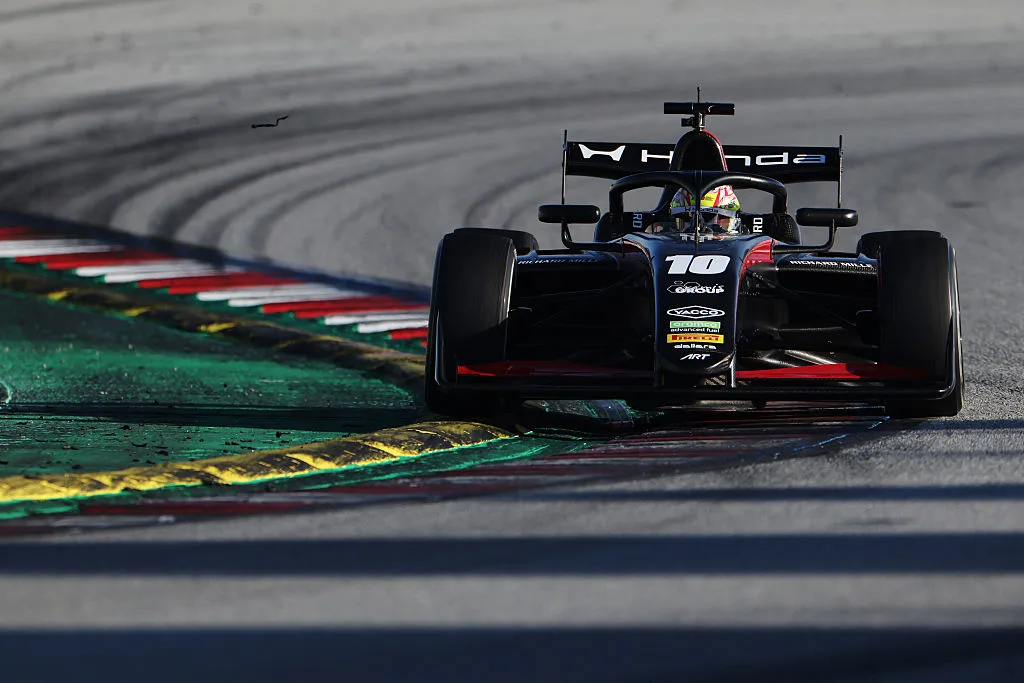
ART Grand Prix’s Taito Kato recorded the fastest lap of the 2026 FIA Formula 3 (F3) Barcelona post-season test, delivering a 1:27.902 during Tuesday morning’s session at the Circuit de Barcelona-Catalunya. The Japanese driver finished just 0.012s ahead of Campos Racing’s Ernesto Rivera, while Rodin Motorsport’s Alessandro Giusti completed the leading three, with the trio separated by only 0.069s.
Trident’s Niccolò Maccagnani subsequently topped the afternoon session with a 1:29.994, finishing 0.704s ahead of AIX Racing’s Dion Gowda. Fellow AIX driver James Egozi secured third, while Trident teammates Kean Nakamura-Berta and Sebastian Wheldon completed the leading five. However, with teams concentrating on longer race simulations throughout the afternoon, Kato’s morning benchmark remained comfortably ahead of the remaining session times.
The final day brought the four-day 2026 F3 post-season testing programme to a close following two days each at Jerez and Barcelona. With several drivers already confirming their places on the 2027 grid, teams used the remaining running to gather technical information, evaluate driver performance and strengthen their preparations before the winter break.
Kato establishes early pace as Barcelona testing resumes
The final day of the 2026 F3 Barcelona post-season test began with considerably more activity than Monday’s opening session, as drivers immediately headed onto the circuit to complete their remaining testing programmes. With three hours of morning running available, several teams concentrated on qualifying simulations, hoping to establish representative lap times before shifting towards longer runs later in the day.
ART Grand Prix’s Kato made an encouraging start, moving to the top of the timesheets within the opening ten minutes. However, Giusti soon challenged the Japanese driver, recording a 1:29.511 to place Rodin Motorsport ahead as the field continued improving.
The session subsequently suffered its first interruption when AIX Racing’s Gowda found the barriers at Turn 8, prompting Race Control to deploy the red flag. The incident temporarily halted the qualifying simulations as marshals recovered the Indian driver’s car and cleared the circuit.
Before the stoppage, Giusti had already improved his benchmark to a 1:28.450, demonstrating the significant progress drivers made as they completed their opening runs.
Following the interruption, teams resumed their programmes, with the improving track conditions and increasing competition producing several changes at the top of the classification.
Rivera challenges for top spot as margins tighten
Rivera emerged as one of the strongest contenders following the restart, recording a 1:28.186 to move Campos Racing ahead of the field. The Mexican’s effort represented the fastest lap of the Barcelona test at that stage, improving considerably on the 1:28.516 that MP Motorsport’s Matteo De Palo had established during Monday’s opening day.
However, Rivera could not establish a substantial advantage over his rivals, with the leading drivers remaining closely matched as their qualifying simulations continued. At one stage, just 0.186s separated the top seven, demonstrating the competitive margins across several teams.
Campos Racing, Rodin Motorsport, Trident and ART Grand Prix all featured near the top as drivers continued refining their approaches to the circuit. With several competitors preparing for the 2027 championship, the session provided another opportunity to assess single-lap performance before the conclusion of official testing.
As the morning approached its halfway point, teams began fitting fresh tyres for another series of competitive runs. The change offered drivers an opportunity to improve their benchmarks, particularly as the circuit continued evolving following extensive activity during the opening hour.
Although Rivera remained a leading contender, Kato subsequently delivered the decisive lap that would establish the fastest time of the entire test.
Kato delivers 1:27.902 to secure fastest Barcelona lap
Kato moved ahead of the field approaching the halfway stage, recording a 1:27.902 to establish a new overall Barcelona testing benchmark. His lap represented an improvement of 0.614s over De Palo’s fastest time from Monday, demonstrating how significantly the leading pace had developed between the two days.
Rivera responded with a 1:27.914, reducing the deficit to just 0.012s. However, the Campos Racing driver could not quite match Kato’s benchmark, leaving the Japanese competitor ahead as teams began shifting their attention towards longer runs.
Meanwhile, Giusti continued Rodin Motorsport’s strong performance, recording a 1:27.971 to finish third, just 0.069s behind Kato. Teammate Reza Seewooruthun also demonstrated competitive pace, securing fourth with a 1:27.989.
Consequently, the leading four drivers finished within just 0.087s, with ART Grand Prix, Campos Racing and Rodin Motorsport occupying the leading positions.
Kato’s result also represented a substantial improvement from Monday, when he finished fifth during the morning session with a 1:29.167. His progress allowed ART Grand Prix to conclude the official 2026 post-season testing programme with the fastest lap recorded across the two days at Barcelona.
Rodin Motorsport impresses despite second morning interruption
Rodin Motorsport continued demonstrating competitive pace throughout the final morning, with Giusti and Seewooruthun securing third and fourth, respectively. The British outfit had already enjoyed a productive Barcelona test, with Giusti finishing second during Monday morning’s session before completing the afternoon in third.
However, the final morning also brought another interruption for the team when Seewooruthun entered the gravel at Turn 10. His incident prompted the second red flag of the session, temporarily halting running as marshals recovered the car.
The stoppage followed a difficult conclusion to Monday morning, when Seewooruthun stopped on track and subsequently lost all his lap times because his car failed to provide sufficient fuel for post-session technical checks.
Nevertheless, Tuesday’s interruption did not prevent him from securing fourth in the morning classification. His 1:27.989 placed him just 0.018s behind Giusti, completing an encouraging result for the two Rodin drivers.
Following the restart, teams continued completing their remaining programmes, although the leading times remained unchanged. With longer runs taking priority, Kato retained first ahead of Rivera, Giusti and Seewooruthun as the chequered flag brought the final morning session to a close.
David completes top five as Van Amersfoort Racing accumulates mileage
Van Amersfoort Racing’s Yevan David completed the morning’s leading five, recording a 1:28.073 to finish 0.171s behind Kato. The Sri Lankan joined the team for Barcelona as the only change to the field that participated at Jerez, replacing Francisco Macedo in the #14 car.
Having completed his rookie F3 campaign with AIX Racing, David will race with Van Amersfoort Racing in 2027. Consequently, the final test provided an important opportunity to establish a working relationship with his new team while adapting to its engineering procedures and car setup.
David also completed 45 laps during the morning, the highest total of the session, demonstrating the team’s focus on accumulating mileage alongside competitive single-lap performance.
Meanwhile, teammate Rashid Al Dhaheri secured seventh with a 1:28.143 across 44 laps, while Enzo Deligny finished thirteenth after recording a 1:28.372.
De Palo completed the morning in sixth, following his session-leading performance on Monday. The Italian recorded a 1:28.076, finishing just 0.003s behind David and 0.174s away from Kato’s benchmark.
PREMA Racing’s Alex Powell followed Al Dhaheri in eighth, with Campos Racing’s Mattia Colnaghi ninth and Trident’s Maccagnani completing the leading ten.
Maccagnani sets early afternoon benchmark for Trident
Following the morning’s competitive qualifying simulations, teams shifted their attention towards longer runs as the final afternoon session began. With just three hours of official running remaining in 2026, several drivers concentrated on gathering information about race pace, tyre behaviour and consistency rather than pursuing outright lap times.
Trident and MP Motorsport were among the first teams to return to the circuit, beginning their final programmes shortly after the pit lane opened. Maccagnani established the early benchmark with a 1:29.994, immediately placing Trident at the top of the afternoon classification.
However, the running soon suffered an interruption when MP Motorsport’s Zhenrui Chi stopped on track, prompting officials to deploy the red flag. Marshals recovered the Italian driver’s car before Race Control allowed the remaining competitors to resume their programmes.
Following the restart, teams continued concentrating on longer race simulations, with drivers completing consecutive laps rather than immediately attempting to improve the leading time.
Consequently, Maccagnani’s early benchmark remained comfortably ahead of the field throughout much of the session, despite several drivers continuing to accumulate substantial mileage.
The Italian had previously finished tenth during the morning with a 1:28.234, meaning his afternoon result represented another encouraging performance as Trident concluded its preparations for the winter break.
Trident completes temporary top-three lockout in final session
Trident demonstrated its strength during the opening stages of the afternoon, with all three drivers briefly occupying the leading positions. Although Maccagnani remained comfortably ahead, teammates Nakamura-Berta and Wheldon improved their times sufficiently to complete a provisional top-three lockout.
Nakamura-Berta moved into second, with Wheldon immediately behind. Just 0.017s separated the pair, although both remained approximately 1.2s slower than Maccagnani’s earlier benchmark.
Their performances continued an encouraging post-season testing programme for Trident, which had also demonstrated competitive pace during the opening test at Jerez. Nakamura-Berta had topped the first day at the Spanish circuit, recording a 1:31.169 to finish just 0.002s ahead of Colnaghi.
However, the final Barcelona session featured considerably greater emphasis on longer runs, limiting the significance of the outright lap times. The three Trident drivers continued accumulating mileage as they refined their understanding of the car and worked through their remaining programmes.
Maccagnani ultimately completed 51 laps, while Wheldon recorded 48 and Nakamura-Berta added another 32. Their combined running provided Trident with substantial information as its preparations for the 2027 season continued.
Gowda and Egozi move AIX Racing into afternoon top three
Although Trident initially occupied the leading three positions, AIX Racing emerged as the strongest challenger during the final half-hour. Gowda returned to competitive running following his morning incident, improving to a 1:30.698 to move into second.
The Indian driver’s lap placed him 0.704s behind Maccagnani, while also moving him ahead of Nakamura-Berta and Wheldon. His improvement represented an encouraging recovery after his earlier contact with the barriers at Turn 8 had interrupted the morning session.
Meanwhile, teammate Egozi also improved during the closing stages, recording a 1:30.852 to secure third. His lap placed him 0.154s behind Gowda, completing an AIX Racing two-three behind the leading Trident entry.
The pair retained their positions as the session approached its conclusion, with no further changes to the leading five before the chequered flag.
Nakamura-Berta therefore finished fourth with a 1:31.260, while Wheldon followed just 0.017s behind in fifth. Rodin Motorsport’s Pedro Clerot completed the leading six, recording a 1:32.309 after concentrating on longer runs.
The AIX Racing trio, which also included Gabriel Gomez, will form the foundation of LN4 Fusion’s entry into the 2027 championship, following the new organisation’s acquisition of AIX Racing’s place on the grid.
Teams prioritise extensive mileage during final afternoon
Although Maccagnani established the afternoon benchmark, the session primarily provided teams with an opportunity to complete longer runs and gather final technical information before the winter break.
Van Amersfoort Racing accumulated particularly extensive mileage, with David recording 60 laps and teammates Deligny and Al Dhaheri completing 59 each. The trio therefore combined for 178 afternoon laps, demonstrating the team’s emphasis on evaluating its drivers and machinery during the final session.
David’s running proved especially notable after he completed another 45 laps during the morning, bringing his total to 105 across Tuesday. Al Dhaheri followed with 103 laps, while Deligny completed 100, giving the Dutch outfit three drivers who reached triple figures during the final day.
Elsewhere, Campos Racing’s Salim Hanna also completed 60 afternoon laps, while Colnaghi recorded 58 and Rivera added 51. The trio continued accumulating mileage following Rivera’s competitive morning performance, which placed him just 0.012s behind Kato.
MP Motorsport’s De Palo completed 56 laps, while teammate Maciej Gładysz recorded 55. Meanwhile, Kato followed his morning benchmark with another 52 laps during the afternoon, bringing his own Day 2 total to 76.
The extensive running highlighted the contrasting objectives between the morning’s qualifying simulations and the final afternoon, when teams concentrated on gathering information they could analyse throughout the winter.
Kato concludes Barcelona test fastest ahead of 2027 preparations
Kato’s morning benchmark ultimately remained the fastest lap across both days at Barcelona, completing an encouraging final test for ART Grand Prix. His 1:27.902 placed him just 0.012s ahead of Rivera, while Giusti and Seewooruthun followed closely behind to complete a leading four separated by less than one tenth.
The result represented a considerable improvement over Monday, when De Palo led the field with a 1:28.516 before Rivera topped the afternoon session with a 1:28.549.
However, the differences between the sessions reflected the varying conditions and testing programmes rather than establishing a definitive competitive order ahead of 2027. While teams concentrated on shorter qualifying simulations during the mornings, the afternoons featured more extensive race-focused running, with differences in fuel loads, tyre preparation and track conditions influencing the lap times.
For Kato, the result provided an encouraging conclusion to the four-day testing programme as he continued preparing for another F3 campaign with ART Grand Prix. Meanwhile, Rivera’s narrow deficit highlighted Campos Racing’s continued competitiveness following its championship-winning 2026 season.
Rodin Motorsport also completed an encouraging final test, with Giusti and Seewooruthun demonstrating strong single-lap performance and accumulating further mileage during the afternoon.
2026 FIA F3 post-season testing concludes at Barcelona
The conclusion of Tuesday’s afternoon session brought the official 2026 FIA F3 post-season testing programme to an end, completing four days of running across Jerez and Barcelona.
The tests provided returning drivers with opportunities to adapt to new teams, while newcomers gained experience with the Dallara F3 2025 ahead of their expected championship debuts. Several organisations also evaluated their developing driver combinations as preparations for 2027 continued following the conclusion of the racing season.
Across the two Barcelona days, De Palo and Kato established the fastest morning benchmarks, while Rivera and Maccagnani topped the afternoon sessions. Their performances highlighted the different approaches teams adopted throughout testing, with qualifying simulations producing considerably faster times than the longer race runs that dominated the afternoons.
The final two days also featured several interruptions, although teams continued accumulating substantial mileage and gathering information throughout the programme.
With the official running now complete, attention turns towards analysing the information collected across both Spanish circuits and preparing for the opening round of the 2027 FIA Formula 3 Championship.
Although the Barcelona results offer an early indication of the developing field, teams will need to translate their testing progress into competitive performances when the championship returns next year.
2026 FIA F3 Barcelona post-season testing: Day 2 results
The following classifications reflect the final morning and afternoon results supplied for Tuesday, 27 October, including the individual lap totals for all 30 drivers.
Morning session
- Taito Kato — ART Grand Prix — 1:27.902 — 24 laps
- Ernesto Rivera — Campos Racing — 1:27.914 — 26 laps
- Alessandro Giusti — Rodin Motorsport — 1:27.971 — 25 laps
- Reza Seewooruthun — Rodin Motorsport — 1:27.989 — 26 laps
- Yevan David — Van Amersfoort Racing — 1:28.073 — 45 laps
- Matteo De Palo — MP Motorsport — 1:28.076 — 22 laps
- Rashid Al Dhaheri — Van Amersfoort Racing — 1:28.143 — 44 laps
- Alex Powell — PREMA Racing — 1:28.200 — 29 laps
- Mattia Colnaghi — Campos Racing — 1:28.218 — 31 laps
- Niccolò Maccagnani — Trident — 1:28.234 — 27 laps
- Miguel Costa — DAMS Lucas Oil — 1:28.327 — 32 laps
- Jin Nakamura — PREMA Racing — 1:28.344 — 31 laps
- Enzo Deligny — Van Amersfoort Racing — 1:28.372 — 41 laps
- Pedro Clerot — Rodin Motorsport — 1:28.415 — 26 laps
- Salim Hanna — Campos Racing — 1:28.466 — 29 laps
- Emanuele Olivieri — ART Grand Prix — 1:28.489 — 26 laps
- Gabriel Gomez — AIX Racing — 1:28.565 — 30 laps
- James Egozi — AIX Racing — 1:28.589 — 38 laps
- Martin Molnár — PREMA Racing — 1:28.645 — 33 laps
- Sebastian Wheldon — Trident — 1:28.647 — 25 laps
- Nandhavud Bhirombhakdi — DAMS Lucas Oil — 1:28.662 — 33 laps
- Keanu Al Azhari — Hitech — 1:28.765 — 25 laps
- Kanato Le — Hitech — 1:28.766 — 26 laps
- Enzo Yeh — ART Grand Prix — 1:28.782 — 25 laps
- Maciej Gładysz — MP Motorsport — 1:28.805 — 24 laps
- Kean Nakamura-Berta — Trident — 1:28.838 — 17 laps
- Alexander Abkhazava — DAMS Lucas Oil — 1:28.846 — 24 laps
- Woohyun Shin — Hitech — 1:28.871 — 39 laps
- Zhenrui Chi — MP Motorsport — 1:29.423 — 24 laps
- Dion Gowda — AIX Racing — 1:29.504 — 16 laps
Afternoon session
- Niccolò Maccagnani — Trident — 1:29.994 — 51 laps
- Dion Gowda — AIX Racing — 1:30.698 — 31 laps
- James Egozi — AIX Racing — 1:30.852 — 32 laps
- Kean Nakamura-Berta — Trident — 1:31.260 — 32 laps
- Sebastian Wheldon — Trident — 1:31.277 — 48 laps
- Pedro Clerot — Rodin Motorsport — 1:32.309 — 48 laps
- Rashid Al Dhaheri — Van Amersfoort Racing — 1:32.461 — 59 laps
- Alessandro Giusti — Rodin Motorsport — 1:32.486 — 48 laps
- Taito Kato — ART Grand Prix — 1:32.554 — 52 laps
- Matteo De Palo — MP Motorsport — 1:32.616 — 56 laps
- Enzo Deligny — Van Amersfoort Racing — 1:32.656 — 59 laps
- Yevan David — Van Amersfoort Racing — 1:32.658 — 60 laps
- Kanato Le — Hitech — 1:32.762 — 45 laps
- Reza Seewooruthun — Rodin Motorsport — 1:32.823 — 48 laps
- Ernesto Rivera — Campos Racing — 1:32.866 — 51 laps
- Keanu Al Azhari — Hitech — 1:32.890 — 41 laps
- Zhenrui Chi — MP Motorsport — 1:32.933 — 17 laps
- Jin Nakamura — PREMA Racing — 1:32.986 — 50 laps
- Woohyun Shin — Hitech — 1:33.073 — 31 laps
- Emanuele Olivieri — ART Grand Prix — 1:33.080 — 53 laps
- Enzo Yeh — ART Grand Prix — 1:33.110 — 52 laps
- Maciej Gładysz — MP Motorsport — 1:33.200 — 55 laps
- Salim Hanna — Campos Racing — 1:33.280 — 60 laps
- Mattia Colnaghi — Campos Racing — 1:33.300 — 58 laps
- Gabriel Gomez — AIX Racing — 1:33.423 — 44 laps
- Alex Powell — PREMA Racing — 1:33.549 — 52 laps
- Miguel Costa — DAMS Lucas Oil — 1:33.713 — 36 laps
- Martin Molnár — PREMA Racing — 1:33.714 — 49 laps
- Alexander Abkhazava — DAMS Lucas Oil — 1:33.940 — 36 laps
- Nandhavud Bhirombhakdi — DAMS Lucas Oil — 1:34.030 — 30 laps