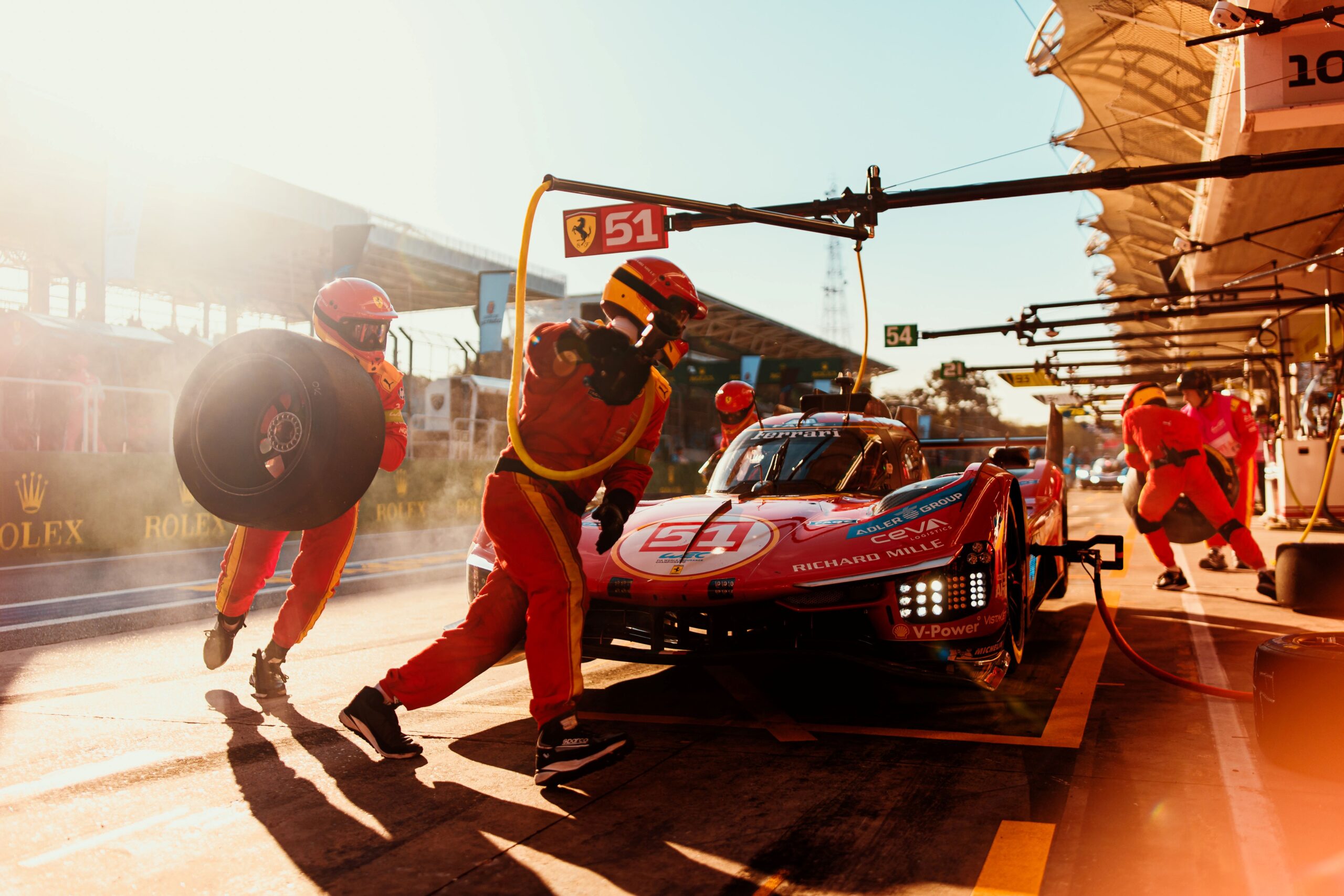
Ferrari converted a calculated strategic gamble into an unexpected podium at the 2026 FIA World Endurance Championship (WEC)’s Rolex 6 Hours of São Paulo.
Antonio Giovinazzi, Alessandro Pier Guidi and James Calado recovered from 11th on the grid to finish second in the #51 Ferrari 499P. Calado crossed the line only 2.254 seconds behind the winner, matching the crew’s best result of its title-defending campaign.
The result also marked Ferrari’s strongest finish at Interlagos with the 499P. Furthermore, it lifted the #51 crew to fourth in the Drivers’ Championship and strengthened the manufacturer’s confidence before the summer break.
Ferrari exceeds its São Paulo expectations
Ferrari entered the fourth round of the season with measured expectations after struggling at Interlagos during its previous visits.
Before the 2026 event, the 499P had never finished higher than fifth at the Brazilian circuit. São Paulo also remained one of only two venues on the current calendar where Ferrari had not reached the Hypercar podium. Nevertheless, the manufacturer showed improved pace from the start of the weekend. The factory cars qualified sixth and 11th, while the independent #83 AF Corse entry separated them in tenth.
Although the grid positions represented progress, Ferrari did not expect the #51 crew to fight for victory.
“We never expected to finish on the podium [in São Paulo] – nobody would have expected that – and to have done so with a race executed almost perfectly is something of which we can be proud,” reflected the Brit, as reported by FIAWEC.com. “It is also an excellent result for the world championship standings. Next, we head to Austin, where we know we can be competitive, so we need to continue to do our very best and keep fighting, because we have seen that this approach pays off.”
Calado, Giovinazzi and Pier Guidi therefore approached the race with a focus on execution rather than outright expectations.
The #51 Ferrari climbs quietly into contention
The #51 crew initially progressed through the field without attracting significant attention. Giovinazzi, Pier Guidi and Calado maintained a clean race while several rivals encountered penalties, contact and operational setbacks. Consequently, Ferrari gradually moved the car into podium contention.
The crew also benefited from clear track at crucial moments. That freedom allowed each driver to demonstrate the 499P’s improved race pace without losing time behind slower traffic.
However, Calado introduced a brief setback during the fifth hour. He made contact with the pit-exit barrier while driving on cold tyres and collected part of the circuit’s advertising. Despite the mistake, the Briton continued without suffering a race-ending problem. He subsequently reclaimed his rhythm and maintained Ferrari’s challenge during the closing stages.
Ultimately, Calado brought the car home in second and finished within striking distance of victory.
Ferrari’s strategy unlocks the 499P’s pace
Ferrari relied on an aggressive but calculated strategy to move the #51 entry from the sixth row into the leading group. The team prioritised clear air and selected its pit-stop timing accordingly. As a result, the drivers avoided prolonged periods in traffic and extracted more performance from the 499P.
Moreover, Ferrari’s decisions allowed the crew to capitalise when other contenders encountered trouble. Pier Guidi praised the team’s execution and highlighted clear track as the key factor behind its recovery.
“In the run-up to the event, predicting a second-place finish would have been very difficult,” mused the Italian. “We were more competitive than in previous seasons, but I would never have expected to finish this high up the order.
“We did the best we possibly could, and the team was perfect from a strategic point-of-view. Having clear track is essential [in São Paulo], and putting ourselves in a position where we could show our true pace was the key to climbing onto the podium. It was an outstanding team effort that leaves us full of confidence, because this was one of the circuits where we did not expect to score many points.”
Ferrari therefore combined stronger underlying performance with decisive strategic calls. Crucially, the team also maintained reliability throughout the six-hour race.
Penalty and contact hinder the #50 Ferrari
While the #51 entry climbed towards the podium, the #50 Ferrari endured a more difficult afternoon. Miguel Molina made a strong start and initially moved the car forward. However, officials handed the Spaniard a drive-through penalty for breaching Full Course Yellow procedures.
The sanction forced Molina, Nicklas Nielsen and Antonio Fuoco into a recovery drive. Nevertheless, the trio fought back to fifth during the final phase.
Then, with approximately ten minutes remaining, Fuoco made contact with Robin Frijns’ BMW. The incident sent the Ferrari into a spin and dropped the #50 crew to seventh. Officials later handed Frijns a five-second penalty, although the decision did not restore Ferrari’s lost positions.
Nielsen acknowledged the team’s disappointment but also drew encouragement from the car’s improved performance.
“It was quite a difficult race for us,” rued the Dane, who drove during the middle two hours. “The positive aspect was the significant progress we saw with the car compared to last year. The result was not what we had hoped for and, unfortunately, difficult days do happen, but now our focus shifts to the next race, where we are aiming to bounce back.”
Therefore, the result failed to reflect the #50 crew’s potential. However, its recovery still demonstrated Ferrari’s stronger race pace compared with previous visits to Interlagos.
AF Corse overcomes damage and penalties
The independent #83 AF Corse Ferrari also endured an eventful race. Two penalties cost the crew valuable time, while contact damaged the car’s front splitter. The damage then reduced the 499P’s performance throughout the remaining distance.
Nevertheless, the team continued its recovery and brought the car home in fifth. The result ensured that two Ferrari entries finished inside the top five. Moreover, all three 499Ps reached the chequered flag despite the penalties, contact and damage they encountered.
That reliability supported Ferrari’s broader progress at a circuit that had previously exposed weaknesses in the Hypercar package.
Detailed preparation rewards Ferrari
Ferrari dedicated significant resources to understanding its disappointing Interlagos performance from the previous season. The technical team analysed the earlier race and identified areas where it could improve the car’s set-up, energy management and operational execution.
That preparation allowed Ferrari to compete more effectively throughout the 2026 event. In addition, the team’s strategic flexibility helped it maximise the 499P’s strengths during the race.
Ferrari Head of Endurance Race Cars Ferdinando Cannizzo credited the manufacturer’s detailed analysis and the drivers’ execution.
“We did a great job as a team,” added Cannizzo. “The effort put into thoroughly analysing last year’s race and understanding how to improve our cars on a circuit that is always one of the most difficult for us paid off for everyone.
“The drivers did very well and reliability was impeccable, as were the set-up, energy management and execution during the various phases of the race. We managed to bring our cars – which started further back on the grid – into the leading positions, exploiting the 499P’s performance and a strategy that was quite risky but always calculated to fight for the podium.”
Consequently, Ferrari left São Paulo with more than an unexpected trophy. The manufacturer also gained evidence that its development work had improved the 499P at one of its weakest circuits.
São Paulo result strengthens confidence before Austin
The podium gave Ferrari an encouraging conclusion to the first half of the WEC season. Giovinazzi described the performance as extraordinary, particularly given Ferrari’s previous difficulties in Brazil. Meanwhile, Pier Guidi and Calado highlighted the championship value of the result.
The team will now shift its attention towards the Circuit of The Americas in Austin. Ferrari expects the American venue to suit the 499P more effectively than Interlagos. Nevertheless, the São Paulo result demonstrated that the manufacturer can challenge even when circuit characteristics appear less favourable.
Ferrari must still refine its execution after penalties affected both the #50 and #83 entries. However, the #51 crew’s recovery showed how strong strategy, reliability and disciplined driving can transform a difficult starting position.
As a result, Ferrari enters the second half of the season with renewed confidence and another significant result in its WEC title defence.