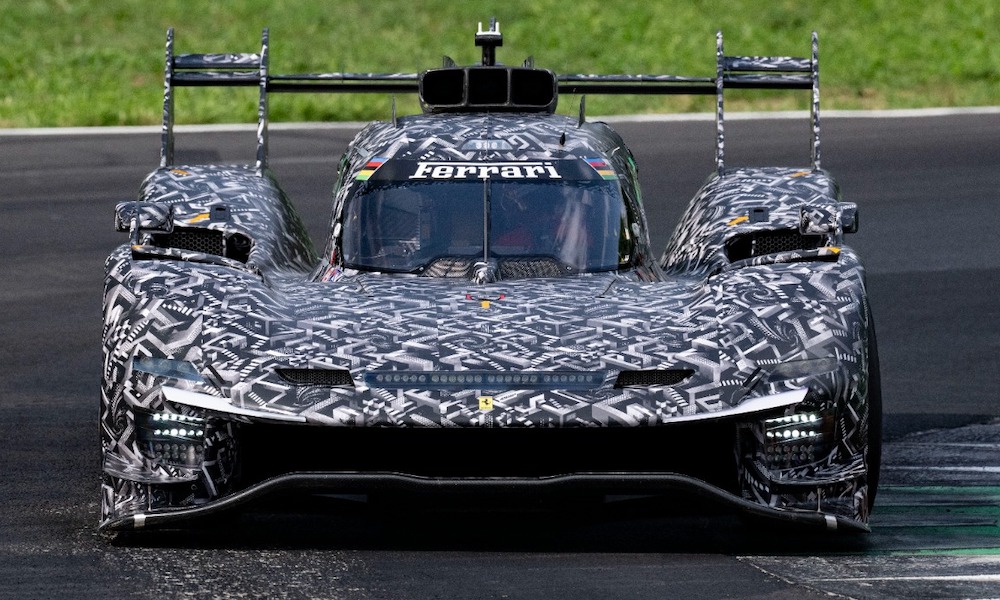
Ferrari has completed the first on-track test of an updated 499P Hypercar as the Italian manufacturer develops a planned Evo package for the 2027 FIA World Endurance Championship (WEC) season.
Antonio Fuoco, Antonio Giovinazzi, Alessandro Pier Guidi and Miguel Molina drove the revised prototype during a one-day test at Monza on Tuesday. Ferrari used the running to assess what it described as a “wide range of technical and aerodynamic solutions”.
The manufacturer intends to use some of its available performance jokers to introduce substantial changes next season. However, Ferrari continues to evaluate several configurations and has not finalised the number or nature of the upgrades it will pursue.
Four factory drivers begin 499P Evo development
Ferrari selected four of its factory Hypercar drivers to complete the updated car’s first laps.
Fuoco, Giovinazzi, Pier Guidi and Molina shared driving duties as the team began collecting data from the proposed 2027 package. Their experience with the current 499P should allow Ferrari to compare the revised car directly with the specification that has competed throughout the 2026 season.
The Monza test represented the first visible stage of a development programme that Ferrari confirmed during the 24 Hours of Le Mans.
However, the manufacturer has not committed to one final configuration. Instead, its engineers will continue assessing different concepts before choosing which changes to submit for homologation.
Ferrari keeps several design options open
Ferrari described the test car as featuring a broad selection of technical and aerodynamic developments.
However, the manufacturer did not detail the individual components or explain how extensively the package altered the existing 499P. Ferrari instead emphasised that the test formed part of an ongoing evaluation process.
“This is a step-by-step process that keeps several design options open until final homologation, providing for on-track testing of different configurations as part of the project’s natural evolution.”
Consequently, the specification that ran at Monza may not represent the final 2027 car.
Ferrari can use the early test to compare solutions, identify productive development directions and remove concepts that fail to deliver the expected gains. The team can then refine its preferred package before completing the homologation process.
Camouflaged livery conceals extent of revisions
Ferrari released images from the test showing the 499P in a camouflaged livery.
The design obscures several details and prevents close inspection of the revised bodywork. Therefore, the photographs provide limited evidence about the scale of the aerodynamic changes.
Nevertheless, Ferrari’s decision to run the car publicly confirms that its 2027 programme has moved beyond simulation and design work.
The manufacturer can now measure how its proposed updates behave in real conditions and compare the results with wind-tunnel and computational data.
Monza also provides a useful environment for evaluating aerodynamic efficiency. Its lengthy straights and heavy braking zones place particular emphasis on drag, stability and energy management.
Performance joker plan remains undecided
Ferrari confirmed at Le Mans that it intended to use performance jokers when developing its 2027 car.
The regulations allow Hypercar manufacturers to introduce approved changes during a model’s homologation cycle. These updates give manufacturers an opportunity to address weaknesses or improve areas of the package without designing an entirely new car.
However, Ferrari has not finalised how many jokers it will use or which systems the changes will cover.
The Monza programme will help the manufacturer determine which developments justify inclusion in the final package. Ferrari must then work with the FIA and Automobile Club de l’Ouest before homologating the revised specification.
Therefore, the team still has several technical and regulatory steps to complete before it can race the 499P Evo.
Ferrari has used only one joker since 499P debut
Ferrari introduced the 499P to FIA WEC competition in 2023.
Since then, the manufacturer has used only one performance joker. Ferrari modified the car’s brake ducts midway through the 2024 campaign, marking its only joker-supported change across the prototype’s first four seasons.
The team also made aerodynamic adjustments before the 2026 season. However, those changes did not require another joker.
Instead, Ferrari introduced them during the car’s winter re-homologation after taking the 499P to the Windshear wind tunnel for the first time.
Consequently, Ferrari retains greater development flexibility than manufacturers that have already used several jokers. That remaining allocation gives the team scope to produce a broader 2027 update while keeping further options available for the final years of the regulations.
Ferrari plans major revision despite previous success
The 499P has already delivered substantial success for Ferrari.
The manufacturer won three consecutive editions of the 24 Hours of Le Mans between 2023 and 2025. Ferrari also secured both the Drivers’ and Manufacturers’ FIA WEC titles during the 2025 campaign.
However, Toyota ended Ferrari’s Le Mans winning streak in June 2026. The Japanese manufacturer also leads the current championship after the opening half of the season.
Ferrari sits 44 points behind Toyota in the Manufacturers’ standings at the campaign’s midpoint, placing additional importance on its performance during the remaining rounds.
Nevertheless, Ferrari planned the 2027 updates before its more difficult title defence. The manufacturer has not developed the Evo package solely in response to its current championship position.
Instead, the project forms part of a longer-term development strategy for the 499P.
Evo package could reshape proven platform
Ferrari now faces the challenge of improving a car that has already achieved major victories and championship success.
A substantial revision could strengthen the 499P in areas where its rivals have gained ground. However, Ferrari must also protect the qualities that made the car competitive across different circuits and race conditions.
Therefore, the team’s decision to keep several configurations open carries particular significance. Engineers can compare different concepts without committing prematurely to a package that could compromise another aspect of the car.
The factory drivers will also provide important feedback throughout the process. Their familiarity with the current specification should help Ferrari assess changes to handling, braking behaviour, aerodynamic balance and energy use.
Peugeot also begins 2027 development work
Ferrari is not the only Hypercar manufacturer to reveal elements of its 2027 programme.
Peugeot also tested a revised version of the 9X8 at Paul Ricard during the same week. The French manufacturer intends to introduce an Evo package aimed at improving performance, efficiency and competitiveness.
However, the two programmes operate from different positions. Ferrari retains unused performance jokers, while Peugeot has already exhausted its standard allocation and must seek approval for additional changes.
Their simultaneous tests nevertheless demonstrate how manufacturers have begun preparing for the penultimate phase of the current Hypercar regulations.
Further teams may follow as the competitive field continues to evolve and manufacturers assess how best to maximise their packages before the rules cycle concludes.
Monza test begins lengthy homologation process
Ferrari’s first Monza running provides an initial glimpse of its intended 2027 direction rather than a definitive preview of the final car.
The manufacturer must analyse the test data, compare its design options and decide which performance jokers to deploy. It must then finalise the technical package and complete the required homologation work.
However, Ferrari has now placed its planned 499P Evo on track with four experienced factory drivers.
The one-day test therefore marks an important step towards the next version of the prototype as Ferrari seeks to build upon the 499P’s Le Mans and FIA WEC success in 2027.