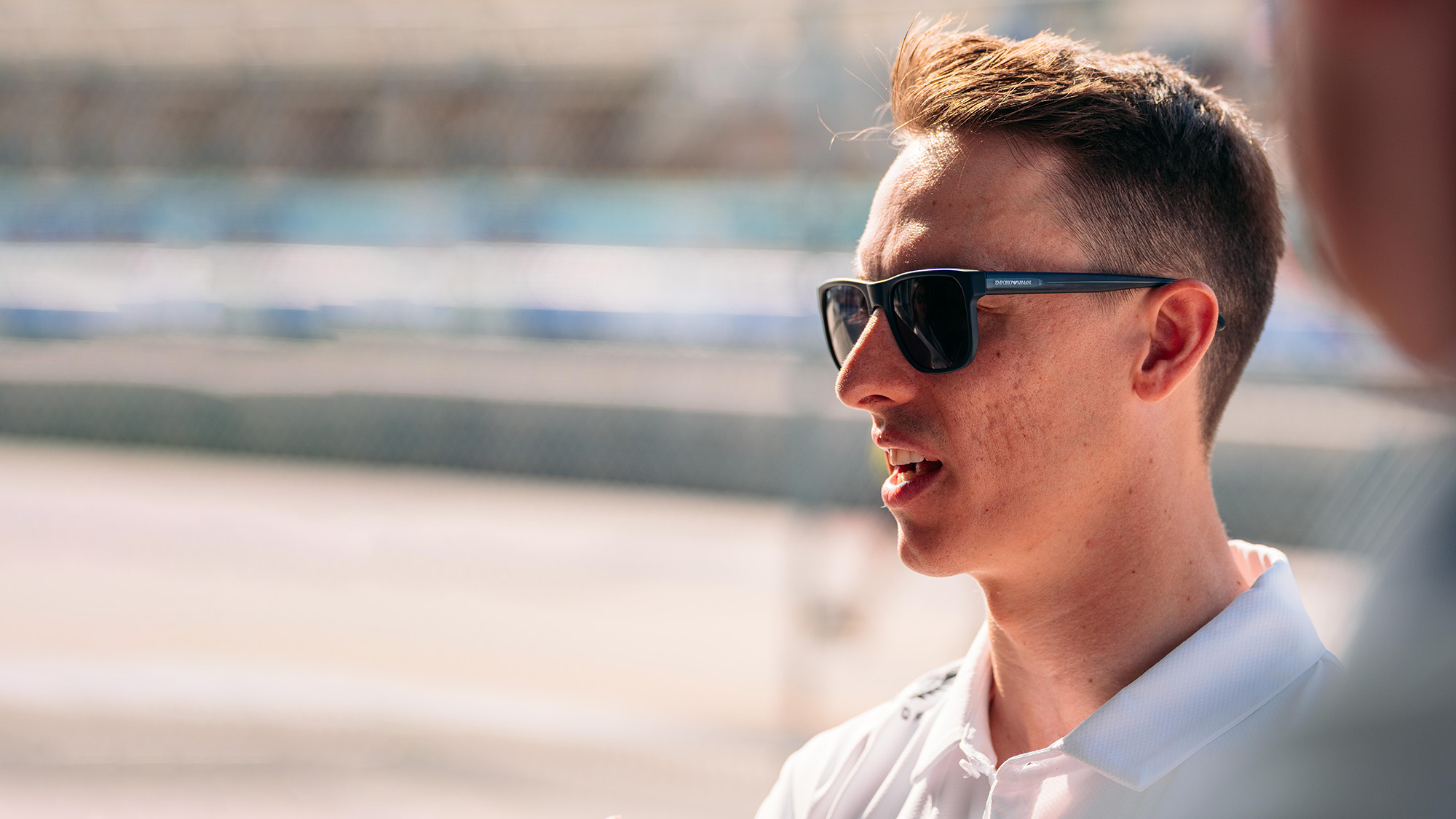
Jake Hughes will begin a new chapter in his career when he makes his endurance racing debut with Algarve Pro Racing during the 2026 European Le Mans Series (ELMS) season.
The 30-year-old British driver will share the #25 Oreca 07-Gibson with Tristan Vautier and Matthias Kaiser, starting with the 4 Hours of Barcelona. His new programme follows three seasons in the FIA Formula E World Championship and an extensive single-seater career that also took him through British Formula 4, FIA Formula 3 and Formula 2.
Hughes will now exchange short-format single-seater contests for four-hour, multi-class races. Consequently, he must adapt to sharing a car, navigating traffic and contributing to a collective strategy while learning the demands of LMP2 competition.
Algarve Pro Racing eases Hughes into endurance racing
Hughes has entered unfamiliar territory despite his extensive experience across several categories. However, Algarve Pro Racing has helped him settle into the team and understand the different demands that await him.
In particular, Vautier and Kaiser will provide useful references as Hughes learns how to build an endurance race weekend. Their experience should also help him understand when to attack, when to manage the car and how to approach traffic from the other classes.
“I couldn’t have asked for better because everybody within Algarve Pro Racing has been so welcoming, helping me get up-to-speed and acclimatise to endurance racing. This will be my maiden endurance racing campaign and the transition to this point has been seamless, but I’ll still have to get used to racing among multiple classes and sharing a car with teammates while getting to know how to put together a good weekend. I’ll learn quickly with Tristan (Vautier) and Matthias (Kaiser) alongside me.”
Therefore, Hughes will not approach the season alone. Instead, he can rely on an established team and two teammates who can support his transition throughout the campaign.
At the same time, he must contribute his own pace and technical feedback as Algarve Pro Racing attempts to fight at the front of the highly competitive LMP2 field.
Formula E departure opens a new opportunity
Hughes had expected to continue racing in Formula E after spending three seasons in the all-electric championship. Nevertheless, political and financial circumstances temporarily removed him from the series’ driver market and encouraged him to explore a different direction.
Endurance racing had already attracted his attention. Moreover, his close friend Nick Yelloly regularly encouraged him to consider the discipline before winning the LMP2 class at the 2025 24 Hours of Le Mans.
“The stars aligned at the right time. Anybody with knowledge of my career will know I anticipated staying in Formula E for some time, but political and financial factors took me out of the driver merry-go-round for a moment. I’ve been looking at endurance racing from afar and one of my best friends, Nick Yelloly, has been encouraging me to get involved for some time. Not being on the Formula E grid has given me the freedom to pursue this and I’m relishing the opportunity. Nick won the 24 Hours of Le Mans in 2025 and he will be my rival this year, which will be particularly fun!”
As a result, Hughes will immediately compete against one of the people who helped inspire his move. Yelloly will return to the ELMS with Inter Europol Competition after winning at Le Mans and finishing second in the 2025 championship.
Their friendship will consequently add another dimension to Hughes’ rookie campaign as both drivers pursue victories and the overall LMP2 title with rival teams.
Traditional circuits renew Hughes’ enthusiasm
Formula E challenged Hughes with its unique cars, energy-management requirements and largely street-based calendar. However, his move to the ELMS will take him back to several permanent circuits that shaped his early career.
Silverstone holds particular importance for the Birmingham-born driver. The British round will mark his first competitive appearance at the circuit for several years and give him an opportunity to race at home once again.
“Formula E is very challenging and niche, and it has its own nuances. The calendar doesn’t take you to the tracks you grow up on in junior categories, so I’ve missed the likes of Silverstone, Imola and Spa. Doing qualifying laps on circuits like those is where I got the bug and decided to make a career out of car racing, and a personal 2026 highlight will be returning to Silverstone for the first time in four or five years. I feel very lucky to be going back there.”
Furthermore, the calendar will reunite Hughes with Imola and Spa-Francorchamps, where fast corners and elevation changes will showcase the Oreca’s aerodynamic performance.
His previous circuit knowledge should reduce part of the learning curve. Instead of starting from scratch at every venue, Hughes can concentrate on understanding how the LMP2 car behaves around familiar layouts.
Oreca 07 provides an intense first impression
Hughes first drove the Oreca 07-Gibson in Abu Dhabi and immediately noticed significant differences from the Formula E machinery he had recently raced.
The Gibson V8 engine created a more dramatic experience through its sound and vibrations. Meanwhile, the car’s size initially disguised the level of cornering performance that it could produce.
“I have driven a wide array of cars in my career and I found the ORECA 07-Gibson LMP2 to be very different from Formula E cars. I was surprised when I got into the car for the first time in Abu Dhabi. The noise and vibrations from the screaming Gibson V8 added a lot of drama and made it feel as though I was going double the speed, which makes driving intense and a serious, adrenaline-fuelled event. I was also very impressed with the cornering speeds; it’s a pretty big car in terms of its dimensions and doesn’t look like it should be capable of pulling 3G through turns – that’s comparable to Formula 2. I love that you’re flat-out from the moment you step into the cockpit. It’s a car that encourages you to push to extract lap time, which racing drivers want.”
Consequently, the Oreca gives Hughes an opportunity to use the high-downforce driving skills that he developed during his single-seater career. Its performance through fast corners also compares favourably with the Formula 2 machinery that he previously raced.
However, Hughes must manage more than outright speed. He will also need to protect the tyres, adjust his approach around slower traffic and deliver consistent lap times throughout longer stints.
Competitive LMP2 field sharpens title ambitions
Hughes will enter one of the strongest categories in European endurance racing. The LMP2 grid includes established ELMS champions, Le Mans winners, experienced prototype drivers and several successful teams.
Nevertheless, he welcomes that standard of competition. Algarve Pro Racing also enters the season with its own history of success, giving the #25 crew a realistic opportunity to challenge for major results.
“I’m very much expecting a very competitive 2026 ELMS season. The grid is stacked with good teams and driver crews, and we’re going to have one hell of a fight. We will have to be at the top of our game to win races and championship titles, and that’s exactly what we want. We get into racing to be pushed hard. Come the end of the season, I hope we see that we had a lot of fun and success along the way.”
Accordingly, Hughes does not view his first season simply as an extended learning exercise. While he must adapt to endurance racing, he also wants to fight for victories and contribute to a championship challenge.
Strong teamwork will prove crucial. Vautier, Kaiser and Hughes must align their set-up preferences, avoid mistakes and execute each race cleanly to remain competitive throughout the year.
Late start shaped Hughes’ determined approach
Although Hughes eventually reached Formula 2 and Formula E, he began racing later than many of his rivals.
He spent his childhood playing football and entered his first kart race at 16. Therefore, he needed to accelerate his development and produce results quickly as he attempted to build a professional career with significant reliance on sponsorship.
“I find talking about myself difficult because I don’t like to be the centre of attention. To use a well-worn cliché, I like to do my talking on the track. A lot of people aren’t aware that I started racing late. I played football as a kid and only found karting by accident, entering my first race aged 16. It meant I had to accelerate my learning and, in my first Formula 4 season at the age of 19, I knew I had to win races and championships to succeed because we were heavily reliant on sponsors and you only get support if you achieve results.
“Those times have stood me in good stead for the rest of my career because I have had to earn everything, and that’s also reflected in who I am off the track. I’m fully focused on my racing, while also working as a reserve driver in Formula E and holding a simulator and test role with current F1 World Champions, McLaren. I still find time to cycle, play golf and football. In fact, football is my main interest – it goes back to childhood, as my family are passionate supporters of Aston Villa.”
That compressed development path helped Hughes establish a determined and adaptable approach. It should now support him as he learns another discipline and attempts to reach a competitive level quickly.
Alongside his ELMS programme, Hughes will maintain his Formula E reserve duties and his simulator and testing work with McLaren. Therefore, he will continue drawing experience from different forms of high-level motorsport throughout the year.
Barcelona begins a new phase for Hughes
The 4 Hours of Barcelona will give Hughes his first opportunity to apply his preparation in competitive endurance racing.
He must navigate multi-class traffic, share set-up decisions with Vautier and Kaiser and manage the longer race format. In addition, he will need to develop an effective rhythm during the limited practice running before his first LMP2 race start.
However, Algarve Pro Racing’s support and the Oreca’s performance have already given Hughes confidence ahead of the opener. His previous experience across several single-seater categories also provides a strong technical and competitive foundation.
After three Formula E seasons, Hughes now faces a completely different challenge. Yet the change gives him an opportunity to revisit the circuits that inspired his career, pursue success in LMP2 and establish a new future in endurance racing.