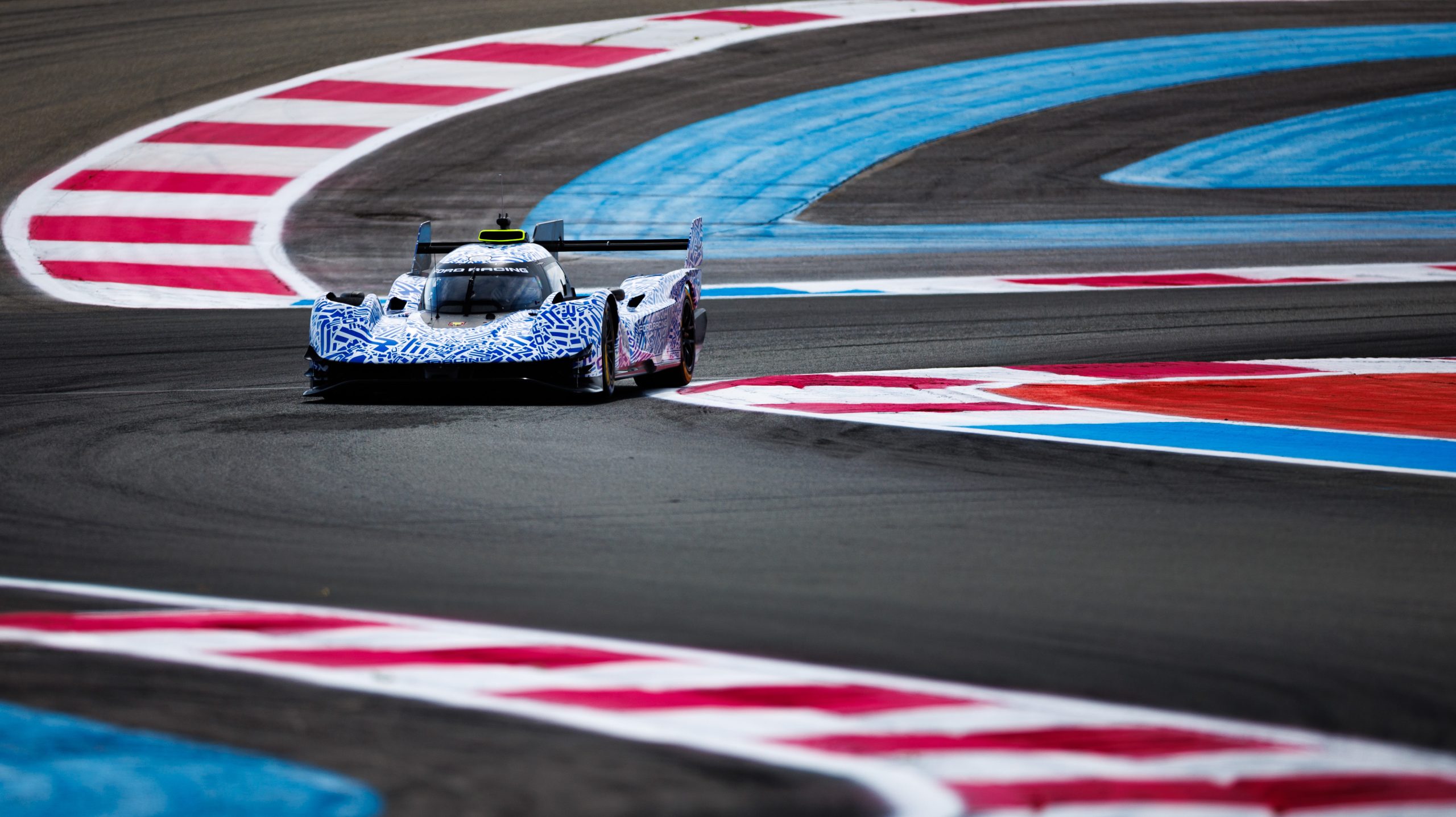
Ford Racing has completed the first full test of its new Hypercar as preparations continue for the manufacturer’s return to the top level of the FIA World Endurance Championship (WEC) in 2027.
The yet-to-be-named prototype covered more than 1,000 kilometres during a shakedown and three days of running at Paul Ricard, marking the next major stage of a development programme that will continue across Europe and the United States through the remainder of 2026.
Logan Sargeant, Matt Campbell, Tom Blomqvist and Mike Rockenfeller drove the car in France, while Sebastian Priaulx and Nick Yelloly also attended to contribute feedback and prepare for future testing. Ford confirmed its six-driver factory Hypercar line-up earlier this year.
Ford reaches significant Hypercar milestone ahead of 2027 WEC entry
The Paul Ricard running represented the car’s first extended track programme after Ford fired up its 5.4-litre Coyote-based V8 in the ORECA-built chassis in July.
Ford Racing Global Director Mark Rushbrook described the test as an important moment, while acknowledging how much development remains before the programme reaches competition.
“Getting our Hypercar out on-track for the first time was a huge moment for the team,” commented Rushbrook. “This is only the first step of a long and demanding development road, but every mile we put on this car brings us closer to Le Mans, and closer to reclaiming our place at the top of endurance racing.”
Ford has spent months preparing the car away from the circuit, including extensive dynamometer work in Dearborn and simulator development at its North Carolina facility.
Hypercar Programme Manager Dan Sayers believes that preparation allowed the team to begin meaningful work immediately at Paul Ricard.
“This is exactly the milestone we set out to hit,” echoed Sayers, reflecting upon the model’s first extended running since the 5.4-litre, Coyote-based V8 engine was fired up at chassis partner, ORECA in early July.
The test therefore represented more than simply the first opportunity to accumulate mileage. Ford also began validating the work completed through its virtual and bench-testing programmes.
“Everything we did in the build-up – the dyno work in Dearborn, the fire-up in France, the countless hours in the sim – was about making sure that when we rolled out onto the track, we were ready to plug and play. There’s a long list of milestones still ahead of us before Q1 2027, but these past couple of weeks have given the team a lot of confidence and strong foundations to build upon.”
Sargeant encouraged by strong start
Sargeant formed part of the driving group at Paul Ricard as he prepares for his return to prototype competition with Ford.
The former F1 driver currently races in WEC’s LMGT3 category with Ford customer team Proton Competition, giving him race experience within the championship before the manufacturer enters Hypercar next season.
He highlighted the inevitable learning process involved in starting an entirely new programme, but felt Ford began from a strong position.
“Kicking off a new programme always takes time,” acknowledged Sargeant, who currently competes for Ford customer outfit, Proton Competition in FIA WEC’s LMGT3 division. “You’re figuring out how all the pieces fit together, and we’re still working through that. That said, we really hit the ground running – and starting testing from where we did is a huge credit to the team.
Ford’s extensive simulator programme gave its drivers and engineers a baseline before the car completed its first serious track mileage.
“There have already been countless hours poured into this project, including a ton of time in the simulator, so we’ve had a massive head-start. Now, it’s about making sure everything comes together flawlessly, and that’s the next step for us. We can honestly say we’ve started in the best possible way.”
Campbell completes most mileage at Paul Ricard
Campbell accumulated the most track time of Ford’s drivers during the three-day test and reported a largely trouble-free programme.
The Australian also experienced the 5.4-litre V8 from inside the cockpit for the first time, describing the noise as even more dramatic than videos of the car have suggested.
“I’ve been here for the whole test and from my side, it’s gone smoothly,” added Campbell. “I’ve seen fans online raving about how awesome the sound is, but from inside the cockpit, it’s on another level – it’s absolutely deafening! I’m genuinely excited for what’s ahead with this car.
Minor issues arose as Ford accumulated mileage, although Campbell regarded them as a normal part of developing a brand-new prototype.
“We know there’s a long road in front of us, but this has been a really positive start. I’ve had the most track time out of the drivers, and aside from a few minor teething issues – which you’d expect at the beginning of a new programme – everything has gone well. From here, things really ramp up; I’m heading back to the USA for three days of sim work before returning to Europe for the next test.”
Ford prepares intensive three-continent test programme
Paul Ricard begins a much larger development programme as Ford prepares for its first top-class WEC campaign in almost six decades.
The team will next conduct three days of simulator work in North Carolina before returning to Europe for another track test at Portimão at the beginning of September.
Further European running will follow at Silverstone, Monza, Imola and MotorLand Aragón. Ford will then move its testing programme to the United States towards the end of 2026, with Circuit of The Americas and Sebring both scheduled to host the Hypercar.
The programme will focus on areas including performance, reliability, hybrid-system integration and aerodynamic validation as Ford moves closer to homologating the final race specification.
Ford Hypercar project builds towards 2027 WEC return
Ford will join a growing Hypercar field in 2027 as it returns to the top class of international endurance racing for the first time since its famous programme of the 1960s.
Sargeant, Campbell, Blomqvist, Rockenfeller, Priaulx and Yelloly will form the six-driver factory roster across Ford’s two-car effort. The manufacturer has yet to reveal the final driver pairings or official name of its new prototype.
Paul Ricard provided the first significant indication of how far that programme has progressed. With more than 1,000 kilometres completed and a busy testing schedule still ahead, Ford has now moved firmly from preparation into full-scale development before its 2027 WEC debut.