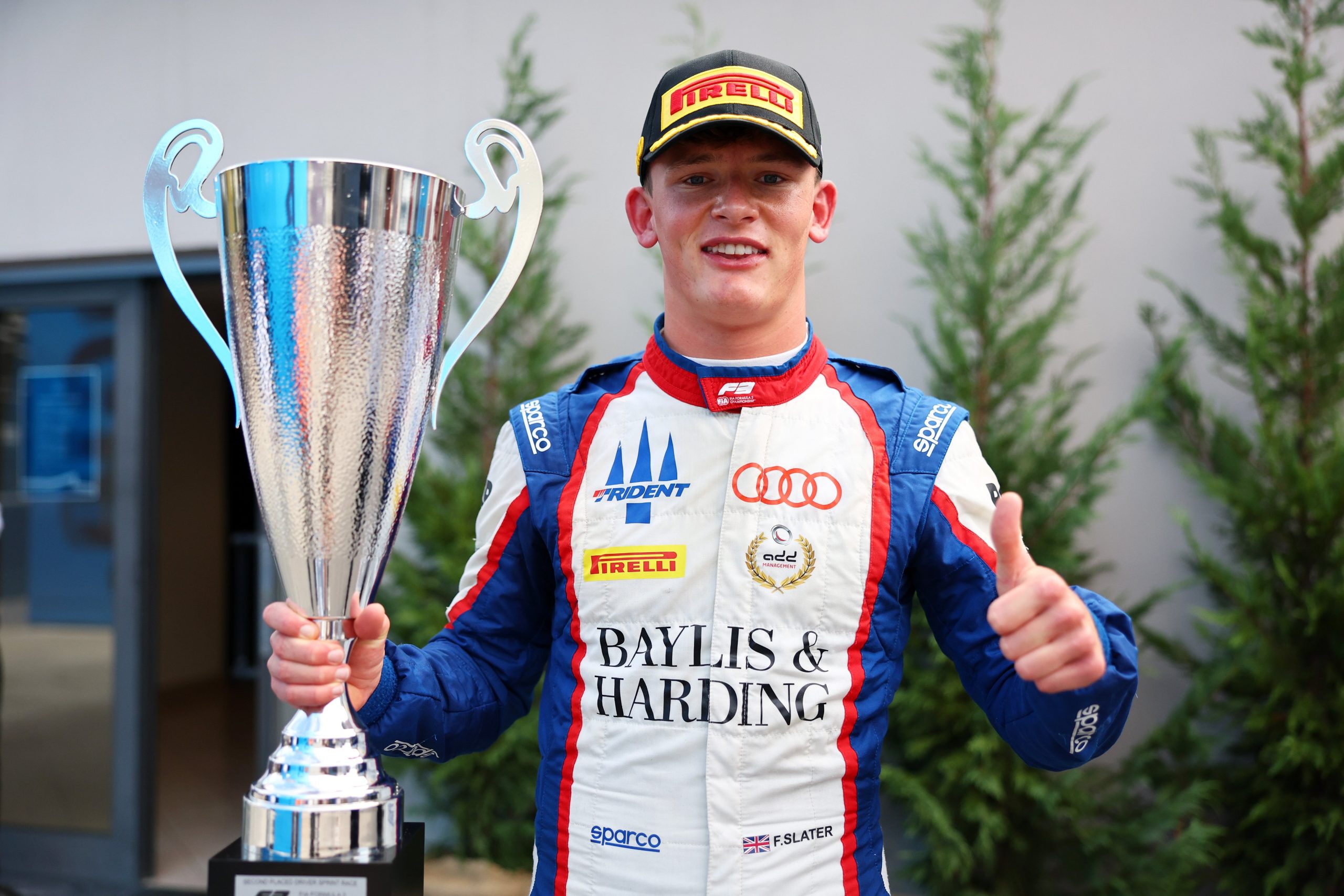
Freddie Slater strengthened his position at the top of the 2026 FIA F3 Drivers’ Championship with a charge from P12 to P2 in Saturday’s Monza Sprint Race, securing his eighth podium of the season after another chaotic contest at the Italian circuit.
During the post-Sprint press conference attended by Pit Debrief, the TRIDENT driver reflected on his recovery through the field, his increasingly measured approach to the championship and the challenge that awaits from pole position in Sunday’s Feature Race. Later in the press conference, Pit Debrief asked Slater whether Monza’s three DRS zones had turned overtaking into a question of choosing where to attack rather than simply finding an opportunity.
Slater also looked ahead to the season finale in Madrid, where the circuit made a strong impression on him during the recent test.
Slater works his way through the field to take P2 in the 2026 Monza F3 Sprint Race
The TRIDENT started the Sprint Race from P12 after taking pole position in Qualifying, which reversed the top 12 for Saturday’s grid. However, he initially found few opportunities to make significant progress as the field remained closely packed through the opening laps.
“It was a pretty chaotic race. During the first few laps there were not many opportunities and I think I only gained one or two positions. Then the momentum kept going. I knew the key to racing at Monza was to keep moving forward because, as soon as you go backwards, it is very difficult to reset.”
As the race developed, incidents ahead created openings while the powerful slipstream allowed Slater to build momentum through the field. Rather than forcing his way through immediately, he remained patient and waited for the race to develop around him.
“A lot of people made mistakes and there were several incidents ahead. I knew I needed to bide my time because it was a long race and the tow and DRS are so powerful. I used that to my advantage and came through the field.”
That patience, combined with the pace TRIDENT provided, allowed Slater to climb all the way to second place.
“It was a very positive race from my side, and the team gave me an amazing car. It is one I will remember for a long time because it was good fun.”
Four-wide 2026 Monza F3 Sprint battle sends Slater onto the grass
Slater’s progress included several aggressive battles into the opening chicane, where the slipstream repeatedly brought several drivers together under braking. One of the most dramatic moments came when Slater found himself four wide and briefly ran onto the grass.
“That was not ideal. I did not fancy mowing the grass at Monza. We were four wide and the slipstream was so powerful that all three of us were arriving together, so it was always going to happen.”
Although the incident appeared dramatic from the outside, Slater felt the situation remained manageable from inside the cockpit. However, he admitted that the limited awareness drivers have when several cars arrive side-by-side made the moment difficult to judge.
“It probably looked spectacular on television, but in the car it felt manageable. When you are four wide, nobody knows exactly where everyone else is. I tried to get back onto the track, managed to do so and then picked the move off at the end to come away with P2.”
The recovery ultimately delivered another podium, but Slater continues to measure his championship campaign by more than the headline results alone.
Slater sticks with measured 2026 F3 championship approach after Monza Sprint Race success
With some of his closest championship rivals enduring difficult results, Slater had an opportunity to increase his advantage before F3 heads to Madrid for the final round. However, he insisted that their struggles would not change the approach he has taken throughout the season.
“Definitely, for sure. I think when you see people having bad days, of course, you want to maximise more. But at the end of the day, we’re only maximising every race the same we’ve done all year of just trying to get the absolute maximum we can in that race without taking too much risk.”
That restraint has become an increasingly important part of Slater’s rookie campaign. Rather than risking a strong points finish in pursuit of only a slightly better result, he has learned when to accept what the race offers.
“And I think that’s what I’ve learned throughout the year, especially when we went into round two, round three, is actually kind of just picking up a fourth and a fifth instead of trying to fight for a third or a second and taking full risk.”
For Slater, that shift has not meant becoming overly conservative. Instead, it has meant identifying when the potential reward no longer justifies the level of risk.
Slater carries 2026 Monza F3 Sprint mindset into Feature Race
Despite the championship entering its decisive stages, Slater does not intend to alter the approach that has put him in contention. He plans to carry the same mentality into Sunday’s Feature Race before turning his attention towards Madrid.
“So it’s been the same approach since we started really. And now it’s going to be the same attitude now going into the Feature Race and see what we can do tomorrow.
“And then we look forward to Madrid, which is going to be very interesting and chaotic. But yeah, let’s try and maximise the results tomorrow and then see where we’re at.”
The emphasis on maximising every opportunity has become central to Slater’s title challenge. Rather than looking only at wins or podiums, he has increasingly focused on protecting his championship position on weekends where circumstances work against him.
That idea formed another major part of his reflections after the Sprint Race.
‘It’s the bad days that count’
Slater returned to the importance of consistency later in the press conference when discussing how crucial a strong Monza result could prove before the championship finale. For the Briton, the foundation of his title challenge has come from execution and limiting the damage on weekends when circumstances work against him.
“For sure, it’s very important for a good result tomorrow and also in total this weekend. But for me, I know I keep banging on about it, but it’s the same thing that’s been all year. It’s just execution, trying to maximise every result possible and try not to have any bad days.”
However, Slater believes championships often depend less on what a driver achieves when everything works and more on what they salvage when things go wrong.
“And I think this is where this championship is. One is on the bad days and how much you can get the damage limitation, how much can you maximise those results. It’s not about the wins and the podiums, it’s the bad days that count.”
That philosophy has shaped the way Slater evaluates his performances throughout the year.
Monza highlights importance of damage limitation
Monza provides a particularly strong example of the uncertainty Slater has needed to manage because its Qualifying format and powerful slipstream can leave drivers vulnerable to circumstances outside their control. Nevertheless, he believes TRIDENT has consistently limited the damage when those situations have developed.
“So I think that’s what we’re doing a really good job at the moment, especially on a track like Monza, where it’s a little bit like a gamble going into Qualifying, as you saw yesterday, with only one lap. So I think it’s part of the game and it was always kind of the approach I had and I knew it was going to have to be like this.”
That understanding shaped Slater’s expectations from the beginning of the campaign. He knew that even a title-winning season would inevitably include weekends when victories were not realistic.
“I knew I couldn’t win every race. I knew I had to just maximise the bad days. And I think that’s what’s put us in this position.”
Sunday will now present a completely different challenge. Instead of carving his way forwards from the sixth row, Slater will start the Feature Race from pole position.
Slater targets break with Monza pole ‘curse’ after 2026 F3 Sprint success
Slater’s Qualifying performance put him at the head of the grid for Sunday’s Feature Race, although pole position offers no guarantee of an easy afternoon at Monza. When told during the press conference that no F3 driver had previously won at Monza from pole position, Slater immediately set his sights on changing that statistic.
“Cool stat, but I’m aiming to break that for sure. But, you know, we just got to play out and see what happens. You know, it’s Monza at the end of the day.”
Saturday’s Sprint Race showed how dramatically the order can change as drivers repeatedly gain and lose momentum in the tow.
“You saw what happened in that race. The ebb and flow throughout the race where people are dropping back, coming forward is always very chaotic. So just as it’s going to be important to what we did today, we have a good car underneath us.”
That gives Slater confidence for Sunday, but he still expects the race to demand a very different style of management from the front.
Strong start becomes first priority
For Sunday, Slater sees a clean start and consistent driving at the front as crucial. Rather than using the tow to attack from the midfield, he will need to control the race while the cars behind benefit from the aerodynamic advantage he used so effectively on Saturday.
“We just need to get a good start and then just manage from there and see where we end up. I think it’s going to be important to be consistent, very clean driving and try and keep the momentum as well at the front.”
Slater believes the lack of forward momentum among the leaders contributed to the unpredictability of Saturday’s race because repeated defensive moves allowed more cars to join the fight.
“Because I think that’s what made the race more chaotic today was the momentum at the front was kind of always defending going backwards and it just brought more people in. And that kind of meant there was just more chaos and more drama.”
Therefore, controlling the pace rather than becoming trapped in constant defensive battles could prove crucial.
Front runners need to maintain momentum
Slater believes the leading drivers can influence how chaotic Sunday’s race becomes. If they continually slow one another while defending, the cars behind can use the tow to close the gap and expand the fight for the lead.
“So then I think tomorrow is really important for the front guys to just keep going with the momentum and get away. So yeah, we’ll see how it plays out and I look forward to it.”
That task becomes even more difficult because of Monza’s three DRS zones, which give drivers several opportunities to build a run on the car ahead.
The effectiveness of those zones, however, varies considerably around the lap. That difference shaped Pit Debrief’s question to Slater during the post-Sprint press conference.
Slater about on DRS tactics in 2026 Monza F3 Sprint Race
Pit Debrief asked Slater whether Monza’s three DRS zones had made racing more about choosing where to make a move rather than simply finding an overtaking opportunity. Slater agreed to an extent, although he noted that each DRS zone does not provide the same level of assistance.
“I think a little bit, yes. I think it’s quite interesting how the one out of Lesmo 2 doesn’t feel as powerful, maybe just because it’s more tunnel effect.”
By contrast, another DRS opportunity produces a much stronger closing effect and can allow a driver to recover considerable ground on a rival.
“But the one on the main straight into Parabolica is very, very powerful. It’s pretty incredible how far you can come back from, especially when the guy in front doesn’t have DRS. For sure, you’re kind of working out when you want to use it.”
That variation means the driver must think beyond simply opening DRS whenever the opportunity arises.
Corner exits shape overtaking opportunities
Reaching a DRS zone alone does not guarantee an attack. Drivers must also execute the preceding corner correctly and monitor what develops around them because a poor exit can remove much of the advantage before the straight even begins.
“But also, if you have a bad corner, you don’t get the same effect. So it’s kind of picking your opportunities when they’re coming, when you see someone struggling, etc.”
For Slater, overtaking at Monza therefore remains closely linked to reading the behaviour of the cars ahead. A struggling rival, a poor exit or the absence of DRS can suddenly create an opportunity that did not exist moments earlier.
“So it’s just trying to read the race, you know, trying to read what happens in front of you and then manage from there.”
That requirement will become even more important when Slater starts from pole. Instead of using the tow to recover positions, he could spend Sunday providing it to the cars behind.
Beyond Monza, however, another very different challenge awaits.
Slater impressed by 2026 Madrid F3 test
F3 will conclude its 2026 campaign at the Madring, where the championship recently completed a test ahead of the circuit’s first race weekend. Slater came away from that running enthusiastic about the venue and particularly impressed by its character.
“Yeah, I loved it. I thought the track was incredible. I think it had character. It was a bit more old school, you know, all these new tracks that are coming out at the moment, they’re smooth, they’re flat, they don’t have, it just doesn’t feel as exciting to drive.”
Rather than viewing Madrid as another conventional modern circuit, he felt its bumps and close barriers gave it a greater sense of speed and consequence.
“And Madrid reminds me of Macau, Monaco, those sort of tracks, Oulton Park, you know, in the UK, like where you actually have a bit of excitement, bumps and walls actually closing in on you.”
Those characteristics place Madrid closer to the type of circuit Slater finds particularly engaging from inside the cockpit.
Madrid Qualifying already excites Slater
For Slater, Madrid’s old-school qualities make the circuit more enjoyable to drive and create a stronger sense of commitment than he feels at smoother, more conventional modern venues.
“So it’s a lot more fun to drive. And I can’t wait to get out there for a Qualifying run on Friday, which is going to be probably one of the most exciting parts of the weekend.”
His enthusiasm remained clear as he looked towards the championship finale.
“And yeah, what an incredible track to drive. And yeah, I’m very excited for it.”
Before Slater turns his attention fully towards Madrid, however, Monza still offers one major opportunity. His Sprint Race recovery demonstrated the value of patience, positioning and race management from the midfield, while Sunday’s Feature Race will test the opposite skill set as he attempts to control the contest from pole.
Yet Slater’s wider philosophy remains unchanged. Whether he starts P12 or P1, he intends to maximise what the race offers, limit the costly days and allow that consistency to shape the closing stages of his F3 championship challenge.