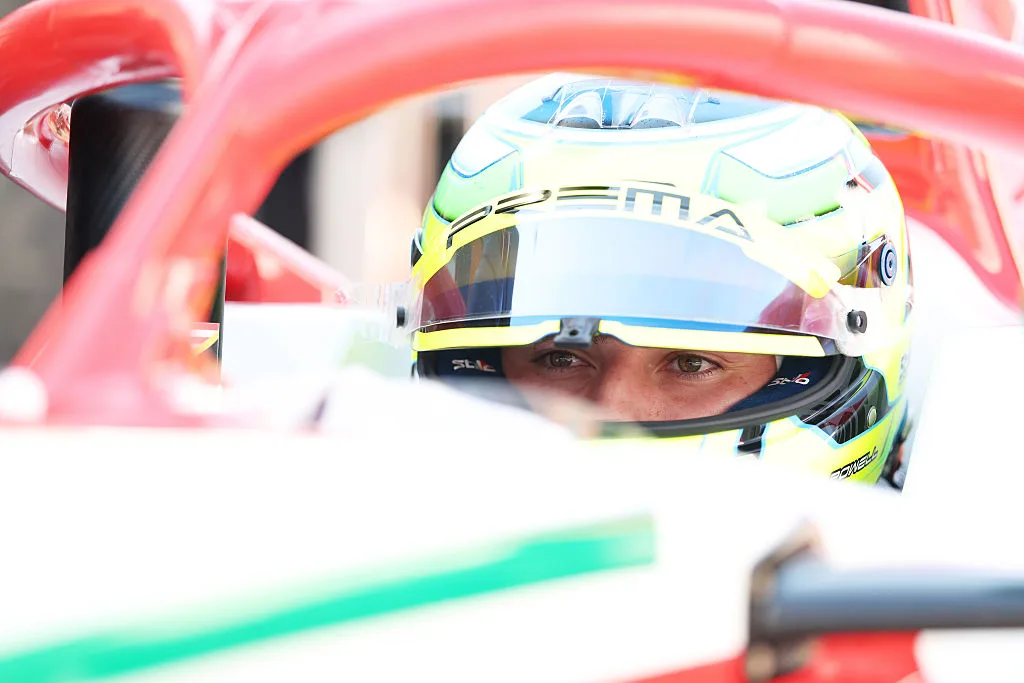
Alex Powell only contested the final two rounds of the 2026 FIA F3 season, but the American-Jamaican driver made enough of an impression to turn a late call-up into a promising introduction to the championship. PREMA Racing drafted Powell in for Monza and Madrid following Louis Sharp’s departure, giving the 18-year-old little time to prepare for a significant step up.
Monza provided the difficult introduction that Powell expected, but Madrid offered a much clearer demonstration of his potential. He qualified inside the top 10, claimed his maiden F3 podium in the Sprint Race and followed it with another points finish in Feature Race 1. Therefore, Powell ended his brief campaign with 14 points and 23rd in the Drivers’ Championship despite contesting only two rounds.
Powell receives a late opportunity with PREMA
Powell entered 2026 competing in Eurocup-3 after building experience across Italian F4, Formula 4 Middle East and Formula Regional. He also already knew PREMA well after racing for the Italian team earlier in his single-seater career and winning the Italian F4 Rookie Championship with them in 2024.
That existing relationship became important when PREMA and Sharp parted ways ahead of the penultimate F3 round. The team [brought Powell back for Monza, Madrid and the preceding Madring test] PREMA confirms Alex Powell for the remainder of the 2026 season, placing him alongside James Wharton and José Garfias. Powell described the opportunity as meaningful given PREMA’s role at the beginning of his single-seater career, but the timing gave him little opportunity to ease himself into F3.
The Madrid in-season test offered valuable mileage before his race debut, although Powell spent most of the running outside the leading positions. Rather than providing immediate evidence of outright pace, the test primarily allowed him to learn the car, tyres and procedures before facing the considerably less forgiving environment of a race weekend.
Monza delivers a baptism of fire
Powell made his competitive debut at Monza, one of the most unusual circuits on the F3 calendar and a venue where tow management heavily influences qualifying. His lack of experience immediately showed as he qualified 24th, leaving himself with significant ground to recover in both races.
The weekend consequently became an exercise in learning rather than chasing results. Powell left Monza without points, but every session gave him information he had not previously possessed about F3 race starts, tyre management and competing within a 30-car field. He later described the weekend as a “baptism of fire”, an assessment that accurately reflected how much he needed to absorb in a short period.
PREMA’s wider season also provided important context. The team had struggled compared with its previous F3 standards and eventually finished seventh in the Teams’ Championship. Powell therefore joined an operation that could not simply rely on dominant machinery to ease his transition, although Wharton had regularly demonstrated that the package still possessed points-scoring potential.
Madrid qualifying shows a significant step forward
Powell arrived in Madrid with one major advantage over Monza: familiarity. His participation in the in-season test meant that he already understood both the Madring and the F3 car, while the new circuit also denied the regular field the years of track knowledge they possessed elsewhere.
He took advantage immediately. Powell improved considerably from Practice and secured 10th in the opening qualifying session, a result he considered a [“good step forward” in only his second F3 weekend] Powell reflects on Madrid F3 Qualifying. The result also placed him third on the reversed Sprint Race grid and created his first genuine opportunity to fight near the front.
Powell managed the opportunity well. He avoided trouble during a race where overtaking proved difficult and maintained third behind Théophile Naël and teammate Wharton. His first F3 podium therefore arrived in only his third race start and gave PREMA two cars inside the top three.
A maiden podium rewards rapid adaptation
The result carried greater significance because Powell had entered the championship so late. He still needed to learn tyre management over an F3 race distance, yet he controlled his pace and avoided the mistakes that often punish inexperienced drivers. After the race, Powell explained how PREMA’s engineers and his teammates had helped accelerate his adjustment as he [reflected on his maiden F3 podium] Powell rewards PREMA with maiden F3 podium in Madrid.
Powell then strengthened his weekend in Feature Race 1. Starting 11th, he navigated an opening-lap accident that eliminated six drivers before moving into the points as the race developed. He eventually finished seventh behind Alessandro Giusti, adding another six points to the eight he collected from his Sprint podium.
The final Feature Race produced no further points, but Powell started 12th and once again placed himself close to the top 10. By that stage, his improvement from qualifying 24th at Monza to competing around the points in Madrid already demonstrated how much progress he had made across only two weekends.
A small sample offers plenty of encouragement
Powell finished the season 23rd with 14 points, placing him ahead of several drivers who contested substantially more rounds. However, the limited sample makes sweeping conclusions about his F3 potential premature. Madrid suited his circumstances because he had tested at the circuit while the rest of the field also lacked previous race experience there, and the reverse grid helped convert his strong qualifying result into a podium opportunity.
Nevertheless, Powell still needed to capitalise on those circumstances, and he did. He qualified competitively, kept himself out of trouble in the Sprint and followed the podium with seventh in Feature Race 1. Those results provided a sharp contrast to his difficult Monza debut and demonstrated an ability to process lessons quickly.
Powell’s two-round cameo therefore achieved more than simply giving him early F3 experience. Monza exposed how demanding the step could become, while Madrid showed how quickly he could respond once he gained familiarity with the machinery. Fourteen points cannot define a full F3 campaign, but Powell used his limited opportunity to leave a considerably stronger impression than his late arrival initially suggested.