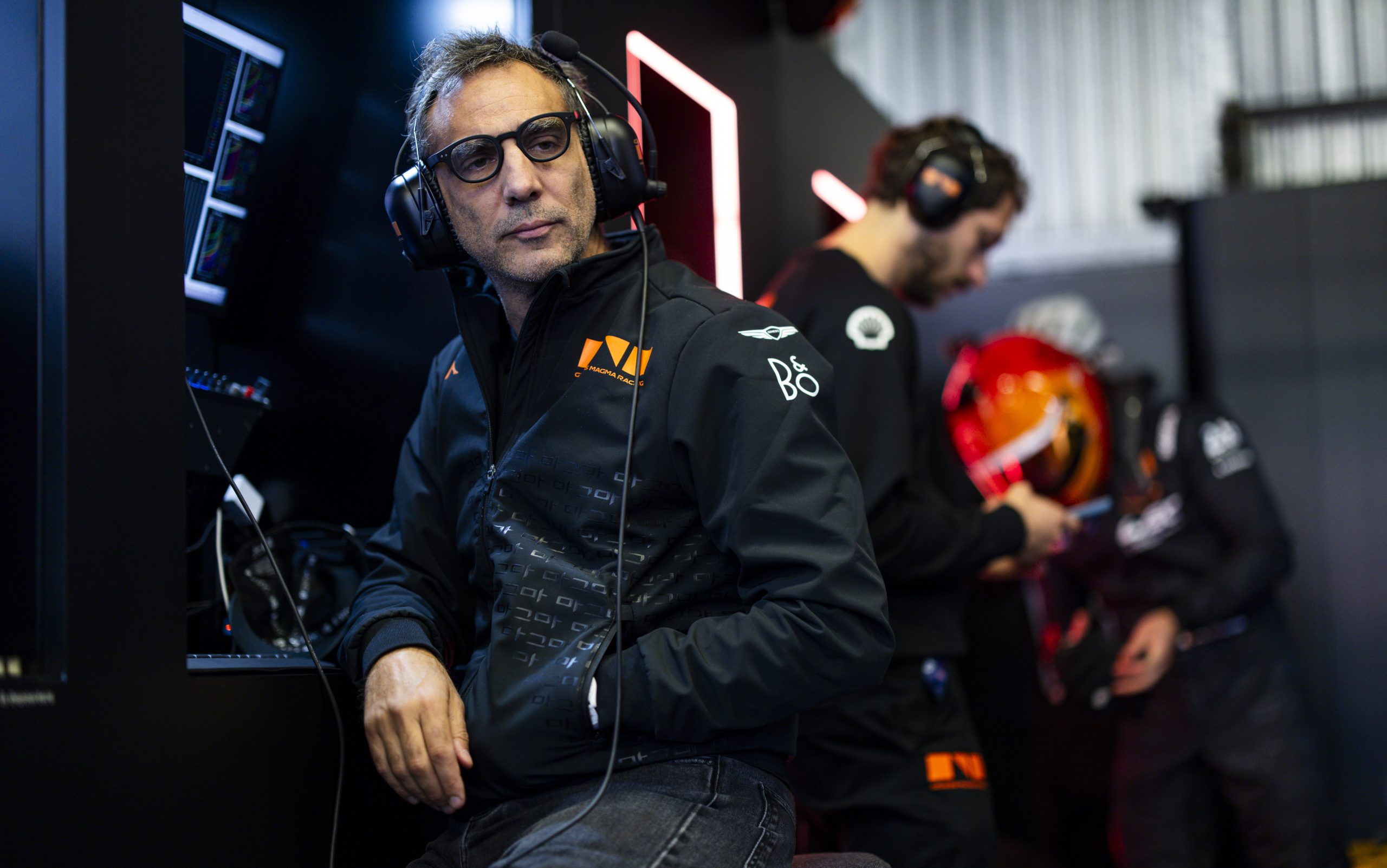
Genesis Magma Racing Team Principal Cyril Abiteboul has called for greater operational discipline following a frustrating 6 Hours of Fuji, insisting that the South Korean manufacturer must eliminate avoidable mistakes as it continues developing its FIA World Endurance Championship (WEC) Hypercar programme.
The manufacturer demonstrated its growing competitiveness during the sixth round of the 2026 season, qualifying third and fifth with its two GMR-001 Hypercars before challenging for a maiden podium. However, late penalties prevented Genesis from converting that pace into championship points, leaving Abiteboul with mixed feelings about the team’s progress.
Ahead of the inaugural 6 Hours of Barcelona presented by Visit Qatar, Abiteboul reflected on the achievements and challenges of Genesis’ first season in the championship. While he praised the reliability of the GMR-001 and the team’s rapid development, he stressed that operational improvements must now accompany its increasing competitiveness.
With Ford and McLaren preparing to join the Hypercar category in 2027, Abiteboul has also outlined his expectations for Genesis’ second campaign, identifying consistent points finishes and stronger race execution as priorities.
Genesis demonstrates podium potential at Fuji
Genesis entered the 6 Hours of Fuji seeking to build on its improvements throughout the opening rounds of its maiden FIA WEC campaign. The team had gradually developed the GMR-001’s competitiveness, moving closer to established manufacturers while gaining experience in Hypercar competition.
Its preparations for the Japanese round demonstrated that progress, with both entries performing strongly during practice. Despite limited experience at Fuji Speedway, Genesis secured its best qualifying positions of the season after officials cancelled the qualifying sessions because of heavy rain.
The #19 GMR-001 of Dani Juncadella, Paul-Loup Chatin and Mathieu Jaminet started third, while the sister #17 entry of André Lotterer, Pipo Derani and Mathys Jaubert secured fifth. The strong Fuji qualifying performance placed both Genesis cars ahead of several more established Hypercar competitors.
Chief Engineer Justin Taylor explained that the team had anticipated the possibility of losing qualifying to the weather, prompting it to prioritise representative lap times during the earlier sessions.
“In free practice, our qualifying simulations showed that the car was performing well, and we planned ahead to make sure we were ready in case qualifying was cancelled, which paid off.”
The #19 crew subsequently remained competitive during the race, running among the leading five while managing tyre performance and gaps to its rivals. Jaminet acknowledged the significance of challenging near the front.
“The car had decent pace, running fifth while managing tyres and the gaps,” he noted. “It was one of the first times this year that we were genuinely competing up front.”
Late penalties deny Genesis valuable championship points
Despite the encouraging performance, Genesis’ hopes of securing a breakthrough result unravelled during the final 45 minutes of the six-hour contest.
Officials handed both GMR-001s drive-through penalties for separate infringements, significantly compromising their positions in the closely contested Hypercar field. The #17 received its penalty after failing to respect a black-and-orange mechanical warning flag, while the #19 incurred a sanction for speeding under yellow flag conditions.
Those penalties erased the advantage Genesis had established through its pace and race execution earlier in the afternoon. Rather than challenging for its first podium, the team finished outside the points, with the #19 classified 11th and the #17 taking 15th.
The Fuji race result highlighted the narrow margins separating a potential breakthrough from disappointment in international endurance racing. Although the team demonstrated the speed to challenge more established competitors, operational errors prevented it from capitalising on that performance.
Speaking in an interview published by FIA WEC, Abiteboul acknowledged the conflicting emotions surrounding the result.
“The positive takeaway is that we were capable of achieving a standout result. On the flipside, we were unable to secure it,” he explained.
The Frenchman recognised that Genesis had made considerable progress in only six races, but he also expressed frustration that the team could not convert its improving competitiveness into a stronger result.
“You can either take pride in competing for the podium in only our sixth race, or feel frustration over the mistakes,” Abiteboul said. “I think the reality lies somewhere in-between.”
Abiteboul refuses to use inexperience as an excuse
Although Genesis remains one of the newest manufacturers in the Hypercar category, Abiteboul does not believe its relative inexperience should excuse avoidable mistakes.
The team entered FIA WEC in 2026 after an extensive development programme that included building its operational structure, recruiting experienced personnel and completing thousands of kilometres of testing. However, competing against established manufacturers has introduced challenges that testing alone cannot fully replicate.
While Abiteboul accepts that the team must continue learning, he believes Genesis should develop its processes without relying on costly race incidents to identify weaknesses. For him, achieving consistent execution represents an essential part of becoming a competitive manufacturer-backed operation.
“I don’t buy into the mindset that making mistakes is great because it helps you to learn. Personally, that philosophy doesn’t appeal to me. We don’t need to make mistakes to make progress.”
His position reflects the expectations Genesis has established for its programme. Rather than treating the debut season solely as an opportunity to gather experience, the manufacturer wants to demonstrate measurable improvements in reliability, performance and race operations.
The Fuji result reinforced the importance of that approach, particularly as the team had already developed a car capable of challenging for competitive positions. Eliminating avoidable penalties could allow Genesis to capitalise more consistently on its improving pace without necessarily requiring substantial changes to the GMR-001.
GMR-001 reliability provides major encouragement
Despite the disappointment at Fuji, Abiteboul highlighted the GMR-001’s reliability as one of Genesis’ most important achievements during its inaugural season.
The South Korean manufacturer developed its Hypercar around a 3.2-litre twin-turbocharged V8 engine, working to establish a competitive package capable of meeting the demanding requirements of endurance racing.
Genesis invested heavily in reliability testing before its championship debut, with the GMR-001 surpassing 8,000 kilometres during its development programme. That preparation has subsequently contributed to the car’s improving durability as the team gains competitive experience.
Abiteboul believes the manufacturer has already achieved several of its initial objectives, particularly after completing two consecutive races without technical problems.
“We set ourselves ambitious targets, and they have already been met,” he explained.
“We have now completed two consecutive races without a single technical glitch. That is hugely satisfying, because reliability – essential and non-negotiable when representing a manufacturer – is particularly tough to achieve in endurance racing.”
Maintaining that reliability will remain an important priority, especially as Genesis begins shifting its attention towards achieving consistent championship results.
The team’s progress also suggests that its technical development and operational preparation are producing results, even if mistakes during races continue to undermine some of those achievements.
Formula 1 and WRC experience influences Genesis development
Abiteboul has drawn extensively on his previous motorsport experience while overseeing Genesis Magma Racing’s development, combining lessons from Formula 1 and the World Rally Championship (WRC).
The Frenchman previously served as Managing Director of the Renault Formula 1 team and currently holds the position of Hyundai Motorsport President, overseeing the company’s wider international racing activities.
Those responsibilities have provided experience in managing manufacturer-backed programmes, developing competitive machinery and establishing the operational structures required to compete at the highest level.
However, Abiteboul believes different motorsport disciplines offer different lessons, particularly regarding reliability, preparation and identifying the factors that contribute most directly to performance.
“We quickly identified what was strategic, what was top priority and what was secondary. F1 teaches you how to pinpoint key performance differentiators, while rallying instils the value of solid homologation, robust durability and racking up kilometres.”
Genesis has attempted to apply those principles throughout its first FIA WEC season, balancing the development of its new Hypercar against the demands of competing with established manufacturers.
The team’s improving pace suggests that its technical approach has begun producing results, although Abiteboul now wants to ensure that race operations develop at the same rate.
Barcelona presents opportunity to build on previous testing
Genesis will continue its development at the 6 Hours of Barcelona, where the team enters the weekend with previous experience of the Circuit de Barcelona-Catalunya.
Unlike several venues on the FIA WEC calendar, the Spanish circuit is familiar to the manufacturer following testing in December 2025. Those sessions formed part of the GMR-001’s preparation for its competitive debut, providing valuable data on the car’s behaviour and reliability.
Nevertheless, Abiteboul does not believe that familiarity should dramatically change the team’s objectives. Instead, he wants Genesis to concentrate on delivering a clean race while maintaining the reliability it demonstrated during the previous two rounds.
“First and foremost, I expect us to maintain our reliability and focus on ourselves. Right now, our main enemy is ourselves. We need to bulletproof our procedures, communication and execution.”
His comments underline the importance of internal improvements as Genesis attempts to turn its growing competitiveness into regular points finishes.
The team will field its established two-car programme at Barcelona, with Juncadella, Chatin and Jaminet sharing the #19 entry. Lotterer, Derani and Jaubert will continue in the sister #17 GMR-001.
The inaugural 6 Hours of Barcelona will take place on Sunday, 18 October, with the six-hour race beginning at 12:00 local time. The event marks the penultimate round of the season, providing Genesis with another opportunity to evaluate its progress before the championship concludes at Monza.
Abiteboul targets consistent points finishes in 2027
Looking beyond the final two rounds of 2026, Abiteboul has identified the team’s second season as an important opportunity to convert its technical progress into stronger championship performances.
Genesis has already demonstrated that the GMR-001 can challenge established manufacturers, particularly during qualifying and the opening stages of races. However, the team has struggled to consistently translate that potential into championship points.
Abiteboul believes improving operational execution will prove just as important as continuing to develop the car. With reliability becoming an established strength, the team can focus on reducing penalties, improving communication and ensuring that its race performances reflect its competitive potential.
The Genesis Team Principal has therefore outlined a clear minimum objective for 2027: scoring points at every round of the championship.
“If we achieve that, we will be in a position to score points in every race, which is likely our minimum goal.”
The target reflects the programme’s long-term ambitions while acknowledging the work still required before Genesis can regularly challenge for podiums and victories.
However, achieving that consistency will become increasingly difficult as the Hypercar category continues expanding, with two major manufacturers preparing to join the championship next season.
Ford and McLaren arrivals increase Hypercar competition
Genesis will face even stronger competition in 2027, with Ford and McLaren preparing to enter the Hypercar category.
Both manufacturers have launched extensive development programmes ahead of their debuts, adding further depth to an already competitive field featuring Toyota, Ferrari, BMW, Cadillac, Peugeot, Alpine, Aston Martin and Genesis.
Ford will return to top-level endurance racing with a new Hypercar developed in partnership with ORECA. The American manufacturer has already confirmed its six-driver line-up, including Logan Sargeant, Mike Rockenfeller, Sebastian Priaulx, Matt Campbell, Tom Blomqvist and Nick Yelloly.
Meanwhile, McLaren will make its return with the MCL-HY, an LMDh-based prototype developed in partnership with Dallara and United Autosports. The British manufacturer’s preparations for 2027 have included extensive testing as it works towards challenging for overall honours.
Rather than viewing their arrival as a threat, Abiteboul welcomed the additional competition and the continued growth of the championship.
“We can’t wait to go head-to-head with them,” he explained.
“Strong competition from prestigious brands is fantastic news. This golden age of endurance racing must allow everyone to work with composure, but with the right ambition for the medium-to-long term – because for us, this is definitely a long-term commitment.”
His comments reinforce Genesis’ intention to remain in FIA WEC beyond its initial development period, with the manufacturer viewing its Hypercar programme as a long-term investment.
Genesis seeks cleaner execution during final 2026 rounds
Genesis enters the final stages of its debut FIA WEC campaign with clear evidence of progress, having improved the GMR-001’s performance and reliability throughout the season.
The team’s qualifying results at Fuji demonstrated its potential to challenge established manufacturers, while its ability to compete among the leading Hypercars offered encouragement for the future. However, the late penalties also exposed weaknesses that Abiteboul believes Genesis must address without allowing them to become recurring problems.
Barcelona now provides another opportunity to build on that progress, particularly given the team’s previous testing experience at the circuit. With the programme’s technical foundations strengthening, attention has increasingly shifted towards operational consistency and maximising opportunities during races.
The 2026 season will conclude at the 6 Hours of Monza on 8 November, giving Genesis two remaining opportunities to improve its results before preparing for an expanded Hypercar field in 2027.
Abiteboul remains confident in the manufacturer’s long-term prospects, but his expectations extend beyond simply learning from setbacks. As Genesis continues developing its programme, eliminating avoidable mistakes will become essential to achieving the consistent points finishes and podium challenges it hopes to deliver in the coming seasons.