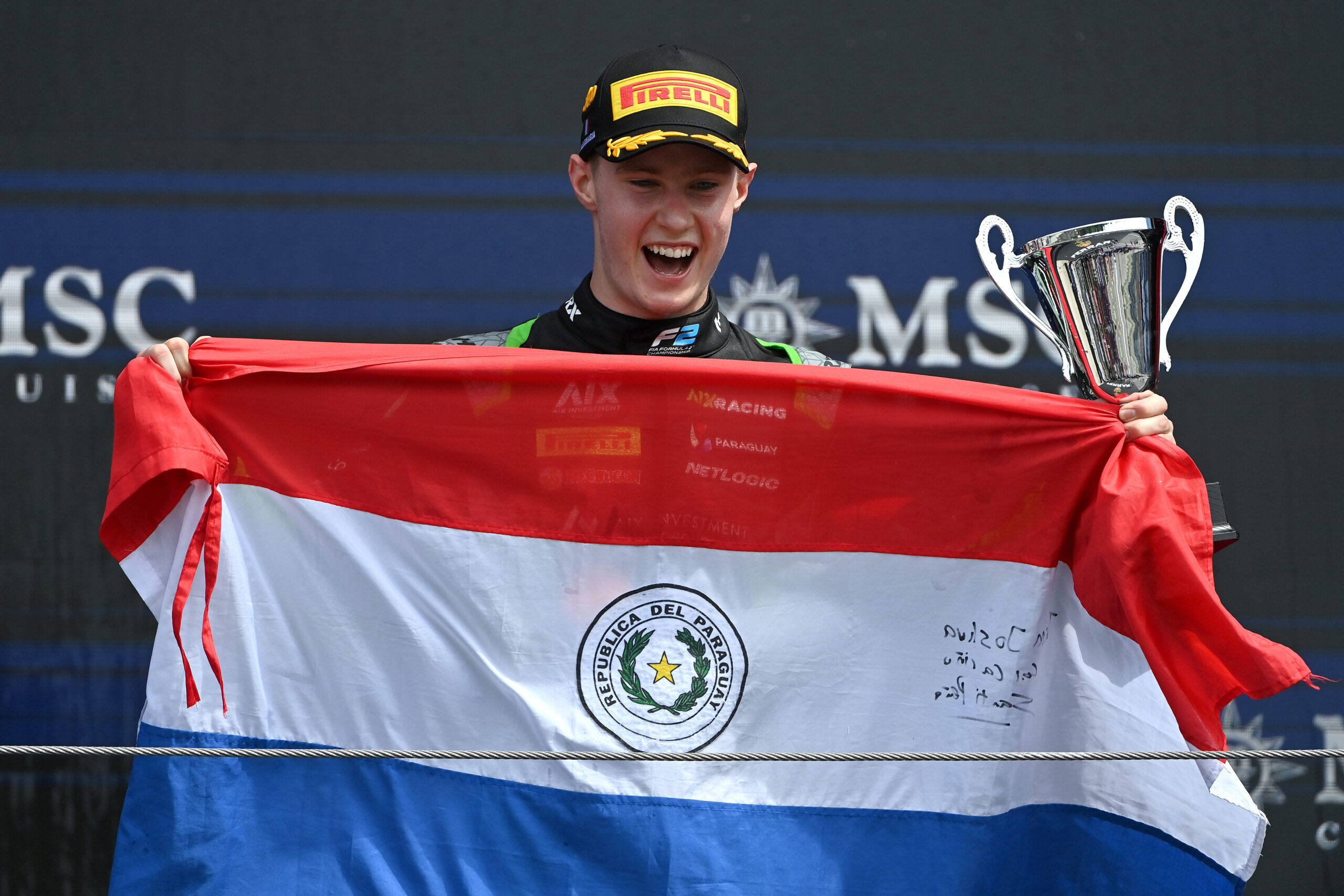
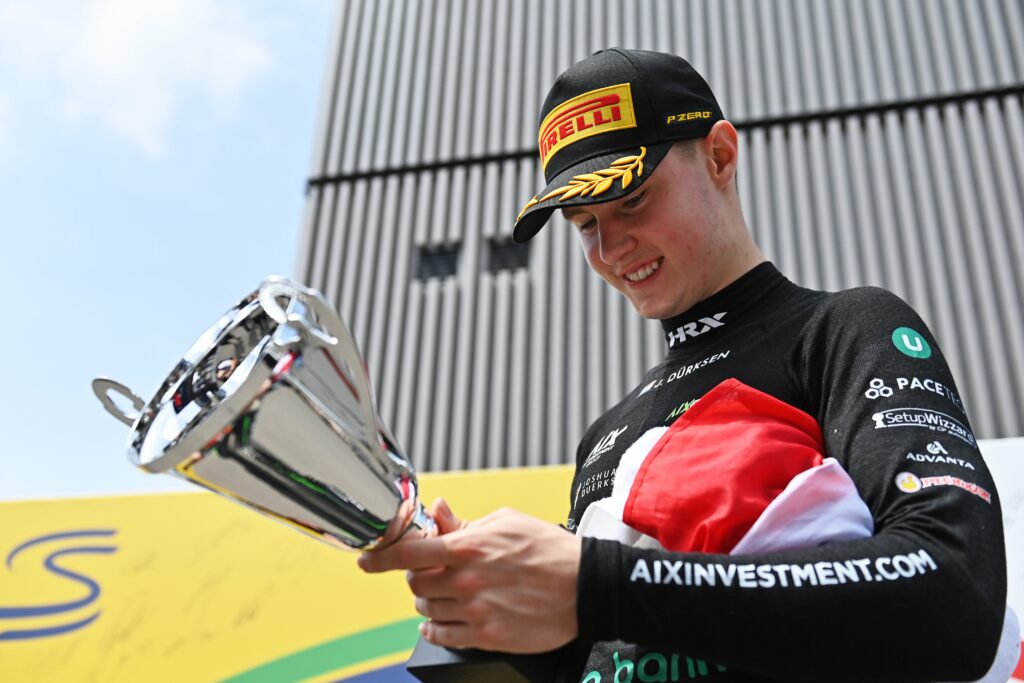
Paraguay’s sporting landscape is changing at remarkable speed. A country historically defined by football and a deep-seated rally tradition is now entering new territory, building momentum across international events, investing in infrastructure, and gaining global visibility through its athletes. At the heart of the emergence of Paraguay in single-seater motorsport stands its first Formula 2 race winner and podium finisher Joshua Dürksen, accompanied by his long-time manager Eduardo Sánchez.
For both men, the rise of motorsport in Paraguay is not an isolated development but part of a wider shift in national sporting culture. Speaking exclusively to Pit Debrief, they described their ambitions, the rapid growth they see at home, and how motorsport now intersects with the country’s international sporting ambitions.
Racing to raise the flag: Sánchez’s vision for Paraguayan single-seaters
When asked what the future of Paraguay’s single-seater landscape should look like, Sánchez did not start with driver academies, funding structures, or long-term development models. He went straight to something emotional and symbolic: the visibility of his country on the grid.
“For me, it’s very easy. My vision, and I think Joshua will agree with me, our goal is to see the Paraguayan flag and to shine for everyone. That’s all. It’s very clear and very easy. And we want to push and fight for that. That’s all.”
For Sánchez, the growth of single-seater motorsport in Paraguay means more than podiums or statistics. It means Paraguayans watching international races and spotting their flag, recognising that their country belongs on the world stage alongside traditional single-seater powerhouses. Each step he and Dürksen take—from karting to Formula 2 and whatever may follow—carries that weight. They do not only pursue trophies; they use every start, every result, and every appearance in the paddock to place the Paraguayan flag in spaces where it has never been seen before.
The growth of go-karting
If Sánchez frames the future of Paraguayan motorsport in terms of flags and visibility, Dürksen grounds that vision in what he sees at home. For him, the national shift becomes clearest when he looks back at where he began. His memories of karting in Paraguay stand in sharp contrast to what young drivers experience now.
“And for me, I’m quite happy. I think we will have good news because I see that motorsport in Paraguay is growing a lot. So I’m actually very happy because I see a bright future in Paraguay and motorsport, because I think when I was go-karting, you know, we were not a lot.”
“We were maybe in total 40 go-kart drivers when I was racing go-karts. In every category, if you combine all of this, it was maybe 40–50 maximum.”
Today, that picture could hardly look more different. When Dürksen returns to the go-kart circuit where he raced as a child, he finds a paddock that feels almost drastically different from those early days: full grids, busy mechanics, and a constant flow of young drivers preparing for international competition.
Bigger tracks, new circuits and a more ambitious Paraguay
Participation, of course, is only one part of growth. As interest rises, conversations about infrastructure naturally follow. According to Dürksen, these conversations are no longer abstract ideas but active proposals and plans circulating within Paraguayan motorsport.
“And of course they want to make a bigger go-kart track. They want also to make a new racetrack. So there are many projects in progress, many ideas, many businesses. So I see a really bright future in motorsport in Paraguay.”
This shift extends beyond circuits and into the business side of the sport, where companies are beginning to recognise motorsport not as an indulgence, but as a viable investment with measurable returns.
“And I hope, as I told you, I hope the companies—and I’m quite sure they will—see nowadays more the value of sponsoring a driver, of investing in motorsport. Even if the amounts are quite high, I think they are starting now to slowly see that motorsport is actually returning that investment and just making everything better and bigger. So, I see a bright future in Paraguay.”
Together, these developments—growing grids, new circuits, and a shifting business mindset—signal a turning point. Motorsport in Paraguay is no longer operating on the margins. It is stepping into the mainstream, supported by a community that increasingly sees it not just as a sport, but as an industry with the capacity to grow, innovate and represent the nation on a global stage.
Abu Dhabi, a presidential visit and the WRC
While Dürksen described growth from the ground up, Sánchez focused on what is shifting at the top—the political arena, the international stage, and the institutional spaces where global motorsport bodies take notice. To him, these developments matter just as much as packed karting grids. They signal that Paraguay is no longer an outsider looking in.
He illustrated this with a moment that, in his view, marked a turning point in Paraguay’s visibility: “One important thing about that too is if you can see the impact of Joshua in our country. I don’t know if [you were] there in Abu Dhabi two years ago, when the President goes. The first meeting with Mohammed ben Sulayem was there. The paddock… it was very, very crazy that afternoon in the paddock. And after that we have now the World Rally Cup. That’s huge here in Paraguay.”
Moments like these, Sánchez said, are not coincidences. They are evidence of barriers being pushed aside—politically, institutionally, and culturally.
“So every step we take is something that we have to break a wall. And we are breaking a lot of walls. And trying to help not only Joshua, but all the categories, all the industries here.”
For Sánchez, this is a true measure of growth: not only that more Paraguayans are racing, but that Paraguay is steadily earning its place within the global motorsport conversation.
Motorsport breakthroughs reaching the Palacio de Gobierno
Motorsport remains at the centre of Dürksen’s story, and the most striking signs of its rise come from moments he never imagined during his early karting years. The sport now generates reactions that travel far beyond the paddock—reaching even the highest levels of Paraguayan leadership.
“It’s just growing a lot. Speaking with the President, he calls me on FaceTime, congratulating me for the podium. It’s just something massive.”
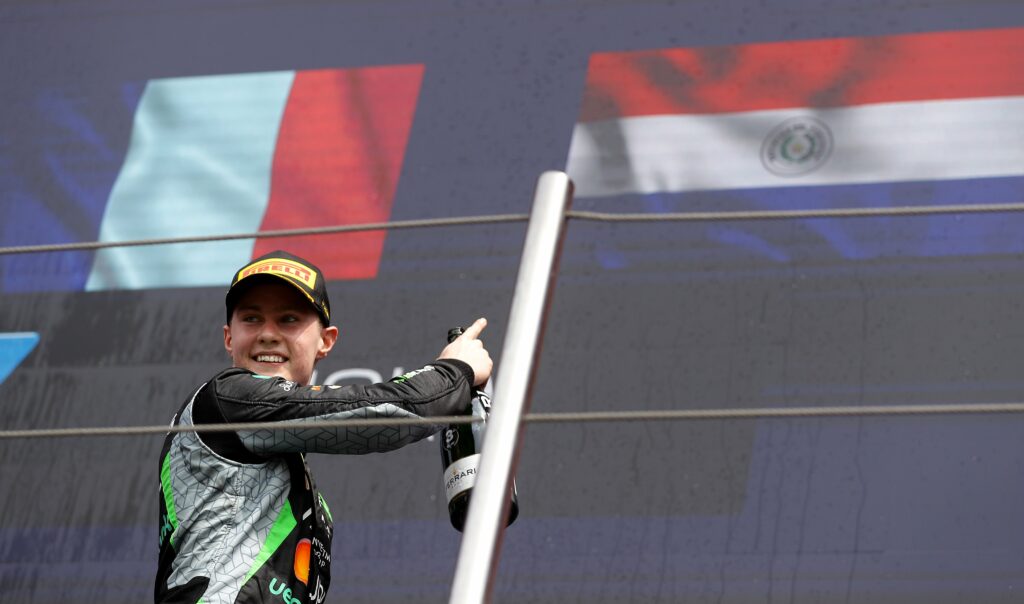
That call followed his maiden Formula 2 podium in the 2024 Imola Feature Race. What would once have been a personal sporting milestone suddenly carried national resonance, and one which received well-deserved attention from the country’s leadership.
From Trans Itapúa to the world stage: Rally del Paraguay joins the WRC
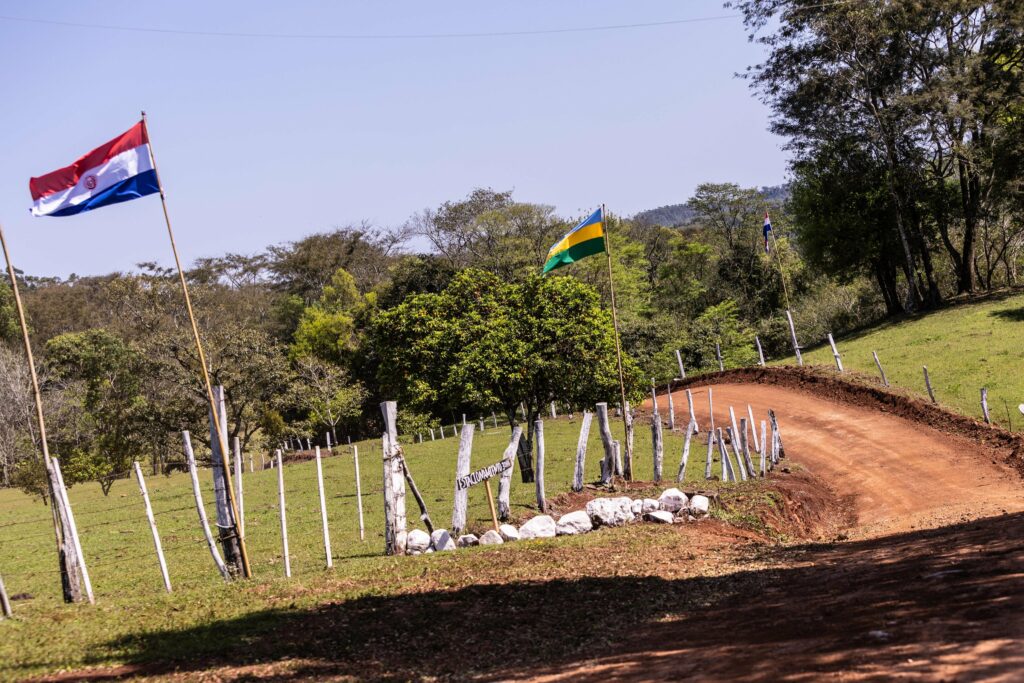
From there, the picture widens. Paraguay’s rallying tradition—rooted in the long-running Rally Trans Itapúa, held annually since 1981—has evolved rapidly. In 2024, a trial event served as the final test before Paraguay stepped onto the global stage. One year later, the 2025 Rally del Paraguay, based in Encarnación, became an official round of the World Rally Championship.
Nineteen special stages and 335 kilometres of competition later, Paraguay had become the 38th nation ever to host a WRC round. Drivers, teams, and global broadcasters descended on Itapúa’s red-earth roads in a moment that would have once been unimaginable.
“And like Edu said, having the World Rally Championship in Paraguay is also something that literally we have never dreamed about. We have never thought that it would be possible, and now it’s possible.”
A nation hosting the Americas
After outlining motorsport’s rise, Dürksen widened the frame. He sees the same momentum running across Paraguayan sport more broadly—different disciplines stacking on top of one another, reinforcing a collective sense of transformation.
The clearest symbol, he said, came in August 2025, when Asunción hosted the Junior Pan American Games for the first time. Known as Asu 2025, the event brought 3,975 athletes from all 41 Panam Sports nations to venues across Asunción, Luque, Ypacaraí and Encarnación. Over 336 events in 28 sports, Paraguay became the sporting capital of the Americas for two weeks. As hosts, they fielded 327 athletes and finished with 23 medals—3 gold, 6 silver and 14 bronze—a breakthrough return at their first hosting of the Pan American Games of any level.
That success set the stage for an even more consequential step. In October 2025, after a tight two-city race, Asunción defeated Rio–Niterói by 28–24 to secure hosting rights for the 2031 Pan American Games. It will be the first time in history that Paraguay welcomes the senior Pan American Games. The bid drew strength from rare political and institutional alignment: the backing of President Santiago Peña, the influence of Paraguayan Olympic Committee president and IOC member Camilo López, and an ambitious plan to expand the Parque Olímpico and upgrade transport links, while partnering with El Salvador to stage the surfing events.
“We had the Pan American Junior Games here, now we will have the Senior Games. The football national team classified finally to the World Cup again.”
For Dürksen, these milestones are all connected—evidence that Paraguay is entering a new sporting era defined by ambition, visibility and coordination.
A sporting identity reimagined
As Dürksen spoke, the pattern became increasingly clear. The World Rally Championship, the Junior Pan American Games, the 2031 Pan American Games, the football team’s World Cup qualification—they all reflect a country recalibrating its relationship with sport.
“So not only in motorsports, but I think in every single kind of sport in Paraguay, it’s growing massively. And I’m super happy that people are starting to see that sports are important. Sports are not only for entertainment, but they also really contribute a lot to the growth of the whole country.”
For Dürksen, the first Paraguayan driver to race in Formula 2, motorsport is one of the most visible drivers of this momentum and cultural shift, but it moved in step with a larger transformation. Paraguay is discovering how sport could project identity, attract investment, strengthen institutions, and reshape both how the country sees itself and how the world sees Paraguay.
From “lonely land” to a national sporting hub
If one example captures Paraguay’s transformation in physical terms, it is the evolution of the site used for the Pan American Games. Dürksen recounted the story with clear admiration, using it as a symbol of what long-term investment can achieve.
“I have so many stories to tell you guys. For example, this Pan American Games was made in the Olympic Committee of Paraguay, on their space. They have shown us a video from 2011, when it all started. What they gave to them, it was just like a lonely land. There were just two trees, an old house, almost demolished, almost breaking down. There was nothing.”
What has happened since then is extraordinary. That “lonely land” is now the Parque Olímpico, a sprawling sports complex in Luque, just outside Asunción, owned by the Paraguayan Olympic Committee and inaugurated in 2017 after major investment. What began as an empty plot has become one of the most comprehensive Olympic centres in the region.
Parque Olímpico: The physical story of Paraguay’s sporting ambition
The Parque Olímpico now houses an Olympic Training Centre, a synthetic athletics track, an Olympic Aquatic Centre, a velodrome, a shooting range, a skatepark, tennis and padel courts, beach volleyball and beach soccer venues, and dedicated facilities for archery, hockey, golf, speed skating and more. It has already hosted the 2019 FIFA Beach Soccer World Cup, served as a core cluster for the 2022 South American Games, and most recently anchored events for the 2025 Junior Pan American Games—a progression that would have been unimaginable when the land was first handed over.
“And if you look at today, it’s the biggest Olympic Centre, let’s say, in South America. The most complete, the most everything. And it’s just growing so much. So I want to show you what really Paraguay is investing in the sports, and it’s really paying off. So I’m extremely happy for that.”
For Dürksen, the Parque Olímpico is not simply a collection of facilities but a statement of national intent—proof, in concrete and floodlights, of how far Paraguay has come and how much further it aims to go.
Sport diplomacy: When competition becomes policy
To close the discussion, Sánchez placed everything—events, infrastructure, international visibility—into a broader political context. For him, sport is not merely a cultural phenomenon or an economic sector. It is a strategic tool.
“Sport diplomacy is a part of the agenda here. It’s very important for everybody.”
This brief statement ties together everything he and Dürksen described: the presidential visits, the global partnerships, the symbolism of the flag, the investment in facilities, and the international reach of events like the WRC.
A country accelerating into a new era
Taken together, the reflections of Dürksen and Sánchez reveal a Paraguay in motion—not quietly, not gradually, but confidently and visibly. Karting grids are full, sponsors are shifting attitudes, new circuits are being planned, and global institutions are paying attention. Behind it all is a sense that sport, and motorsport in particular, can play a defining role in shaping how Paraguay sees itself and how the world sees Paraguay.
And anchoring this vision is Sánchez’s simple, unwavering goal: “To see the Paraguayan flag and to shine for everyone.”
It is that aspiration—clear, emotional and deeply patriotic—that now drives one of the most compelling sporting rises in South America.