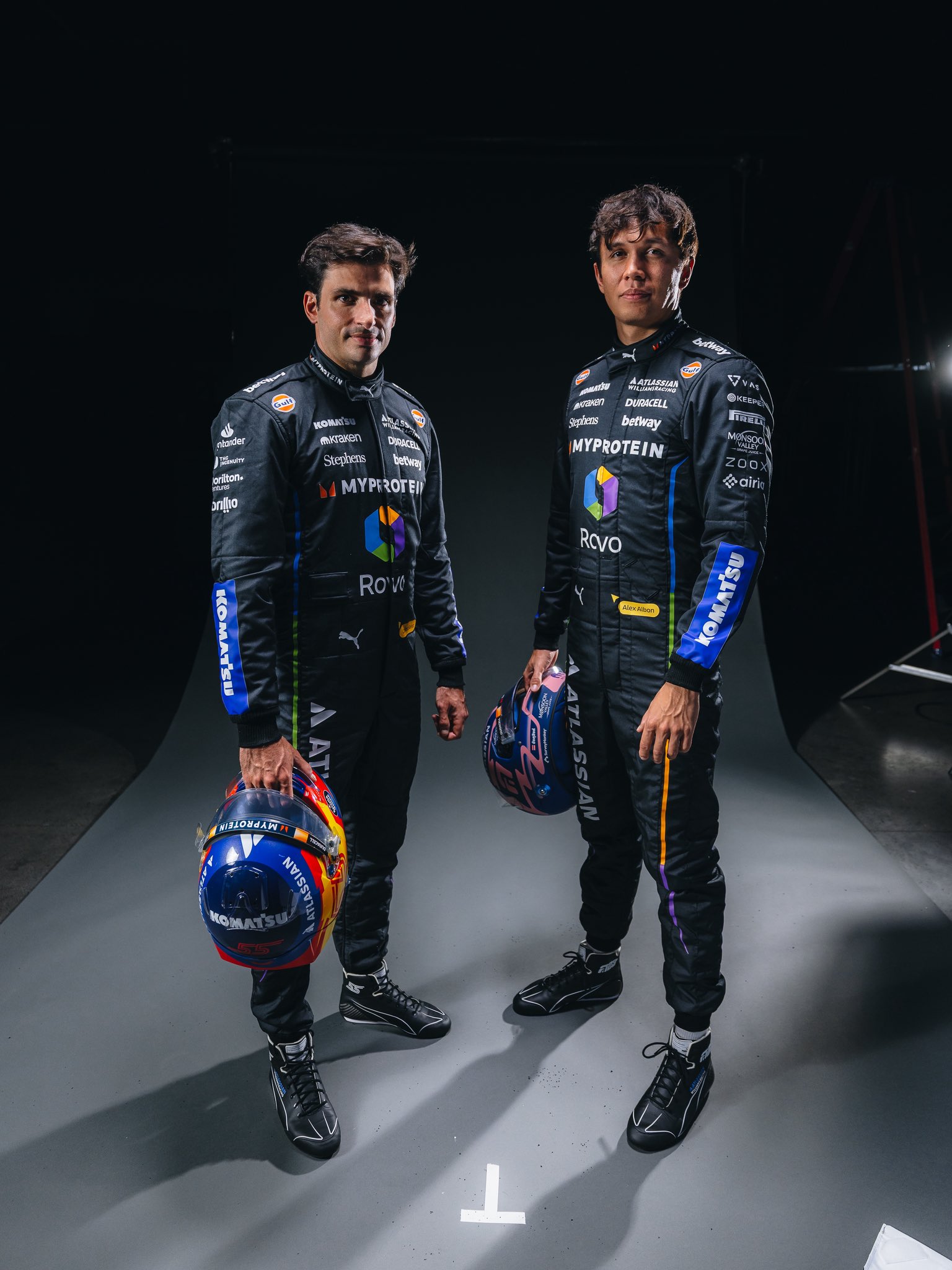
Following the conclusion of a fantastic F1 season for Williams, Alex Albon provided a transparent response regarding the arrival of Carlos Sainz. This new addition has led to an evolution of the team’s internal culture.
Albon’s reflections offered a rare look at how the presence of a proven race winner forces a driver to adapt not just their on-track performance, but their entire professional methodology. He highlighted a significant transition from a team centred around a singular lead driver to an organisation operating with two equal technical pillars.
Albon viewed this shift as essential for the team’s progress.
A cultural shift: From lead driver to parity at Williams F1
One of Albon’s most candid observations concerned the shift in how the team managed its driver pairing. In previous seasons, the Thai driver was the clear focal point for development when up against Latifi and Sargeant, a dynamic he admitted has now evolved into a state of parity.
“I would say that, being totally honest, just as an approach between the two guys, we’re much more equal in the way that the team treats us,” Albon noted. “I could definitely say I had the majority of the preferential treatment in previous years.”
The current mindset, however, was centred on equality. By balancing the technical focus between two high-calibre F1 drivers, Williams increased their data-gathering capacity. As compared to previous years, Albon is required to share the engineering spotlight he once commanded alone.
Technical synergy and “feedback ping-pong”
Albon highlighted an exceptional level of technical alignment with Sainz, despite different driving styles. This synergy allows the team to pursue a unified development path rather than being pulled into two different directions by conflicting driver demands.
“In terms of us two working together, more backwards and forwards in terms of feedback ping-pong, where we’re just having the same opinions about the car,” Albon described. “We speak in a very similar language, I think. Carlos is more experienced than I am, but in terms of our age and our approach, we handle things in a very similar way.”
This alignment is a critical asset for the development. Albon explained that while they have different driving styles, they often arrive at qualifying with very similar set-ups.
“I feel like every driver would say this, when you have a teammate who’s a step up, you learn more. There’s more to learn in terms of your driving styles. There are some corners that you were previously quick at, which you’re now the same as,” the Thai driver shared.
“And there are some corners that you need to learn, adapt, drive differently. And I’m sure it goes the other way for Carlos too.”
This constant internal pressure is precisely what the team needs to bridge the gap to the front-runners.
Mastering the non-driving side of the sport
Perhaps the most significant takeaway for Albon was the realisation that Sainz’s value extended far beyond lap times. He pointed to Sainz’s methodical approach to the operational and developmental side of F1 as the area where he has learned the most.
“I think the biggest thing I’ve learned from Carlos is more the non-driving side of things,” the Williams driver admitted.
He cited that Sainz’s experience was most visible in his rigorous structure of free practice programs, car development in simulator and conducting meetings.
This confirms that the “Sainz Effect” is as much about professionalising the development process as it is about on-track results. This effect has also refined Albon’s own approach as Williams prepares for F1’s 2026 technical reset.