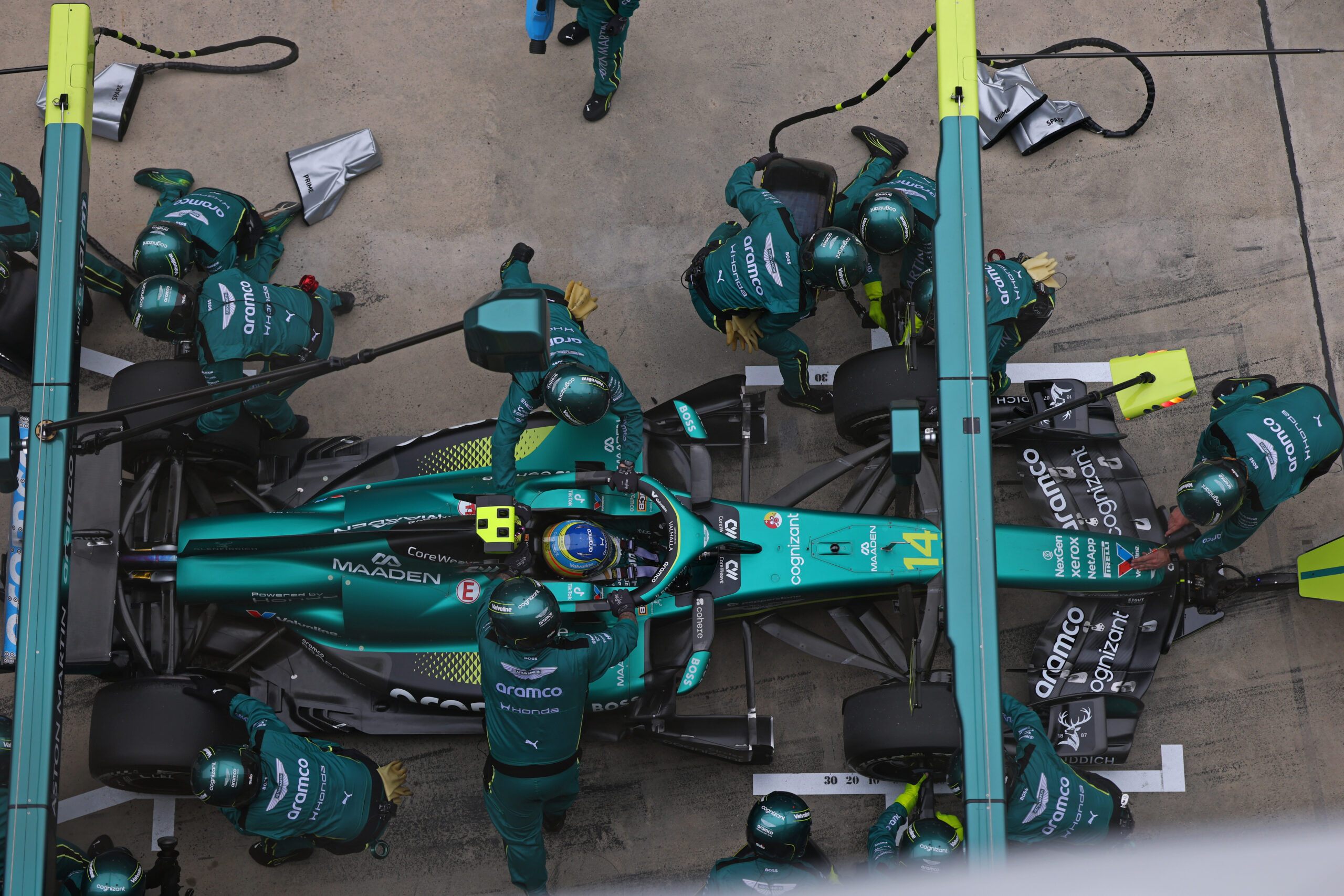
Fernando Alonso’s F1 Chinese GP weekend ended in a physical crisis that forced a premature retirement. While the Aston Martin showed early promise, a violent vibration transformed the cockpit into a hostile environment.
This issue eventually bypassed technical telemetry to become a direct safety hazard for the driver. The final result for Alonso’s race had been a DNF, marking a difficult F1 Chinese GP finish for the team.
Physical toll on Fernando Alonso at the 2026 F1 Chinese GP
The mechanical resonance reached a terrifying peak around lap 20 of the race. High-frequency oscillations from the Honda power unit migrated through the carbon fibre chassis and into the driver’s extremities.
Alonso eventually parked his machine because the physical feedback from the car became unbearable.
“I retired because the engine vibrations were actually different today – or rather, excessive – and starting around lap 20 or so, I began to lose all feeling in my hands and feet,” Alonso explained to Spanish broadcaster DAZN after the F1 Chinese GP.
In the high-stakes world of racing, where millisecond-perfect inputs are mandatory, a total lack of sensory feedback represents a massive danger. Reflecting on the decision to stop, he added: “Continuing until the end of the race while losing feeling in my hands and feet didn’t make much sense.”
Managing the vibrations
The team attempted to hide these persistent engine problems through software-based “artificial” gains. By lowering the engine’s RPM ceiling, engineers hoped to reduce the mechanical stress on the driver and the chassis.
However, this strategy created a performance bottleneck that left the Spaniard defenceless during wheel-to-wheel combat. He even waved at Sergio Pérez as the Mexican overtook him.
“Some of the steps we did were achieved artificially,” he said. “I mean, just lowering the RPM of the engine and things like that, so everything vibrates less. But in the race, obviously, you still need to go high in some of the RPM when you make an overtake move, or when you have to recharge or something like that. Over time, it’s more difficult. It’s more demanding.”
These constraints defined Alonso’s technical ceiling during the F1 Chinese GP afternoon.
The battery world championship struggle
The race initially looked positive as the AMR26 launched well off the grid and Fernando Alonso was P10 once again on lap 1. However, the car quickly faded as the energy deployment issues were brutally exposed against rivals.
“Yeah, the starts are fun,” the Spaniard commented. “Same as in Australia, the car seems to start really well. On lap one, it’s true that we all have the same level of battery, which is full. Then we enter this battery world championship, and in that we are not as good as the others.”
This energy deficit added to Alonso dropping mid-race, eventually leaving him at the back of the pack behind the Cadillacs at the F1 Chinese GP. With the car suffering from excessive shaking and no points in sight, the team accepted the reality of the situation.
“[The vibrating] was worse today than any other session in the weekend,” he lamented. Facing a hopeless track position, he concluded: “We were one lap behind, we were last. It was probably no point to keep on going.”
This marked the definitive end of Alonso’s great efforts at the 2026 F1 Chinese GP.