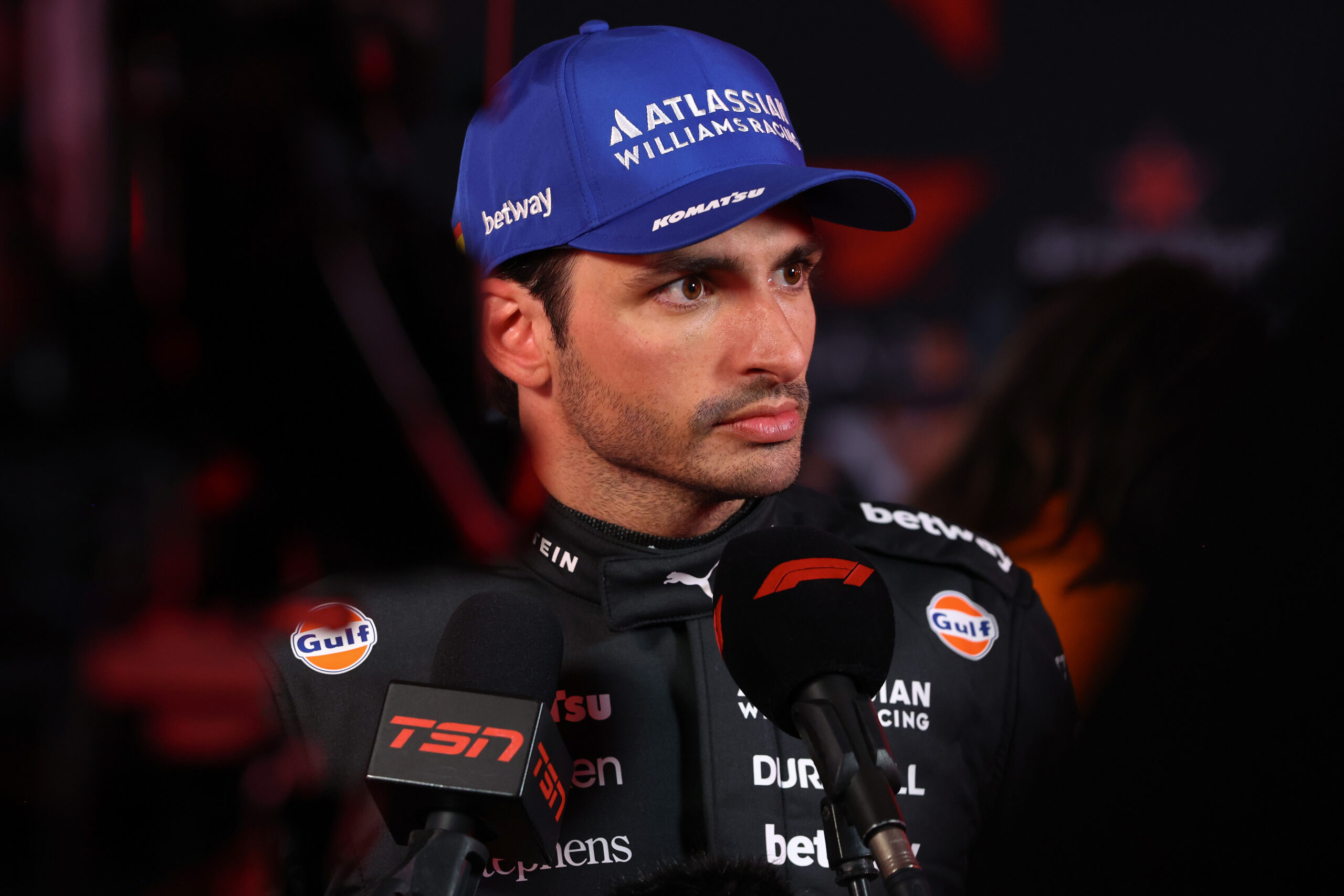
The 2025 F1 season marked a profound reset for Carlos Sainz. After years battling at the sharp end of the grid, the Spaniard embarked on a starkly different chapter, one defined by reconstruction rather than silverware. His switch from Ferrari to Williams was made with pragmatism, not romanticism. Race victories were no longer the yardstick. Instead, points became currency, and clean weekends mattered as much as outright pace.
Williams gained something they had not consistently possessed in recent seasons: a proven winner who could act as a reference point inside the garage, whose feedback could help shape development direction and whose experience could elevate the team’s baseline performance. Alongside Alex Albon, Sainz became an invaluable benchmark, offering clearer insight into where the car truly stood against its rivals.
What emerged was an F1 2025 season far from smooth. It was bruising in places and punctuated by frustrating interruptions. The opening rounds were defined by lost mileage and missed opportunities. A long middle stretch brought quiet consolidation and steady point-scoring. Then the second half flipped the script entirely, with two podiums that felt improbable until Sainz made them happen.
A debut that ended before it began
If Sainz wanted a gentle introduction to life at Williams during the 2025 F1 season, Melbourne delivered the opposite. The race started in soaking conditions, and the opening moments became a quick-fire test of survival rather than speed.
Off the line, Lando Norris launched well, Oscar Piastri was passed by Max Verstappen, and Charles Leclerc picked his way past Yuki Tsunoda and Alex Albon. Behind them, rookie Jack Doohan crashed into the Turn 5 barrier, bringing out the Safety Car. Under that same Safety Car, Sainz’s Williams hit the wall. Both Doohan and Sainz retired, making it three retirements before Lap 2.

For Sainz, it was a particularly painful DNF. Not the slow-burn frustration of fading tyres or strategic compromise, but a sudden end that robbed him of exactly what he needed most in a new environment: laps, learning, and rhythm. It set an unfortunate tone for the early season, where he seemed to be chasing a clean run of weekends as much as he was chasing points.
Finishing the first race
Shanghai at least gave Sainz a full Grand Prix distance to work with, and there were small signs of him bedding in. Still, the result underlined the gap Williams were trying to bridge.
Sainz started 15th and finished 13th, just outside the points, in a race where Albon managed to score by taking ninth. McLaren’s pace and Ferrari’s intra-team dynamics dominated the wider story, but for Sainz it was an early example of the Williams reality: if you were not perfect in qualifying, the race became a long grind in traffic. Sainz ultimately landed in P10, after Lewis Hamilton, Charles Leclerc and Pierre Gasly were disqualified from the Chinese Grand Prix.
Importantly, China provided something Australia did not: data. Sainz could return to the engineers, build a clearer understanding of tyre behaviour and balance changes, and begin the slow process of translating what he wanted from the car into what it could actually deliver.
Contact, penalty, then retirement
Bahrain was the first weekend where Sainz’s season felt defined by setbacks rather than progress. It was not just difficult, it was messy.
Sainz received a 10-second time penalty for forcing Kimi Antonelli off the track at Turn 10. Soon after, he retired because damage to his sidepods was too severe to continue running competitively. That combination hurt on multiple levels. A penalty removes strategic flexibility, and damage alters the car’s behaviour, especially where tyre degradation and stability are crucial.
Most significantly, it was another weekend where Sainz did not get the clean, uninterrupted race he desperately needed. After Australia and Bahrain, the first part of his season already carried the feel of “nearly” and “not quite”, with the scoreboard failing to reflect his underlying capability.
The middle phase
Between Bahrain and the later headline moments, Sainz settled into the part of the season that rarely gets romanticised but often defines a driver’s value to a team like Williams. He became a consistent presence in the top ten, turning weekends into points rather than stories.
This phase saw his contribution extend well beyond the timing screens. Williams needed clear direction on where the FW47’s operating window lay, how to prepare tyres, how to approach set-up trade-offs, and how to execute strategy when fighting in a compressed midfield. These are areas where Sainz has always built his reputation. Even when the car was not a podium threat, those habits lifted the baseline, providing the team with the kind of technical insight and strategic thinking that had been absent in recent years.

His influence became especially valuable during the European leg of the calendar, where Williams faced renewed challenges. The circuits in this stretch exposed persistent weaknesses in the package, particularly on tracks demanding aerodynamic efficiency and robust traction. Sainz endured a dispiriting sequence of races outside the points during this period of the 2025 F1 season, with rivals capitalising on opportunities Williams simply could not exploit.
A slump moment and a DNS that summed it up
By the time the grid reached Austria, Williams were nearing the end of a demanding run of races, and Sainz’s form and fortune dipped again. The Austrian Grand Prix weekend ended with a DNS beside his name, an especially sour note because it was not even the controlled disappointment of finishing 12th or 13th. It was a total blank.
It served as a stark reminder of how quickly a weekend could swing from salvageable to lost. Yet internally, the team used this difficult period constructively. Data gathered during these challenging weekends helped refine set-up approaches and informed updates planned for later in the campaign.
The first podium
Then came Baku, and suddenly the conversation around Sainz and his F1 2025 season, changed completely.
The Azerbaijan Grand Prix ended with Max Verstappen winning, George Russell second, and Carlos Sainz third. That single line in the classification carries enormous weight. Not just a podium, but a podium for a team that was not expected to be there and for a driver who had spent much of the year trying to get his season properly started.

Baku rewards confidence in the car under braking and traction. It also punishes impatience. Sainz’s strength in those conditions is that he rarely chases a lap that is not there. He builds races, manages gaps, and positions himself to capitalise when opportunity arrives. The podium felt like a surprise from the outside, but from the inside it looked like a driver finally aligned with his machinery and ready to deliver.
Sainz later described Baku as “a relief”, explaining that he had been quick early in the year but kept having things happen to him, and that once he had the chance to fight for a podium, he took it. That line captures his 2025 arc perfectly. Early pace and effort, interrupted by disruption, then one clean opportunity converted into a statement result.
The Antonelli Incident
Austin brought another flashpoint involving Antonelli, offering a clear example of how Sainz’s 2025 F1 season combined strong form with costly interruptions.
Sainz attempted an overtake on Antonelli on Lap 6, clipped the rear of the Mercedes, and Antonelli spun but continued. The Spaniard retired from the United States Grand Prix and was later handed a five-place grid penalty for the Mexico City weekend.
Sainz did not accept it quietly. He publicly called the penalty disproportionate and used it to highlight what he saw as weaknesses in how “driving guidelines” are applied. That response was classic Sainz: reflective, specific, and aimed at process rather than drama. It also spoke to his broader role at Williams, where part of his value lay in how he communicated issues, whether technical or regulatory.
Despite the setback, Sainz responded with measured professionalism in the races that followed. He prioritised damage limitation, executed disciplined recovery drives, and continued extracting maximum value from each opportunity. His composed approach stood in stark contrast to the early-season frustrations and underscored how comprehensively he had adapted to his new environment.
The second podium, and why it meant more
If Baku was relief, Qatar was proof.
Sainz started seventh in Qatar. Over the course of the race, he executed a methodical climb to third, finishing behind Verstappen and Piastri, with Norris only managing fourth after a late pass on Antonelli.
The post-race detail revealed why this weekend felt different. Sainz explained that after a difficult Hungary weekend, the team built a plan using simulator work and factory preparation to “switch on” the car for this type of circuit, and that the car felt competitive from the first laps of practice. He outlined a clean, disciplined race. A strong start from P7 to P5, excellent pit stops, astute strategy, and careful tyre and gap management against quicker cars.
Then came the emotional distinction. Sainz said Baku was happier because it was his first Williams podium and brought relief, but Qatar was his “proudest day in Williams” because it represented hard work, understanding, and a perfectly executed weekend by the entire team.
That distinction is key to his 2025 story. The podiums were not identical. One was opportunism meeting readiness. The other was preparation meeting execution.

A measured conclusion
The final race in Abu Dhabi did not add another headline. Sainz finished 13th. In isolation, it reads like a return to the midfield grind. In context, it demonstrated how demanding the season remained for Williams, and how difficult it was to repeat the highs without the right track characteristics and weekend flow.
Still, by year’s end, Sainz had delivered the moments Williams signed him for. He provided a performance benchmark against Albon (14-10 in Grand Prix qualifying to the Spanish star), contributed through the steady points phase, and when the door cracked open for something bigger, he seized it with authority.
The final verdict
Contrast defined Carlos Sainz’s first year in blue. Crashes and damage interrupted the opening races: a DNF under the Safety Car in Australia, a Bahrain retirement following sidepod damage and a penalty. The Mid-season was about quietly scoring and building a working rhythm, even through the challenging European leg where results were harder to come by. Then, late in the year, he produced two results that made people look twice at what Williams could achieve on the right day: P3 in Azerbaijan and P3 in Qatar.
For Williams, Sainz delivered precisely what they sought: a reliable benchmark, clear technical direction, and a driver capable of elevating the team when circumstances aligned. For Sainz, the 2025 season reaffirmed his status as one of F1’s most complete competitors, capable of excelling even when success is not guaranteed.
That is why it felt like a season of two halves. Not because Sainz suddenly became quick, but because the interruptions stopped defining him and the execution started doing so. If 2025 was a foundation year, it was one built on substance rather than spectacle. The lessons absorbed and confidence accrued may yet prove invaluable for both driver and team in the seasons ahead.