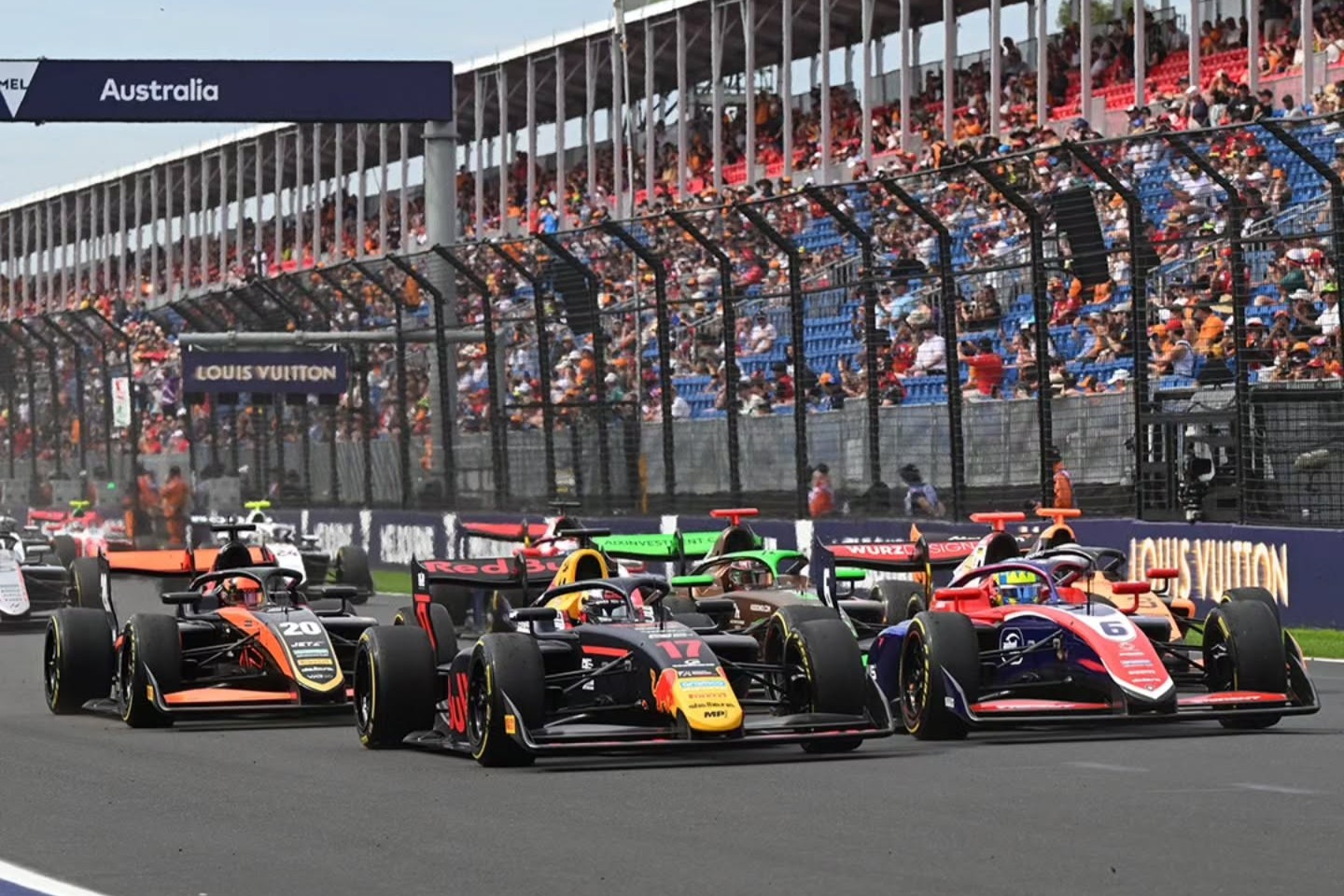
The 2026 FIA Formula 2 and Formula 3 seasons are set to get underway this weekend, March 6-8, in Melbourne, Australia. The Albert Park Circuit, a favourite among drivers, hosts the 2026 F2 and F3 season openers, which will support the F1 Australian GP, providing an exciting mix of speed, unpredictability, and the challenges of a street circuit.
The F2 and F3 Melbourne Round: A stories history at a famous circuit
The Albert Park Circuit has been a central feature of Formula 1 since 1996, becoming a staple of the Australian Grand Prix. The circuit is known for its mix of high-speed corners, challenging street circuit layout, and the unpredictable nature of the weather, which often throws up surprises. For many years, it has been a beloved destination for both drivers and fans alike.
In 2023, the Melbourne round joined the Formula 2 and Formula 3 calendars, adding another exciting chapter to its racing legacy. That season, Zak O’Sullivan of PREMA Racing claimed victory in F3’s Sprint Race after Franco Colapinto’s disqualification. Meanwhile, in F2, Dennis Hauger triumphed in the Sprint Race, with Ayumu Iwasa clinching the Feature Race win. The 2024 edition saw Roman Staněk (Trident) win the F2 Sprint Race and Isack Hadjar (Campos Racing) take the Feature Race, while F3 saw Martinius Stenshorne (Hitech) and Dino Beganovic (PREMA Racing) claim victories.
The most recent edition of the Melbourne Round saw the 2025 season open under grey skies. While inclement weather caused the cancellation of the F2 Feature Race, the weekend was far from dull with AIX Racing’s Joshua Dürksen emerging triumphant in Saturday’s Sprint Race. Meanwhile, in F3, Van Amersfoort Racing’s Santiago Ramos opened his own campaign with a Sprint Race win, with then-rookie and now 2025 F3 Drivers’ Champion Rafael Câmara opening his dominant campaign with the Feature Race victory.
As the 2026 season kicks off, the drivers in both F2 and F3 will look to add their names to the ever-growing list of winners at this iconic track.
The Albert Park Circuit: A thrilling challenge for drivers
The Albert Park Circuit, measuring 5.278 kilometres in length and consisting of 14 turns, is widely regarded as one of the most exciting tracks in motorsport. Its combination of fast straights and tight corners, coupled with its minimal run-off areas, demands precision and skill from every driver. The track’s narrow streets and close barriers heighten the stakes, with any mistake potentially leading to disaster.
The circuit is also infamous for its unpredictable weather, which has a long history of altering race outcomes. Rain, extreme heat, and sudden temperature fluctuations can change the game at any moment, adding another layer of drama to every race.
With four DRS zones—between Turns 1 and 2, Turns 3 and 4, Turns 8 and 9, and Turns 10 and 11—the track offers plenty of opportunities for overtaking, which will make for thrilling racing in both F2 and F3.
F2 and F3 at Albert Park: A technical overview
In F2, the Sprint Race runs for 23 laps, covering a total distance of 121.394 kilometres, while the Feature Race extends to 33 laps, or 174.174 kilometres. For F3, the Sprint Race is shorter at 20 laps, and the Feature Race spans 23 laps.
Several drivers have etched their names into the history of Albert Park with record-setting performances. Dennis Hauger holds the record for the fastest lap in Formula 2, setting a blistering time of 1:28.694 during his time with MP Motorsport in 2024. In Formula 3, Gabriel Bortoleto set the lap record in 2023, clocking a time of 1:33.025 in the Trident Motorsport car.
Technical insights for the 2026 Melbourne F2 and F3 Round at the Australian GP
As a unique street circuit, Albert Park presents teams and drivers with a variety of technical challenges. Both Formula 2 and Formula 3 teams must carefully balance performance and strategy to maximise their chances of success.
F2 Technical Preview
Ahead of the opening round, Pierre-Alain Michot, F2 and F3 Technical Director, offered insights on what to expect at Albert Park for the 2026 season. He highlighted that the circuit’s sweeping and fast layout makes downforce and tyre wear crucial factors in lap time performance. With relatively few major braking zones, drivers will focus on managing tyre degradation, especially on longer runs. Furthermore, the track’s four DRS zones should keep the drivers close together, increasing overtaking opportunities, but pit strategy will be key, especially in the Feature Race.
“We start the 2026 season in Melbourne once again for what I’m sure will be another exciting season of Formula 2 racing. The Albert Park Circuit has provided lots of action in recent years and is a great place to begin the campaign once again. Downforce and tyre wear have a greater impact on laptimes, while the limited number of major braking zones aren’t as demanding as others the drivers will face this season. Overall, the four DRS zones should ensure drivers remain tightly bunched together but pit strategy will be a very important factor in the outcome of Sunday’s Feature event.”
The Soft and Supersoft compounds will be available for F2 at Melbourne, with no step in compound between the softest and prime tyre specifications. The quickest strategy for the Feature Race is starting on the Soft and switching to the Supersoft for the final stint. Drivers will need to manage graining and tyre degradation, especially with Melbourne’s variable weather.
F3 Technical Preview
Melbourne also presents a unique challenge for F3 teams, who must balance top speed with downforce to optimise performance across the track’s mix of medium- to high-speed corners and straights. The four DRS zones will offer overtaking opportunities, but finding the right balance is key. With teams now familiar with the new cars, Qualifying strategies will be critical. Speaking on this, Michot said:
“It is good to be back in Melbourne for the first round of the 2026 season. A year ago we came to Australia with brand new cars, and now one year later the teams will know these cars a lot better than they did at that point, which should make this weekend, and also the season, even more competitive.
“Melbourne is a challenging street circuit, where the teams will have to find the right balance between maximising their top speeds on the four DRS zones, while also recognising the need for downforce with many medium to high-speed sections. How the teams plan for Qualifying this year will also be interesting. Last year a few teams used a different strategy to get their drivers to set flying laps on an emptier track. Trident did this and sealed a front-row start for Sunday. Let us see what the teams do this weekend.”
For the opening round of F3, Pirelli has selected the Medium compound. The smooth surface of the Melbourne street circuit, built on public roads, presents a challenge with tyre graining, which often occurs. Managing graining and overheating will be crucial, especially in the closing laps, when performance could drop off.
Weather forecast: Dry conditions expected for F2 and F3 at the 2026 Australian GP
The Albert Park Circuit is not only known for its challenging layout, where overtaking often proves difficult, but also for its unpredictable weather, which often adds an extra layer of complexity to the racing. Historically, Melbourne has experienced sudden shifts in conditions, and the 2025 F2 season was a prime example, with extremely wet weather making the track unsafe for racing and forcing the cancellation of the Feature Race.
However, for the 2026 season, the forecast appears promising. According to F1’s weather forecast for the weekend, the weekend will feature dry and clear conditions, providing ideal racing weather for both F2 and F3 drivers.
Friday is expected to see a mild and pleasant climate, with temperatures reaching up to 40°C on track. A 5% chance of rain indicates a relatively dry start to the weekend, allowing teams to make the most of the practice and qualifying sessions.
Saturday will bring similar conditions, with temperatures ranging from 12°C to 19°C, and only a 5% chance of rain during the Sprint Races. The mild weather is expected to help drivers maintain good grip levels, crucial for overtaking despite the track’s notoriously narrow layout.
On Sunday, Feature Races will experience no precipitation, and temperatures are expected to peak at 29°C, making for a warm end to the weekend.
What to expect from the 2026 F2 and F3 season openers at the Australian GP at Albert Park
The season kicks off on Friday morning at 08:50 local time, with Qualifying at 14:00. Saturday will see the first Sprint Race at 11:15, followed by Sunday’s Feature Race at 08:50. As always, the weekend promises drama as drivers fight for early-season momentum.
James Wharton, a home hero for PREMA Racing in F3, reflected on the significance of racing in Melbourne: “Melbourne is my home, so it’s always special to race here. The pressure of performing in front of family and friends can be tough, but it also gives me extra motivation. The track evolves so much from Free Practice to Qualifying, so finding the limit is tricky. I think Turn 9 and Turn 12 are the best places to overtake, especially with four DRS zones.”
Meanwhile, the F2 season kicks off on Friday morning at 10:00 local time with Free Practice, followed by the first Qualifying session of the season at 14:55. The Sprint Race on Saturday, set for 14:10 local time, will offer the first real opportunity for drivers to compete head-to-head. Sunday’s Feature Race will begin at 11:25, potentially setting the stage for the rest of the season.
F2 debutant Rafael Câmara, who won the 2025 F3 Feature Race added: “Melbourne is a unique circuit. It doesn’t feel like a typical street track, but you’re still close to the walls. The lack of grip can be challenging, especially on the brakes. The DRS zone into Turn 10 is the best place for overtaking, but the biggest challenge is managing the low grip.”
The stage is set for what promises to be a thrilling start to the 2026 FIA Formula 2 and Formula 3 seasons at the iconic Albert Park Circuit.