After an intense qualifying session, it was finally time for Race 1 of Formula E’s Jeddah E-Prix, under the Saudi Arabian night sky. The grid lined up with an unexpected frontrunner ready to make history following a session filled with shocks and surprises.
An intense Qualifying session
Edoardo Mortara ended Mahindra’s near two-year wait for pole position with a dominant qualifying performance. The Swiss driver clocked a blistering 1:15.336 to secure his fourth career pole, systematically defeating Nico Müller and Norman Nato before overcoming Maximilian Günther in the final. Despite clipping a wall late in his lap, Mortara’s commanding pace proved insurmountable, with Günther settling for second ahead of Pascal Wehrlein, Nato, and Taylor Barnard.
The session delivered stunning shocks as title contenders suffered devastating eliminations. Reigning World Champion Oliver Rowland, championship leader Nick Cassidy, and Jake Dennis all failed to progress beyond the group stages, leaving Wehrlein as the only top-four championship driver to reach the knockout duels. With the championship contenders buried in the midfield and the first PIT BOOST race of the season awaiting, Race 1 promised strategic intrigue and overtaking opportunities under the floodlights. Mortara stood on the brink of becoming Formula E’s oldest-ever race winner, whilst Cassidy, Rowland, and Dennis faced the daunting task of carving through the field.
Pre-Race drama
Drama struck before Race 1 of the Formula E Jeddah E-Prix even began. Nyck de Vries suffered a mechanical issue on the grid, forcing race control to delay the start whilst the marshals removed his stricken Mahindra from the grid. The delay only heightened the tension as the remaining drivers prepared for Formula E’s first race featuring the new PIT BOOST format combined with just a single Attack Mode activation.
Delayed start to racing action in Jeddah ????
— Formula E (@FIAFormulaE) February 13, 2026
Nyck de Vries has an issue with his Mahindra on the grid#JeddahEPrix pic.twitter.com/Hk473EjTU0
Lights out
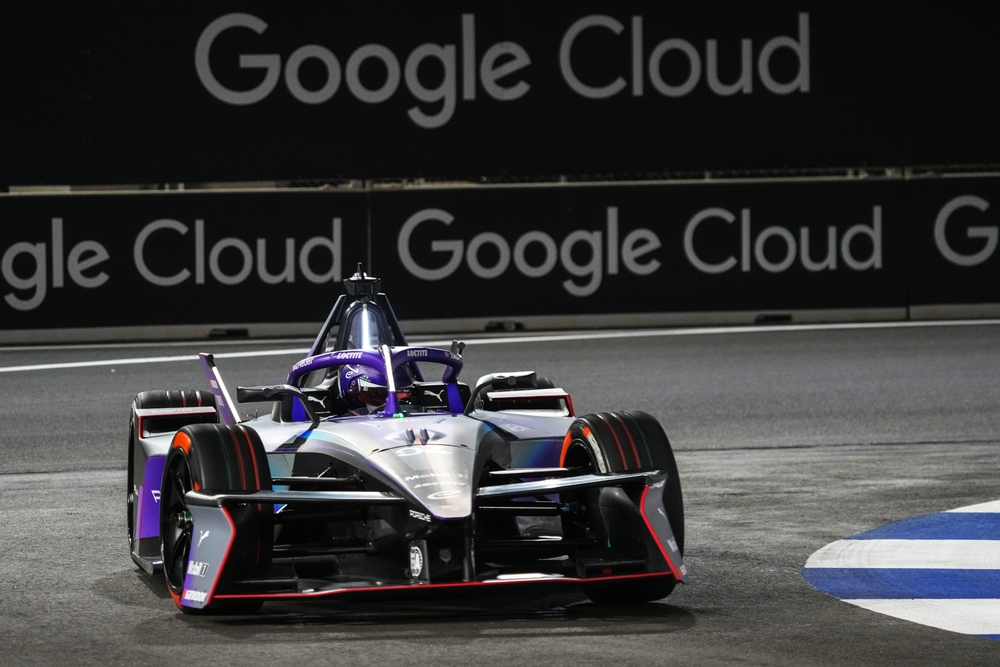
The lights finally went out, and Mortara’s hopes of a fairytale victory evaporated instantly. The pole-sitter suffered a catastrophic start, bogging down and tumbling through the order as the pack swept past him. Norman Nato seized the opportunity to grab the lead, with Günther slotting into second ahead of Wehrlein, Barnard, and the recovering Mortara.
The opening lap chaos continued when Zane Maloney and rookie Pepe Martí collided, leaving Maloney’s car stranded on the side of the circuit. Race control immediately deployed the safety car, bunching the field and resetting the strategic possibilities.
When racing resumed, the real battle began, not just on track but in the strategic war rooms. Every driver still held both PIT BOOST and Attack Mode in reserve, creating a complex puzzle where timing would prove decisive.
A closer look at what happened with our polesitter Edoardo Mortara ????#JeddahEPrix pic.twitter.com/jxqHbu0HXw
— Formula E (@FIAFormulaE) February 13, 2026
Nato controlled the restart and maintained his lead whilst the pack circulated nose-to-tail. Günther pressured the Nissan driver relentlessly, with Wehrlein lurking in third, watching and waiting for his moment. The top positions remained largely static through the opening phase as teams calculated the optimal window to trigger their strategic cards.
The race exploded into life on lap 15. Günther became the first frontrunner to activate Attack Mode, the extra power immediately launching him past Nato into the lead. Wehrlein recognised his opportunity and executed his masterstroke. He dived into the pit lane for PIT BOOST whilst his rivals circulated.
Wehrlein’s masterpiece
The Porsche team executed a flawless pit stop, and Wehrlein emerged ahead of all drivers who had already taken their mandatory pit boost. More importantly, he now held a crucial advantage: fresh energy from the pit stop combined with the freedom to activate his Attack Mode immediately.
Wehrlein wasted no time. He triggered his six-minute Attack Mode window and simply vanished into the distance. The combination of pit boost energy and Attack Mode power created an insurmountable gap to the chasing pack, who now faced an impossible strategic conundrum.
Those who had taken Attack Mode first, including race leader Günther, watched their advantage evaporate as the extra power window expired. They tumbled down the order, their energy spent and unable to respond to Wehrlein’s relentless pace. The Season 10 champion controlled the race with clinical precision, managing his energy perfectly whilst extending his lead with every passing lap.
Late-race shuffle
The strategic complexity created wild swings through the order. Drivers who had activated Attack Mode early found themselves vulnerable in the closing stages, their energy reserves depleted whilst others held power in reserve.
Mortara, recovering from his disastrous start, benefited from optimal late timing. The Mahindra driver carved through the field as those ahead struggled with energy management, ultimately salvaging second place. It represented a remarkable recovery that maintained his championship challenge despite the opening lap setback.
Mitch Evans completed the podium in third, the Jaguar driver also profiting from well-timed strategic calls. Nico Müller brought the second Porsche home in fourth, ahead of António Félix da Costa’s Jaguar.
Championship leader Nick Cassidy demonstrated why he holds the points lead with a superb recovery drive from 13th on the grid to sixth at the chequered flag. The result limited the damage from his qualifying elimination and kept him firmly in the title fight.
What an impressive drive from @PWehrlein ????#JeddahEPrix pic.twitter.com/zGVbj1awSJ
— Formula E (@FIAFormulaE) February 13, 2026
The verdict
Wehrlein’s victory marked a strategic masterclass in Formula E’s new PIT BOOST era. The German driver seized the championship lead through perfect execution, recognising the optimal moment to pit, maximising the energy advantage, and managing the race to the flag without putting a wheel wrong.
For Mortara and Mahindra, second place represented both disappointment and resilience. The pole-sitter had squandered his best chance at becoming Formula E’s oldest race winner, yet his recovery through the field demonstrated the pace that had dominated qualifying.
The bunched midfield finishers told the story of a strategic lottery where timing proved everything. Those who guessed wrong on Attack Mode activation paid the ultimate price, whilst the canny strategists reaped the rewards.
As the grid prepared for Saturday’s second race, one thing became clear: mastering the PIT BOOST format would separate the contenders from the pretenders in Season 12’s championship battle.
Formula E Jeddah E-Prix Race 1 results
| 1 | Pascal Wehrlein | Porsche | |
| 2 | Edoardo Mortara | Mahindra | 2.677 |
| 3 | Mitch Evans | Jaguar | 7.097 |
| 4 | Nico Müller | Porsche | 8.735 |
| 5 | António Félix da Costa | Jaguar | 9.153 |
| 6 | Nick Cassidy | Citroën | 11.381 |
| 7 | Sebastien Buemi | Envision | 11.836 |
| 8 | Jean-Éric Vergne | Citroën | 12.305 |
| 9 | Jake Dennis | Andretti | 12.726 |
| 10 | Taylor Barnard | DS Penske | 13.125 |
| 11 | Max Günther | DS Penske | 16.048 |
| 12 | Dan Ticktum | Kiro | 16.283 |
| 13 | Norman Nato | Nissan | 16.718 |
| 14 | Pepe Martí | Kiro | 17.048 |
| 15 | Felipe Drugovich | Andretti | 19.871 |
| 16 | Lucas di Grassi | Lola | 20.280 |
| 17 | Oliver Rowland | Nissan | 22.257 |
| 18 | Joel Eriksson | Envision | 43.191 |
| 19 | Zane Maloney | Lola | DNF |
| 20 | Nyck de Vries | Mahindra | DNS |