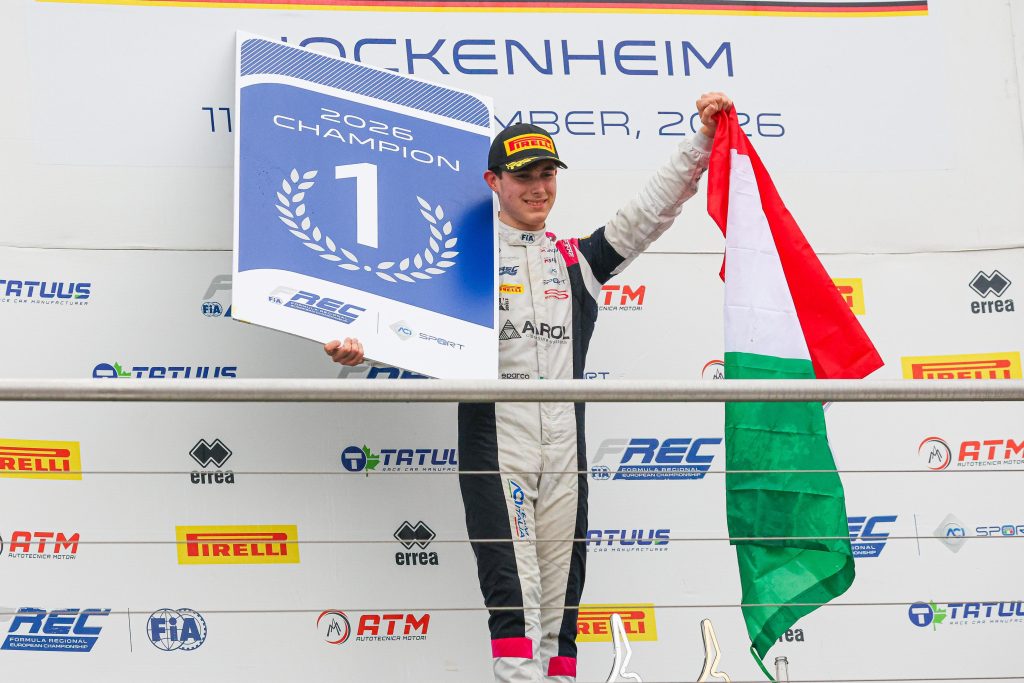
Emanuele Olivieri’s 2026 FIA Formula Regional European Championship (FREC) campaign hardly began like that of an eventual champion. The R-ace GP rookie left the opening round at Spielberg 14th in the Drivers’ Championship with only four points, while several of his eventual title rivals immediately established themselves at the front. Four months later, however, Olivieri left Hockenheim as both the overall and Rookie champion, completing one of the most striking championship recoveries of the 2026 FREC season.
His road between those two points did not rely on overwhelming dominance. Sebastian Wheldon won more races, Kean Nakamura-Berta regularly set the Qualifying benchmark and Rashid Al Dhaheri led the championship at multiple stages. Olivieri instead developed into the most consistent of the four, limiting the damage from difficult weekends, repeatedly finishing on the podium and producing his strongest results precisely when the championship reached its decisive phase. He eventually finished the season on 218 points, nine ahead of Wheldon, 17 clear of Nakamura-Berta and 38 ahead of R-ace GP teammate Al Dhaheri. He also dominated the Rookie Championship, completing an extraordinary recovery from an opening weekend that had initially shaken his confidence.
Spielberg: Four points and a difficult beginning
Olivieri arrived in FREC with significant expectations after already building a relationship with R-ace GP through his Formula 4 career. He entered his rookie season alongside Al Dhaheri and Yuki Sano, but Spielberg immediately tested him. A Race 1 stall, the first of his career, disrupted his weekend and affected his confidence, while he struggled to recover the rhythm required in such a competitive field.
He ultimately left Austria with just four points and sat 14th in the standings. At the front, Reno Francot led the championship on 43 points, Al Dhaheri already had 38, Nakamura-Berta had 34 and Wheldon had 30. Olivieri therefore trailed the championship leader by 39 points after only one round, but that deficit did not define the rest of his season. Instead, Spielberg became the low point against which his subsequent progress stood out.
Zandvoort: The recovery begins
Olivieri’s season began to change almost immediately at Zandvoort. The Italian rediscovered the pace that had eluded him in Austria and delivered his first major result of the campaign in Race 1. While Wheldon dominated at the front, Olivieri secured his maiden FREC podium with third place, set the fastest lap and took the Rookie victory.
He added more points during the second race and left the Netherlands seventh in the championship on 28. That still placed him 54 points behind new leader Wheldon, but the weekend carried greater significance than the raw standings suggested. Olivieri had proven that Spielberg represented an outlier rather than his expected level, and he began establishing himself as a benchmark within R-ace GP despite competing alongside the more experienced Al Dhaheri. When he later reflected on his title-winning season, Olivieri identified Zandvoort as the point at which his recovery truly began.
Spa: Pace without the reward
Spa-Francorchamps did not deliver the same headline result, but it provided another important step in Olivieri’s development. He showed strong pace throughout the Belgian weekend, including leading Friday Free Practice and featuring near the front during the earlier running, but small mistakes in both Qualifying sessions left him further back than his speed suggested.
Wet and interrupted races then reduced his opportunity to recover. The weekend did not transform his championship position, but it reinforced one of the themes that eventually defined his year. Olivieri increasingly had the speed to compete with the established championship leaders, even when the final result did not fully reflect it, and he carried that confidence into his home round at Monza.
Monza: The breakthrough arrives at home
Olivieri entered Round 4 sixth in the standings on 40 points and left fourth on 85 after the weekend that transformed him from promising rookie into genuine championship contender. Race 1 immediately delivered another major result, with Olivieri starting from the front row, challenging Nakamura-Berta for the lead and eventually finishing second, only 0.705s behind the PREMA Racing driver.
The partially reversed-grid second race ended badly, but R-ace GP repaired his car overnight and gave him another opportunity on Sunday. Olivieri took full advantage by securing his maiden FREC pole position and then converting it into his first championship victory on home soil at Monza. Four Safety Car periods repeatedly erased the margins he established at the front, forcing him to control restart after restart, but he handled each without giving his rivals a genuine opportunity.
The victory also made him the first Italian to win a Formula Regional European race at Monza since Andrea Kimi Antonelli in 2023. More importantly for his season, Olivieri scored 45 points across the weekend and climbed to fourth in the standings. He remained 36 behind championship leader Wheldon, but the gap no longer looked insurmountable and the title fight had gained another serious contender.
Hungaroring: Consistency starts paying off
While other drivers experienced dramatic swings, Olivieri began building his challenge through consistency. R-ace GP dominated the Hungaroring round, with Sano winning the opening race ahead of Al Dhaheri while Olivieri finished fourth and again led the Rookie classification.
The second race strengthened his position further. Al Dhaheri controlled proceedings from pole, while Olivieri ultimately took second following Alexander Abkhazava’s post-race penalty. He therefore added another podium only two weeks after his Monza victory and moved onto 116 points.
Al Dhaheri now led the championship with 151, leaving the rookie 35 points away from his teammate, but the fight had started to change around him. Wheldon endured a double retirement in Hungary and dropped from first to third, while Nakamura-Berta also lost ground relative to Al Dhaheri. Olivieri did not need another spectacular weekend to gain. By simply remaining near the front while others encountered setbacks, he continued bringing himself closer to the fight.
Paul Ricard: Two second places turn Olivieri into a genuine title contender
Paul Ricard represented the point at which Olivieri’s championship challenge became impossible to dismiss. Nakamura-Berta dominated the opening race from pole and reclaimed the championship lead, but Olivieri followed him home in second after overtaking Wheldon and Abkhazava during the contest. The result extended a run of consistent scoring that had gradually pulled him into the title picture.
He then produced another strong Qualifying performance for Race 2. Olivieri initially set the quickest time but received a three-place grid penalty, handing pole to Wheldon. Rather than allowing the setback to compromise his race, he recovered to second again. Wheldon won, Nakamura-Berta finished third and Olivieri completed his first consecutive runner-up finishes of the season.
The 36-point weekend moved him from 116 to 152 and changed the shape of the championship. Nakamura-Berta led on 172, while Wheldon and Al Dhaheri shared 159. Olivieri sat only seven points behind that pair and 20 away from the championship lead. The standings after Paul Ricard therefore sent four drivers into the final two rounds separated by fewer points than one conventional-race victory. Olivieri had reached that position without leading the championship at any previous point.
Imola: The weekend that changed everything
If Monza introduced Olivieri as a championship contender, Imola made him the driver everyone else suddenly had to chase. He entered his second home round fourth in the standings, 20 points behind Nakamura-Berta, with Wheldon and Al Dhaheri another seven points ahead of him on equal totals.
Olivieri immediately set the tone after the summer break by topping Free Practice by 0.047s before producing the fastest overall time in Qualifying 1. His second pole of the year also brought two championship points and reduced his deficit before the racing even began.
Race 1 became one of his defining performances. Olivieri led from pole and managed four separate Safety Car restarts without losing control. He also set the fastest lap, claimed his second victory of the season and mathematically secured the Rookie Championship. Most importantly, the result moved him into the overall championship lead for the first time.
The rest of the weekend demanded a different kind of maturity. The partially reversed Race 2 gave the title contenders fewer obvious opportunities, and Olivieri settled for ninth rather than taking unnecessary risks. He then qualified on the front row for Race 3 alongside sensational debutant Oleksandr Bondarev. By that point, Olivieri understood that his championship position mattered more than chasing every possible victory, and he finished second behind Bondarev while Wheldon failed to score and his other title rivals also struggled to match his haul.
Olivieri arrived at Imola 20 points behind the championship leader and left on 200 points, 20 clear of Wheldon. No other weekend changed the title picture as dramatically.
Hockenheim: From comfortable advantage to final-race pressure
Olivieri entered Hockenheim in the strongest championship position he had occupied all season. His eight podiums, including two victories, five second places and one third, had given him a 20-point advantage over Wheldon. Nakamura-Berta sat 25 behind, while Al Dhaheri remained 35 away, leaving all four mathematically capable of taking the title.
Saturday immediately tested that advantage. Wheldon took pole for Race 1 and reduced the deficit by two points, while Olivieri joined him on the front row. The two championship rivals then made contact at Turn 1, eliminating Olivieri immediately and sending Wheldon down the order. The Race 1 incident blew the championship fight open again, particularly after Nakamura-Berta finished second and Al Dhaheri third behind maiden winner Jan Przyrowski.
Suddenly, Olivieri’s comfortable advantage had disappeared. He remained on 200 points, while Nakamura-Berta had closed to 193. Wheldon’s second Qualifying pole then moved him to 184 before the final race, while Al Dhaheri remained mathematically involved on 180. One race now stood between Olivieri and the title.
One final measured drive
The championship finale placed Olivieri fourth on the grid, directly behind Nakamura-Berta and with Wheldon on pole. Wheldon made the start he needed and controlled the race from the front, while Nakamura-Berta initially occupied second, a position that kept significant pressure on the championship leader.
The decisive moment arrived when Nakamura-Berta became involved in contact with Przyrowski. The incident dropped the PREMA driver backwards and allowed Olivieri to move into second. From that point, he no longer needed to chase Wheldon.
The same driver who had stalled during the opening weekend now faced the final laps of the season with the championship entirely in his control. He kept Wheldon within sight but avoided unnecessary risk, protected second and crossed the line 0.895s behind the MP Motorsport driver.
That result gave Olivieri 18 points and took his final total to 218. Wheldon’s fourth victory of the season lifted him to 209, while Nakamura-Berta finished the campaign third on 201 and Al Dhaheri completed the championship top four on 180. Olivieri therefore secured the 2026 FREC title by nine points.
Consistency rather than domination
Olivieri’s championship stands out because he never controlled the season in the conventional sense. He won only twice, while Wheldon claimed four victories and Nakamura-Berta and Al Dhaheri each took three. Nakamura-Berta regularly proved stronger over one lap, while both Wheldon and Al Dhaheri spent more of the season occupying the championship lead.
Olivieri did not lead at all until Imola. Instead, he steadily removed weaknesses from his campaign. The rookie who struggled to reset after his Spielberg stall became the driver who maximised difficult weekends, collected podiums when victories remained out of reach, recovered from penalties and poor starting positions, and rarely allowed one setback to compromise the next opportunity.
That consistency also distinguished his final two rounds. At Imola, he recognised when to attack and when to settle for points. At Hockenheim, he responded to a Race 1 retirement without allowing the suddenly compressed standings to change his approach. Those decisions ultimately mattered just as much as either of his victories.
A Rookie title became something much bigger
Olivieri entered the year as a rookie facing several drivers with considerably more Formula Regional experience. Even within R-ace GP, Al Dhaheri provided an established benchmark after a strong previous campaign, but Olivieri used that environment rather than allowing it to overwhelm him.
By Imola, he had already built an insurmountable Rookie Championship advantage. The overall championship transformed the significance of that achievement, with Olivieri becoming the first rookie since 2020 to claim the outright Formula Regional European crown as well. R-ace GP also completed the season with both the Drivers’ and Teams’ Championships, making Olivieri’s success part of a wider year of dominance for the French team.
What made the achievement particularly striking was how far removed it appeared from the opening weekend. Spielberg had produced four points and doubts over confidence. By the closing stages of the campaign, Olivieri had become the driver most capable of combining pace with championship management.
From four points to 218
The numbers provide the clearest summary of Olivieri’s progression. He left Spielberg with four points before Zandvoort lifted him to 28. By Monza, his maiden victory had carried him to 85 and fourth in the championship. The Hungaroring moved him to 116, while his Paul Ricard double podium took him to 152 and within 20 points of the lead.
Imola then changed everything. Olivieri reached 200 points, took the championship lead for the first time and carried a 20-point advantage into Hockenheim. His final second place added the last 18 points required to finish the year on 218.
That progression captures why his title felt less like a season of domination and more like one of development. Olivieri did not immediately look like the driver the rest of the field would eventually have to beat. He became that driver over the course of the season, with every stage adding something to the competitor who arrived at Hockenheim.
From the confidence lost at Spielberg, through the first podium at Zandvoort, the home victory at Monza, the relentless second places at Paul Ricard and the championship-changing weekend at Imola, Olivieri gradually built the campaign that ultimately carried him to the title.
When the final challenge came, he did not need another spectacular victory. He needed the calm to recognise that second place would complete everything he had built across the previous seven rounds, and he delivered exactly that. The 2026 FREC champion therefore did not take the shortest route to the title. He took one that demanded recovery, patience and continual improvement, and turned four points from a difficult opening round into 218 and two championships by the final chequered flag.