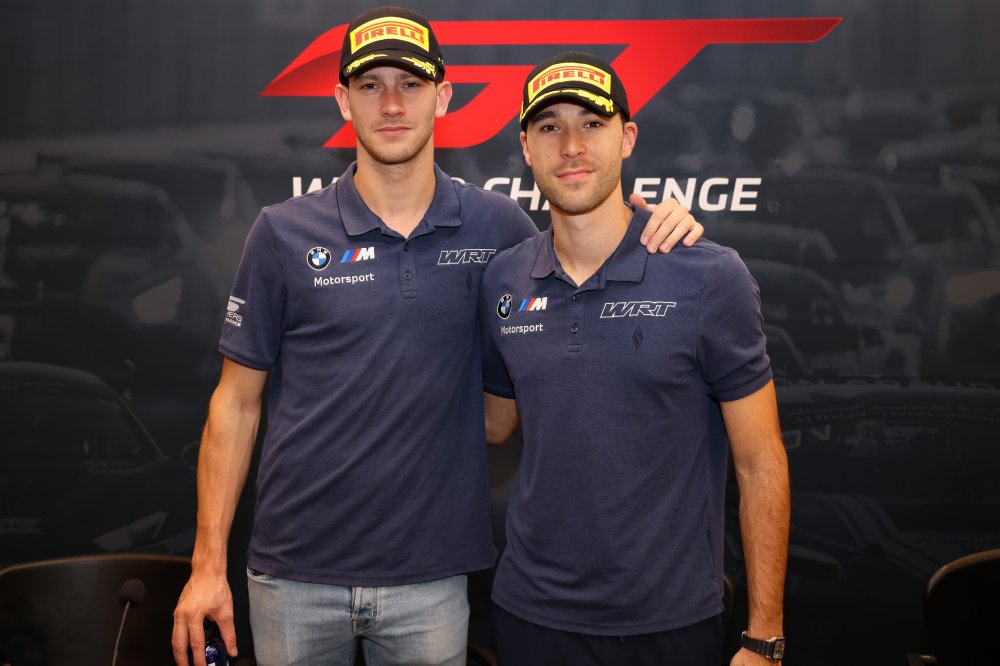
Adapting to a new manufacturer in GT racing demands precision, patience and the right guidance. For Kelvin van der Linde, the transition to BMW machinery became far smoother thanks to the support of teammate Charles Weerts.
Throughout the season, van der Linde relied heavily on Weerts’ experience with the BMW platform. As a result, the South African driver believes that the collaboration strengthened his performance and accelerated his understanding of the car.
Van der Linde on learning from Weerts inside BMW
Moving from one GT manufacturer to another often challenges even the most experienced drivers. However, van der Linde entered the season knowing that Weerts already possessed deep knowledge of the BMW package.
Consequently, the Belgian driver became a natural point of reference as van der Linde adapted to the car and its characteristics.
Speaking exclusively to Pit Debrief, he said,“I mean, obviously, he’s been very important for me this year because he knows the BMW very well. And I mean, I knew he was already… I heard from my brother [Sheldon van der Linde] that he was up to speed very quickly in the BMW when he came from the Audi. And was feeling quite comfortable quite soon when maybe some other drivers [who] had made the transition, they didn’t find the transition so easy.
“So, I mean, he was always very open to me from day one in the testing. And we always were very open with each other. And I’d say he helped me a lot this year.”
This openness created a collaborative environment within the team. Rather than operating as isolated competitors, the two drivers worked together to understand the nuances of the BMW car.

Building confidence through shared data
In modern GT racing, performance analysis plays a crucial role. Drivers rely on telemetry and data comparisons to refine their driving techniques and extract every tenth of a second.
For van der Linde, having a benchmark like Weerts proved invaluable during this process.
“I mean, from where I came in the beginning of the season, knowing nothing about the car, he definitely showed me all the tricks and stuff. And obviously, looking at the data and stuff, you’re having a very good reference of a guy that’s won the championship multiple times. It can only make you stronger.”
By studying Weerts’ approach and comparing data sets, van der Linde could quickly identify areas for improvement. Step by step, the analysis translated into stronger on-track performance.
A partnership that strengthened performance
Ultimately, van der Linde believes that the collaboration improved him as a driver over the course of the season. Instead of struggling through the learning process alone, he benefited from the knowledge of a teammate who had already mastered the platform.
“So, I think he’s made me a very good driver this year and helped me a lot. So, I’m very thankful for that.”
The acknowledgment reflects the importance of teamwork in endurance and GT racing. While individual speed remains essential, cooperation between drivers often determines how quickly a team unlocks the full potential of its machinery.
For van der Linde, the partnership with Weerts delivered exactly that—an accelerated learning curve and a stronger foundation for future success.