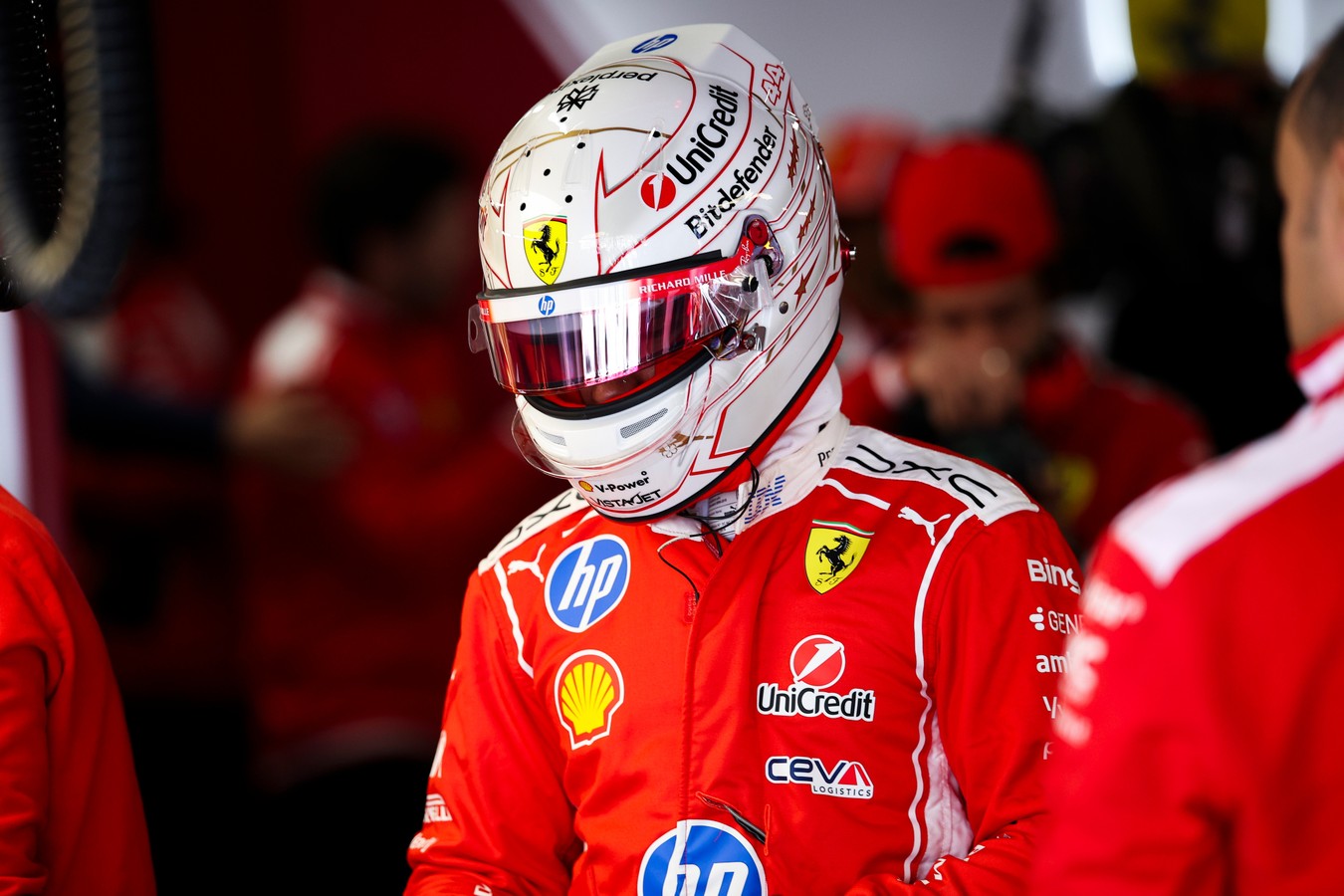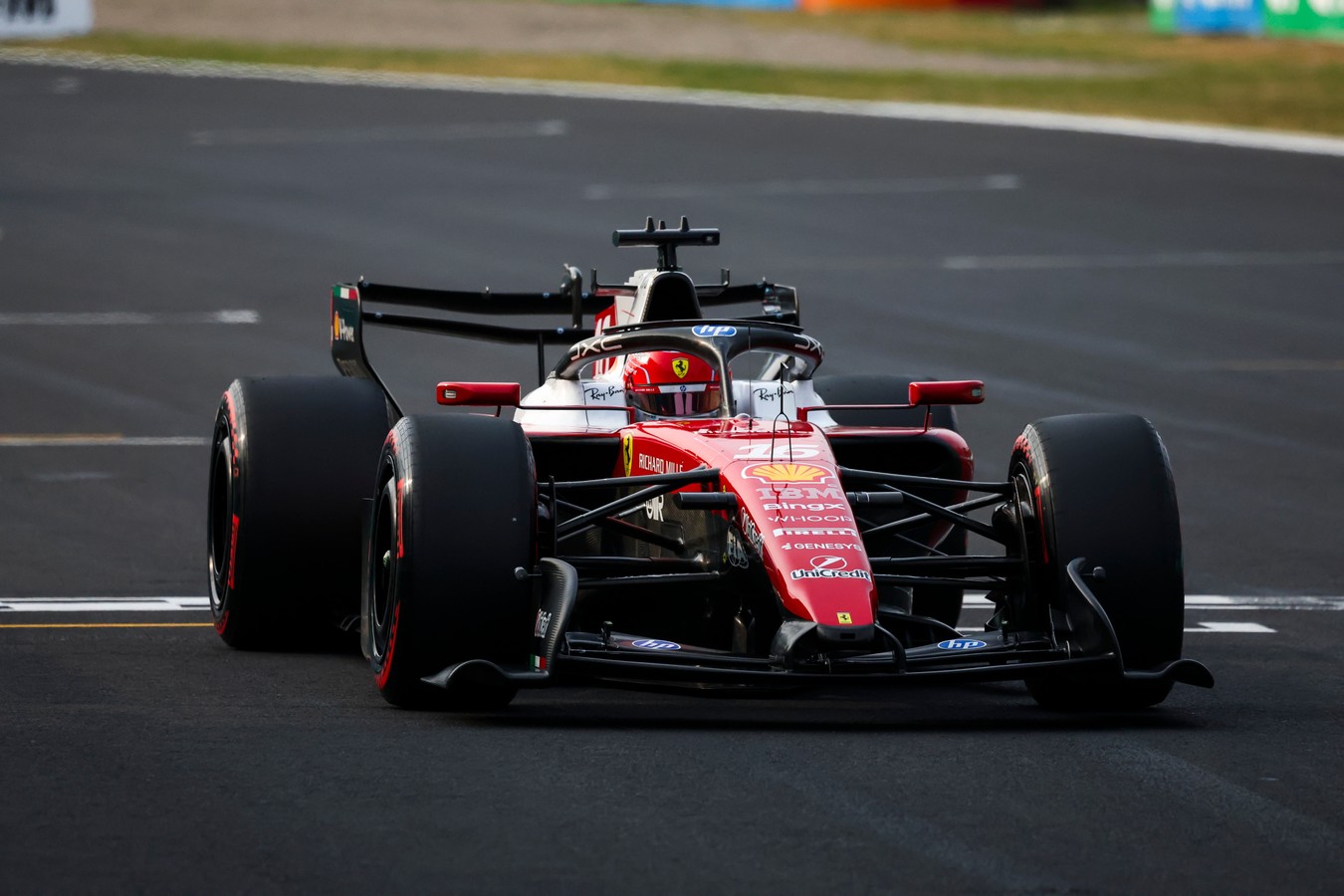
Charles Leclerc qualified P4 for the 2026 F1 Japanese GP after a snap of oversteer on his final Q3 lap prevented a stronger grid position at Suzuka. The Ferrari driver finished with a 1:29.405, placing him behind pole-sitter Kimi Antonelli, George Russell, and Oscar Piastri. Leclerc’s Japanese GP qualifying performance highlighted ongoing struggles with system optimisation in Q3, where Ferrari loses performance compared to Mercedes.
Antonelli claimed his second consecutive pole position for Mercedes. Russell secured P2 ahead of McLaren’s Piastri. Leclerc’s teammate Lewis Hamilton qualified sixth after receiving a black-and-white flag for driving unnecessarily slowly at the pit exit.
Leclerc reflects on F1 Japanese GP qualifying
When asked in the print media pen if his heart rate stayed calm during the session, Leclerc explained the anxiety comes from losing time on the straights rather than in corners during his Japanese GP qualifying runs.
“It stayed pretty calm. I would say that it was a little bit higher when in the straights you start losing time being flat out and that’s where my heart rate goes particularly high,” he stated.
The Ferrari driver acknowledged how his aggressive driving style often produces moments like the snap in Q3. However, the 2026 regulations punish such risks more severely than they reward them.
“But in the corner itself, I mean these are the kind of things that happens in Q3 and especially with my driving style. I know it happens very often in the past but it pays off more than it helps you. Apart from with those cars where with these cars it seems to bite you more than it pays off.”
The straight-line speed loss during the session proved costly. While not matching Shanghai’s severity, the deficit compared to his Q2 lap frustrated him.
“And I lost a big amount of speed in the straight, not a huge amount, not nothing close to whatever I’ve seen in Shanghai, whatever I’ve had in Shanghai, but still I’ve lost some time compared to my Q2 lap which is very frustrating. Something we’ll look at and try to understand.”
FIA intervention helps but more work is needed
The FIA implemented changes to qualifying regulations following earlier rounds. When asked if the intervention helped, Leclerc acknowledged progress after his Japanese GP qualifying session while also suggesting that further steps may be necessary.
“I think it would have been a lot worse if they didn’t make anything happen. So I think it’s going in the right direction. Whether another step is needed or something else could make more of a difference, still to be seen anyway.”
Leclerc expects significant work before Miami. Teams and the FIA will collaborate on proposals to improve qualifying during the upcoming break due to the cancellation of two races.
“I think in the gap from here to Miami there will be a lot of brainstorming from not only the FIA but also the teams for sending propositions of trying to make those rules better in qualifying.”
The race experience differs significantly from qualifying under the new regulations. Leclerc noted the cars behave similarly to a 2025-spec during Grands Prix.
“I honestly think that in the race it’s actually a pretty good car and it doesn’t change much to last year’s car. Even though in the battle the battery etc, we know it’s clear but the driving style doesn’t change much. In qualifying it’s just a bit frustrating at the moment,” he concluded.
Ferrari struggles with Q3 optimisation as Mercedes shows greater robustness
Progress from Friday to Saturday improved Ferrari’s position at the Japanese GP qualifying session. Leclerc expressed satisfaction with the car balance and set-up work. “Yeah it was quite a bit better. I was happier. Honestly in terms of balance I was happy,” he stated.
Through various stages in FP3 and qualifying he was the closest to the Mercedes cars, even going P1 at some moments.
However, Ferrari loses performance in Q3 when Leclerc pushes harder. Mercedes demonstrates greater robustness with their PU.
“It’s just again in Q3 we seem to lose a little bit the optimisation of our system. Mercedes seems to be a little bit more robust at the moment with all that and coming into Q3 they always find a huge amount of performance.”
Leclerc questioned whether Mercedes has additional advantages beyond what Ferrari can see. The gap becomes particularly evident in the final qualifying segment.
“I don’t know if there’s anything more in the background that we don’t know but it definitely looks like we are struggling more whenever we get to Q3. Because when I push more there’s just not that much performance that is coming,” he stated.
Set-up in good window but lacking raw pace during 2026 F1 Japanese GP qualifying
Sector One showed significant improvement from Friday to Saturday during Leclerc’s Japanese GP qualifying session. When asked about the progress, he credited set-up and balance improvements.
“No I think car balance wise and set-up wise we were in a good window. Honestly I would do just the same if I had to go qualifying again.”
However, the improvements cannot overcome the fundamental pace deficit. Ferrari lacks raw speed compared to Mercedes and McLaren, despite looking good against the Woking-based team in FP3 and through most of Saturday qualifying.
“We are just lacking raw pace compared to Mercedes. And I feel like also maybe McLaren a little bit now.”
McLaren’s expected 2026 progress no surprise to Leclerc
McLaren’s step forward at Suzuka did not surprise Leclerc. He anticipated their improvement once they extracted more from the Mercedes power unit.
“I kind of expected them to make this kind of progress. I mean they are a very, very, very strong team. We’ve seen it last year they’ve had an incredible car. They’ve had a bit of a rough start to the season but I mean it’s not such a surprise to see back to where they should be and I’m sure that there’s a lot of progress also in the next few races.”
The development race will prove crucial throughout the 2026 F1 season. Leclerc emphasised development’s increased importance compared to recent seasons.
“So on our side we need to stay on it and keep pushing because as I said at the beginning of the year it’s going to be a development championship where development is going to play a much bigger role than it has in the past few years and we need to be on top of that.”
New 2026 F1 regulations diminish the qualifying challenge for Charles Leclerc
The new regulations have altered the nature of qualifying for Leclerc, removing the reward that once came with pushing to the absolute limit. When asked whether he can still lay everything on the line at Suzuka as he once could, Leclerc explained the dynamic has fundamentally shifted.
“Honestly I think the thing is in Q3 or at least it depends which car you have but with our car in Q3 that’s where you want to get out on the track and try things you’ve never tried before, taking risks that you’ve never taken before and that’s been rewarding for most of us in all our career and now this is not possible anymore.”
Any moment over the limit costs energy and straight-line performance during Leclerc’s F1 Japanese GP qualifying laps. The penalty proves more severe than the potential gain.
“Every time you go a little bit over the limit, anytime you have a bit of a snap, this is costing energy on the power unit side and then you pay the price more. So I feel like at the moment consistency is paying off more than being brave and going to take something that you’ve never tried before which is a shame and which makes qualifying a little bit less challenging and this is something that we need to work on but it’s a known issue.”
Work continues behind the scenes to address the issue. Leclerc expressed hope for solutions soon. “It’s not that the FIA or the teams are just accepting the situation as it is. There’s a lot of work behind the scene and I hope that we can find a solution as soon as possible,” he stated.
Race strategy focuses on strong start
Ferrari’s historically strong getaways remain one of their key weapons heading into Sunday’s race. When asked whether his plan was to lead into Turn 1 from fourth on the grid, Leclerc offered a measured response.
“Leading to Turn 1 is a good plan but I don’t know. I still am of the opinion that the more we go forward, the less there will be our advantage at the start. I hope we can keep it as long as possible and on a track like this it will be important to have it tomorrow because track position is a bit more important.”
Leclerc targets gaining at least one position at the start of Sunday’s F1 Japanese GP. Track position remains crucial at Suzuka despite the new regulations.
“So the target is to at least gain a position and if we can gain two or three, better. I’ll take that and hopefully we can keep the Mercedes behind but I doubt that will be possible,” Leclerc stated.
Overtaking prospects at 2026 Japanese GP remain uncertain under new F1 regulations, says Charles Leclerc
Suzuka’s layout has traditionally made overtaking difficult, but the 2026 F1 regulations have introduced unpredictability to race dynamics. When asked whether the new cars would produce the same yo-yo racing seen at previous rounds or whether Suzuka’s character would suppress it, Leclerc gave a cautious assessment.
“Maybe slightly less because the nature of the first sector probably tends the cars to spread apart a little bit more but I wouldn’t discard it either because we’ve seen it in Shanghai, we’ve seen it in Australia. It’s been a lot more hectic than in the past and there are some places that I think we didn’t see any overtakes in the past that maybe could become an overtaking opportunity.”
His gut feeling suggests overtaking will be more difficult at Suzuka. However, early season predictions proved inaccurate, making him cautious about assumptions.
“So yeah, I don’t know. My gut feeling will say it will be a bit more difficult to overtake but my gut feeling was wrong at the beginning of the year so maybe we need to wait and see,” Leclerc concluded.
Leclerc’s P4 result during the 2026 F1 Japanese GP qualifying sets up a strategic challenge for Sunday’s race. Ferrari must maximise their launch performance while managing energy deployment more effectively than they demonstrated in qualifying’s final segment.