Michelin faces one of the most varied tyre challenges on the 2026 FIA World Endurance Championship (WEC) calendar as the Hypercar field heads to Fuji Speedway for this weekend’s 6 Hours of Fuji.
The 4.563km circuit combines a 1.475km main straight with high-speed corners and a technical final sector, forcing teams to balance outright performance, tyre temperature and degradation across three sections demanding very different characteristics.
Hypercar teams will have Michelin’s soft and medium Pilot Sport Endurance slick compounds available from 25-27 September, while a Wet tyre will cover the possibility of the changeable conditions that frequently influence the Japanese event.
The 6 Hours of Fuji represents Round 6 of the 2026 WEC season and comes immediately after a dramatic Lone Star Le Mans at the Circuit of The Americas, where Ferrari won following the late retirement of Toyota’s leading No. 7 Hypercar. Pit Debrief’s post-COTA championship standings show Toyota leading BMW by nine points in the Manufacturers’ Championship heading to Japan.
Fuji presents three different tyre challenges
Fuji’s layout makes compromise unavoidable. Although the circuit contains only 16 corners and produces one of the shorter lap times on the calendar, each of its three sectors asks something different from the Hypercar tyre package.
The opening sector features Fuji’s defining main straight. Hypercars can exceed 330km/h before the heavy braking zone into Turn 1, making aerodynamic efficiency essential while simultaneously requiring teams to keep the tyres within their operating window.
At those speeds, the Michelin tyres can experience vertical loads exceeding 2.5 tonnes. That places significant demands on tyre construction before drivers reach the more corner-intensive sections of the lap.
Pierre Alves, manager of Michelin Motorsport’s endurance racing programmes, explained that the challenge extends well beyond simply preparing for Fuji’s extraordinary straight-line speeds.
“The first sector includes the long straight, where a good trade-off is necessary between aerodynamic performance, power and tyre temperature management,” explained Alves to FIAWEC.com. “Sector two is more about fast corners, while the third sector is a sequence of slower turns that place the emphasis on mechanical grip. The key promises to be how the drivers care for their tyres through the fast T4 and T5.”
The middle sector therefore shifts emphasis towards high-speed stability and lateral load, before the final part of the lap places greater importance on traction and mechanical grip through its sequence of slower corners.
Managing the tyres through Turns 4 and 5 could prove particularly important because excessive stress early in the lap may compromise performance through the technical final sector and accelerate degradation across longer stints.
Soft and medium compounds available for Hypercar field
As in 2025, teams can choose between soft and medium Michelin slicks, alongside the Wet compound if conditions deteriorate.
However, the tyres themselves have changed. Fuji marks the first appearance at the circuit for the current Michelin Pilot Sport Endurance range, creating another variable for teams already balancing significantly different sector demands.
The latest tyres contain 50% renewable or recycled materials and have been developed to improve warm-up characteristics. That could become particularly valuable at Fuji, where late-September temperatures and changing weather can create periods of relatively cool track conditions.
“This is the current Michelin Pilot Sport Endurance range’s first trip to Fuji,” continued Alves. “These new tyres contain 50 per cent renewable or recycled materials and mark a step forward in terms of warm-up performance. They reach their ideal running temperature sooner into a stint, so the drivers feel more confident during early laps, especially when track and tyre temperatures are relatively low.
“The aim is to strike the ideal balance between warm-up performance, immediate performance and degradation management, in order to benefit from consistent grip over complete stints.”
Faster warm-up can provide an immediate advantage when leaving the pits, particularly during safety-car periods or after stops where drivers need to bring the tyre into its optimum range quickly without overstressing it.
However, outright early-stint performance represents only part of the equation. Fuji has previously rewarded teams capable of extending tyre life and successfully double-stinting sets, making degradation management potentially as valuable as initial grip.
Double-stint strategy helped Alpine to 2025 victory
Tyre longevity played a significant role when the WEC last visited Fuji.
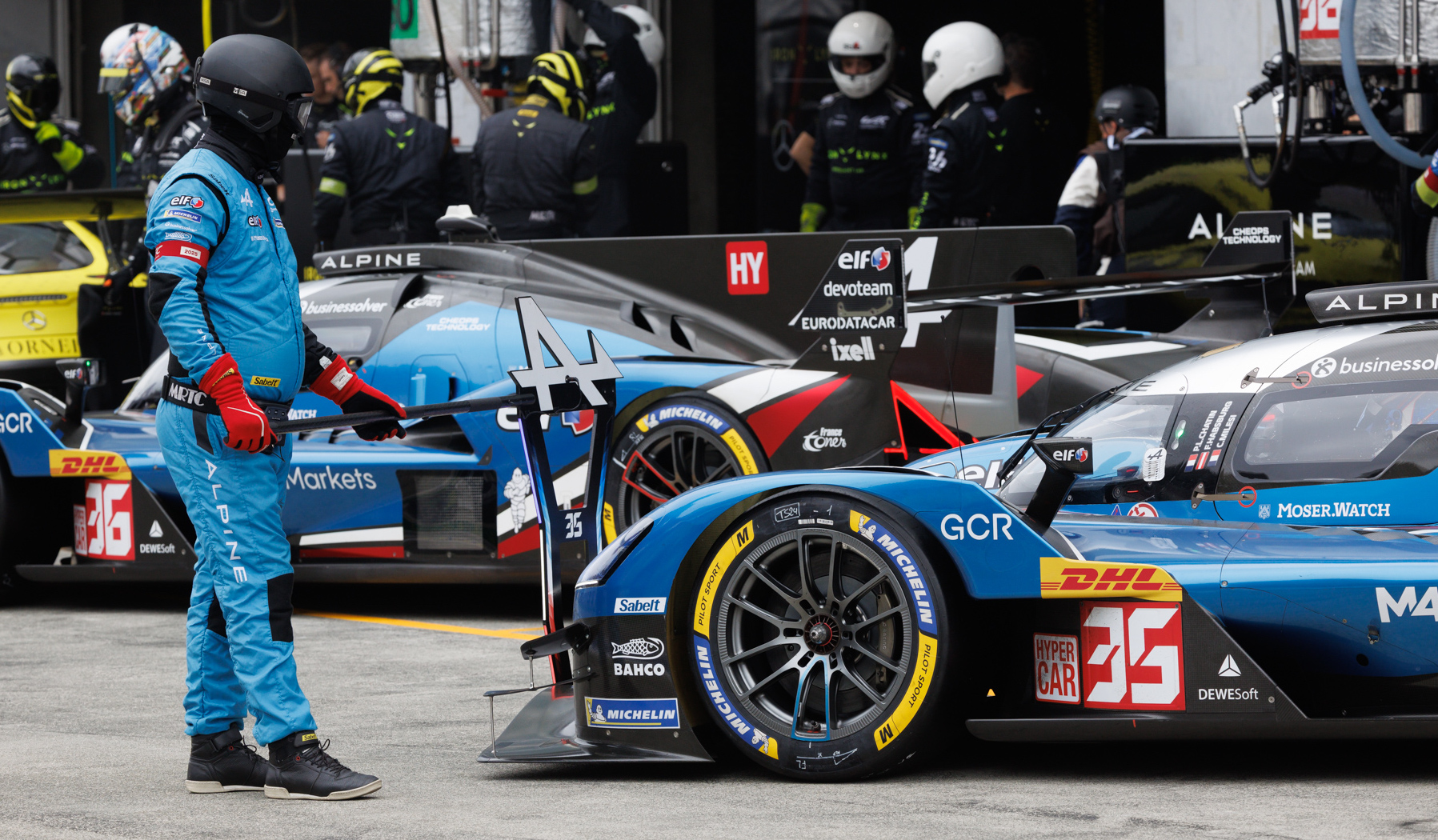
The 2025 event marked the championship’s 100th race and produced the first world championship victory for the Alpine A424. Charles Milesi, Ferdinand Habsburg and Paul-Loup Chatin used a double stint on their Michelin tyres as part of the strategy that carried Alpine to its breakthrough Hypercar success.
The victory remains a landmark result for the A424 programme, with Pit Debrief detailing how the result became a key milestone in Alpine’s development before the manufacturer introduced an upgraded A424 for the 2026 WEC season.
Milesi and Habsburg return to Fuji this weekend and will share the No. 35 Alpine, although the team has changed its line-ups by moving to two-driver crews. Pit Debrief has further detailed the decision to bench António Félix da Costa and Frédéric Makowiecki for Fuji.
Peugeot followed Alpine home in second during the 2025 race, giving French manufacturers the top two positions at a circuit historically dominated by Toyota.
Toyota targets 10th home victory
Toyota enters its home race attempting to add another Fuji victory to an already exceptional record.
The Japanese manufacturer has won nine of the 12 WEC races held at Fuji since the championship first visited in 2012. A 10th victory would further strengthen that record while providing a valuable result in an increasingly close Manufacturers’ Championship.
Toyota arrives leading the standings after an opportunity slipped away at COTA. The No. 7 TR010 Hybrid appeared set for victory with Nyck de Vries at the wheel before a hydraulic problem affected the power steering in the closing stages and forced the car into retirement.
Pit Debrief detailed Toyota’s frustration after the late No. 7 retirement at COTA, although the manufacturer still extended its championship advantage over BMW to nine points.
Fuji provides a significant opportunity to respond. Toyota owns the circuit, has traditionally performed exceptionally well there and understands the demands of the venue better than most of its rivals.
Nevertheless, tyre management remains one of the variables capable of disrupting that historical advantage.
Tight championship increases strategic importance
The tyre challenge arrives during a particularly close phase of the Hypercar championship.
Toyota leads BMW by nine points in the Manufacturers’ standings, while Ferrari sits another 17 behind the German manufacturer following its first victory of the season at COTA. Pit Debrief’s Lone Star Le Mans race report showed how quickly the championship picture changed when Toyota’s late problem allowed the No. 50 Ferrari to take victory.
The Drivers’ Championship remains even closer. Mike Conway, Kamui Kobayashi and de Vries are level at the top with BMW’s Robin Frijns and René Rast, meaning strategy and tyre use at Fuji could carry consequences beyond the race result alone.
Ferrari, BMW, Cadillac, Aston Martin and newcomer Genesis will all attempt to interrupt the recent French and long-term Toyota success at the circuit.
The contrasting nature of Fuji creates several strategic options. The soft compound may provide an advantage when temperatures fall or when teams require rapid warm-up and immediate performance, while the medium potentially creates opportunities for longer or more consistent stints.
Weather could alter those calculations further. Rain has repeatedly influenced Fuji race weekends, making Michelin’s Wet compound another potential factor as teams assess which tyres provide the greatest flexibility throughout the six-hour race.
Warm-up improvements could prove decisive
Michelin’s emphasis on improved warm-up performance addresses one of the most difficult aspects of modern Hypercar tyre management.
Without tyre blankets in WEC, drivers frequently leave the pits with significantly less grip than they will have once the tyre reaches its ideal operating range. Finding temperature without sliding excessively or damaging the tyre can influence both lap time and the longevity of the stint.
Fuji potentially magnifies that challenge. The long main straight provides limited opportunity to generate lateral energy before the heavy braking zone at Turn 1, while cooler conditions can slow the process further.
The latest Pilot Sport Endurance range aims to shorten that warm-up phase while retaining the durability required for complete stints and potential double-stint strategies.
That balance could become particularly significant late in the race. A tyre capable of reaching its working range quickly offers an advantage immediately after a pit stop, but teams must avoid extracting so much performance in the opening laps that degradation becomes costly later in the stint.
Fuji’s three contrasting sectors will continually test that compromise.
Fuji begins decisive final phase of 2026 season
The race forms the sixth round of the eight-event 2026 championship and starts the final stretch of a season in which several manufacturers remain in contention.
Friday opens with two Free Practice sessions, before a third practice and Hypercar Qualifying take place on Saturday. The 2026 Fuji timetable culminates with the six-hour race beginning at 11:00 local time on Sunday, 27 September.
For Michelin, the weekend requires one tyre range to handle more than 330km/h speeds, high-load fast corners, traction-sensitive slower sections and potentially changing weather conditions.
The improved warm-up characteristics of the new Pilot Sport Endurance tyres add another element to the strategic equation, while the choice between soft and medium compounds should give teams different routes through the race.
Alpine showed in 2025 how effectively managing Michelin’s tyres across extended stints could help decide the outcome. With Toyota pursuing a 10th home victory and an increasingly close championship fight behind it, tyre management could once again prove central to success at Fuji.